

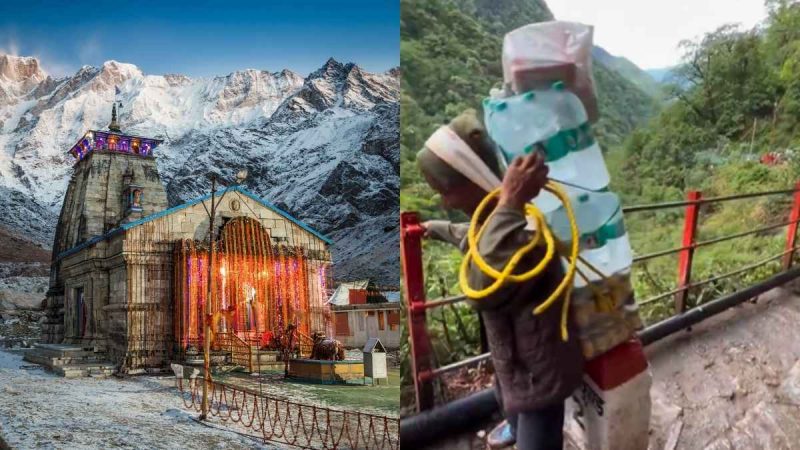
With the Char Dham Yatra now in full swing, pilgrims have been taking to social media to highlight the challenges they’re facing. From people jumping barricades to cutting queues, several concerns have come to light. Now, another issue grabbing attention is the high cost of water at Kedarnath Dham. In a viral video, a shopkeeper near the shrine calmly explained why a bottle of water, usually priced at around ₹20, can cost up to ₹100 there.
The Real Reason Why Water Costs Up To ₹100 In Kedarnath
You’ve probably noticed that food and beverages tend to cost a bit more in the hills, and the reason is quite simple: transportation. Even something as basic as bottled water becomes expensive because getting it to such high altitudes is a challenge. Shopkeepers often have to rely on manual labour or limited transport options to carry goods uphill, which significantly drives up the cost.
That’s exactly what a shopkeeper explained in a now-viral video. He shed light on the challenges of transporting goods through Kedarnath’s tough terrain, where supplies are either carried manually or loaded onto mules and taken across steep mountain paths, which significantly increases costs. He revealed that shopkeepers often pay around ₹1,500 just to transport a single load of three cartons up to the temple area.
Beyond these delivery costs, vendors also have to manage rent and set up temporary shops, all within a limited season that lasts barely four to five months. With such constraints, profit margins remain quite modest.
In a follow-up video shared by the X page @gharkekalesh, a porter was seen carrying nearly 40 kg of water bottles and packaged drinks uphill, earning about ₹2,500 per trip, showing the intense physical effort involved in getting everyday essentials to such high altitudes.
Also Read: Kedarnath Dham Opens To Massive Rush; Video Shows Devotees Ignoring, Jumping Barricades On Day 1
Netizens Share Their Two Cents
The viral video of a Kedarnath shopkeeper explaining the high cost of water has stirred a debate online. While some argued that the bottles are already being sold at MRP, meaning the maximum retail price, many others empathised with the sellers, agreeing that the pricing is justified given the logistical challenges.
“Nothing wrong. Anybody who finds it costly may carry all their requirements. Then I think they will realise that they have to pay not ₹80 but maybe ₹160,” one netizen wrote.
“People will go to an airport and pay ₹200/- for the same bottle because the printed MRP is higher. People need to understand the logistics and difficulty involved in the hilly region. Your perspective would be right, but just step into their shoes and think as well,” another user wrote.
A visitor, who had been to the dham, wrote, “Boss, I paid ₹100 when I went to Kedarnath. What is the debate all about?”
“It is great that we have sensible people who clarify things before they react. The price is justified for all the work they do,” one of the comments read.
“Respect. This man just gave a masterclass in real-world economics. No roads, everything hauled up on mules for ₹1500 a load, crazy rent & only 4-5 months to earn. Suddenly, ₹80 water doesn’t sound expensive,” another user commented.
Also Read: Char Dham Yatra 2026: Uttarakhand Introduces New Health & Travel Guidelines For Pilgrims
Let us know your thoughts about this in the comments.
Cover Image Courtesy: Canva Pro/mediaphotos & X/@gharkekalesh
For more such snackable content, interesting discoveries and the latest updates on food, travel and experiences in your city, download the Curly Tales App. Download HERE.
FAQs
Why does a water bottle cost ₹80–100 in Kedarnath?
This is because of high transportation costs. Goods are carried manually or via mules across steep terrain, which significantly increases expenses.
Can pilgrims find cheaper alternatives?
Prices are fairly consistent near the shrine due to similar logistics. Carrying essentials from lower altitudes can help reduce costs.
Why is transportation of food and beverages so expensive in Kedarnath?
This is because there are limited transport options. Supplies are often carried by porters or mules over long, difficult mountain routes.