

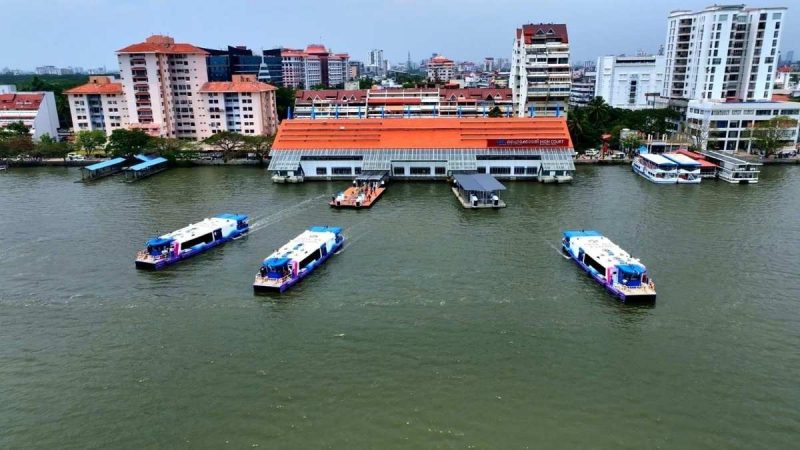
Recently, the Maharashtra Maritime Board has revealed an ambitious project to develop a 36-route water metro across Mumbai city. The project aims to transport up to 18 million passengers annually. Read on to know more about the project.
Mumbai To Get Water-Metro System
According to a report by the Hindustan Times, the proposal was approved by the chief minister, Devendra Fadnavis, at a meeting held on March 17th. Modelled on the successful water metro system in Kochi, Kerala, the project is based on a detailed report prepared by Kochi Metro Rail Ltd and submitted earlier this month.
In the past, Mumbai has experimented with water transport, including hovercraft services in the 1990s and a Belapur-Gateway route launched two years ago. Both of them were discontinued due to high costs and poor public reviews. The current proposal calls for the construction of 21 routes spanning 125 km in the initial phase, each with approximately 25 terminals.
Also Read: IndiGo Launches Daily Direct Flights Between Kolkata And Shanghai; Check Full Schedule
The service is expected to carry around 44,000 passengers daily, amounting to nearly 18 million annually. The project will be executed under a public-private partnership model, with ₹3,436 crore allocated for safety infrastructure and civil navigation and ₹3,156 crore for marine assets, including 207 vessels to be operated by private players.
Routes Of The Mumbai Water Metro
According to the news portal, an operations control centre will be established at Kalher, near Bhiwandi, with a backup at Fountain Junction and a dedicated boatyard at Mira-Bhayander. A project management consultant is likely to be appointed within four months, followed by environmental clearances. A private partner will then be brought on board, after which vessel procurement and viability gap funding processes will begin. The project is said to be executed in three phases, with phase one targeting completion by 2029, phase two by 2030 and the final phase by 2036.
The routes of the water metro will include Versova-Madh, Marve-Manori, Gorai-Borivali, Gateway-Mandwa, Belapur-Elephanta and Thal-Khanderi, along with other tourism services. The route also aims to connect Vasai, Kalyan, and Navi Mumbai International Airport, as well as other important stops like Bandra, Vashi, and Nariman Point.
Also Read: From March, IndiGo To Launch Direct Flights To 6 Cities From Navi Mumbai Airport; All About It
The project will include electric boats, hovercraft and conventional vessels. It is expected to reduce pressure on the local train network while offering faster and easier commuting alternatives.
Please let us know your thoughts in the comments.