

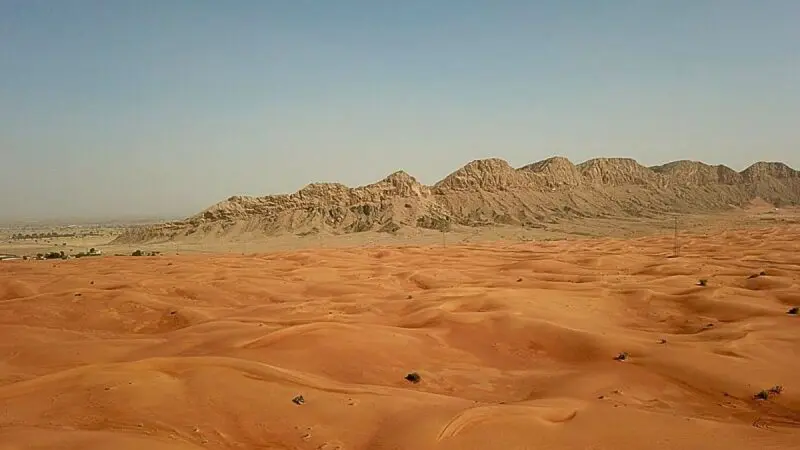
It’s no secret that Al Faya in Sharjah is a place for massive discovery, and it gives insight into the human settlements. And according to an international research project, new evidence has been uncovered. It shows how the early humans have repeatedly occupied Buhais Rockshelter in Sharjah. This is over tens of thousands of years, and challenges previously held assumptions about the human settlement in southeastern Arabia.
Al Faya Shows Evidence Of Continuous Human Settlement
In a report of the Gulf News, it was mentioned how the study, which was published on Monday in Nature Communications, is titled ‘Evidence from Buhais Rockshelter for human settlement in Arabia between 60,000 and 16,000 years ago’. This study, as mentioned in the report, was led by Eisa Yousif, who is the Director-General of the Sharjah Archaeology Authority and Dr. Sabah Jasim, who is Advisor to the Sharjah Archaeology Authority. It was in collaboration with Dr. Knut Bretzke of Friedrich Schiller University Jena and Professor Adrian Parker of Oxford Brookes University.
Findings Based On Archaeological Excavation At Buhais Rockshelter
According to the findings, which are based on archaeological excavation at Buhais Rockshelter, which is inscribed as a UNESCO World Heritage site of Sharjah, a new chapter to the early settlement history. It challenges the long-standing assumption that the region was largely uninhabited between 60,000 and 12,000 years ago. Yes, it mentions that this was due to extreme aridity during the last glacial period, which extended the well-established Jebel Faya archaeological sequence into a previously undocumented timeframe. However, the results have identified multiple phases of human presence at the site.
Also Read: Sharjah Allows Remote Working For Government Entities; Here Are Other UAE Weather-Related Updates
Faya Palaeolandscape Inscribed As UNESCO World Heritage Site
The human presence at the site dates back to approximately 1,25,000, 59,000, 35,000, and 16,000 years ago. Not to mention, the latter three occupation phases have previously been documented, which fills a critical gap in the archaeological record of the region. The study also demonstrated that occupation phases coincided with periods of increased water availability. It provided clear evidence of such a pattern in Arabia during the timeframe between 60,000 and 12,000 years ago.
It should be noted that it is located within the Faya Palaeolandscape, which was inscribed as a UNESCO World Heritage Site in 2025. Positioning the Faya Palaeolandscape as one of the most important and continuous records of early human presence, the study also reflects the strength of long-term collaboration between Sharjah Archaeology Authority and leading international research institutions.
Cover Image Courtesy: Wikipedia/Alexandermcnabb
For more such snackable content, interesting discoveries and the latest updates on food, travel and experiences in your city, download the Curly Tales App. Download HERE.FAQs
Where is Jebel Faya located?
Jebel Faya is located near Al Faya, which is around 50 minutes east of Sharjah city.
Is Sharjah's Faya on the UNESCO World Heritage list?
Yes, the historical site of Faya has been inscribed on the prestigious UNESCO World Heritage site list since 2025.
Does Sharjah come under Dubai?
No, Sharjah does not come under Dubai; it is a separate emirate. It's worth mentioning that the United Arab Emirates has seven emirates, including Abu Dhabi, Dubai, Sharjah, Ajman, Umm Al Quwain, Ras Al Khaimah, and Fujairah.