

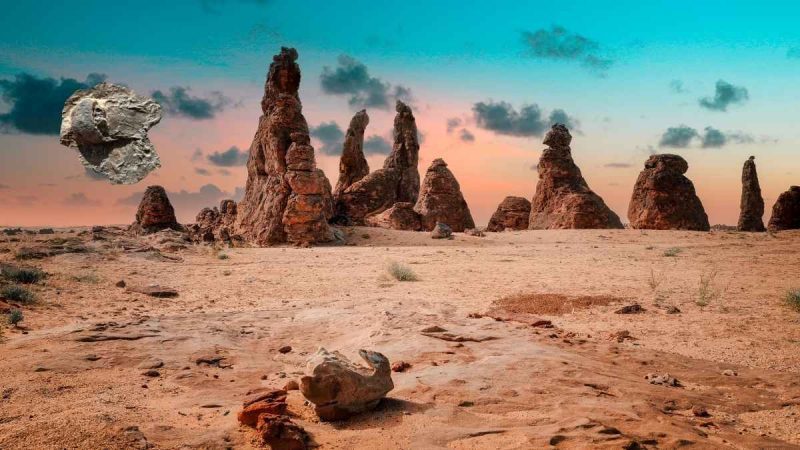
AlUla is a vast desert in Saudi Arabia that has millions of years of history embedded in its sands. And the Royal Commission for AlUla has announced the documentation and publication of a rare fossil discovery. This is of a horseshoe crab that dates back approximately 465 million years! Here’s all you need to know about this massive discovery.
465 Million-Year-Old Horseshoe Crab Discovered In AlUla
Dating back 465 million years, the horseshoe crab fossil is truly a massive discovery for AlUla, as revealed in a report by the Gulf News. This discovery, published for the first time at the global level, strengthens the region’s standing as an international centre for geological and scientific research, especially when it relates to the Earth’s history and biodiversity. It dates to the Middle Ordovician era and is roughly dated between 485 and 444 million years ago. Regarded as among the oldest known horseshoe crab specimens in the world, this reinstates the fact that AlUla has some of the oldest fossils.
More About The Fossil
Gulf News, in its report, has further mentioned how these fossils are distinguished by their unusually large size. Especially when they are compared with other species from the same era. All the specimens that were found have been preserved upside down. This is a mode of fossilisation that has not previously been recorded. Additionally, traces of fossils also indicate attempts by organisms to right themselves.
Also Read: Solo Travellers Feel Safest In These Gulf Cities, Topping Global Rankings!
Fossil Samples Preserved In The Commission’s Museum Collection
It’s worth mentioning that the geological layer analysis of the area suggests that it was often subject to repeated strong seasonal storms. This indicates that ancient creatures gathered in shallow coastal environments affected by these events. This contributed to their preservation within the sedimentary deposits. Providing a clear picture of the ancient environment of AlUla as a coastal region, it just adds more scientific dimension to the understanding of the geological and environmental history here.
Through this discovery, previously undocumented species are yet to be formally classified. The fossil samples have preserved in the commission’s museum collection in order to support future research and public engagement. The discovery shows the commitment of the commission towards advancing scientific research and reinforcing the region’s position as the global destination for zoological discovery.
Cover Image Courtesy: Canva Pro/kashif Hameed from Scopio & X/RCU_SA
For more such snackable content, interesting discoveries and the latest updates on food, travel and experiences in your city, download the Curly Tales App. Download HERE.