
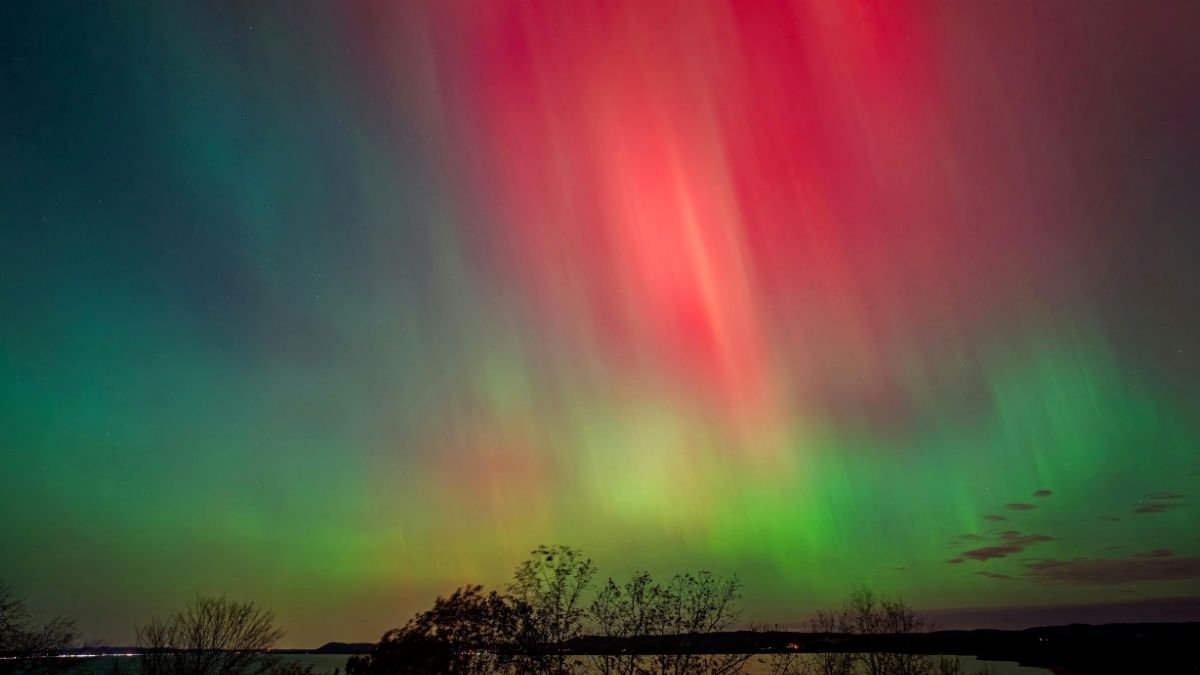



People often travel to Norway, Sweden, Finland, or Iceland to witness the mesmerising Northern Lights, also known as the aurora borealis. But what if you didn’t have to plan an expensive trip to Europe or spend a fortune to experience this spectacular phenomenon? According to NASA, auroras could light up the skies over parts of India, as well as Europe and Australia. Intrigued? Scroll on to know more about this.
Can You See Aurora Borealis In India?
According to Times Now, a powerful solar storm is heading towards Earth and could trigger auroras across parts of Europe and, surprisingly, northern India as well. NASA reports that a coronal mass ejection (CME), a massive burst of plasma and magnetic fields from the Sun, has been directed towards Earth.
As a result, a geomagnetic storm is expected between June 8 and 9, potentially creating favourable conditions for auroral displays.
The Space Weather Prediction Center (SWPC), the US agency responsible for monitoring solar activity, has observed several significant solar eruptions over the past week. While most of these events were not Earth-directed, some, including the latest CME, are expected to interact with Earth’s magnetic field and may produce visible effects in the sky.
According to experts, when charged particles from a CME reach Earth, they can disturb the planet’s magnetic field and trigger geomagnetic storms. These storms are responsible for creating auroras, the colourful light displays typically seen near the polar regions.
Also Read: Northern Lights Guide: Where To See, Best Places, How To Reach, Budget & More
When & Where To See Them
Experts further note that the intensity of the storm will depend on how the CME’s magnetic field interacts with Earth’s magnetic field. If conditions align favourably, the geomagnetic storm could reach strong levels. Now, where will these auroras be visible in India?
According to the Times Now report, auroral activity could be visible in parts of northern India on Monday night. However, any display is likely to be faint and will depend on several factors, including the strength of the storm, cloud cover, local light pollution, and the critical Bz component of the solar storm’s magnetic field.
In simple terms, if the incoming solar cloud carries a strongly southward-pointing magnetic field, it can reconnect more efficiently with Earth’s magnetic field. This allows more solar energy to enter the atmosphere, increasing the intensity of auroras and potentially pushing them to lower latitudes.
However, it is still too early to confirm exactly when or where the auroras will be visible. Scientists will be able to make a more accurate prediction once the solar storm reaches monitoring satellites positioned about 1.5 million kilometres from Earth. At that point, forecasters will have approximately 15 to 60 minutes of advance warning before the storm impacts Earth.
Also Read: You Can Now Get Permanent Residency In The Land Of The Northern Lights— But There’s One Catch!
Do, stay updated and keep checking NASA’s social media handles for more updates!
Cover Image Courtesy: Pexels (representative image)
For more such snackable content, interesting discoveries and the latest updates on food, travel and experiences in your city, download the Curly Tales App. Download HERE.FAQs
What is the aurora borealis?
The aurora borealis, or Northern Lights, is a natural light display that occurs when charged particles from the Sun interact with Earth's magnetic field and atmosphere.
Which parts of India may have a chance of seeing the auroras?
According to reports, parts of northern India could witness faint auroral activity if weather and geomagnetic conditions remain favourable.
Can solar storms be dangerous?
Strong solar storms can disrupt satellite communications, GPS systems, radio signals, and power grids. However, they generally do not pose a direct threat to people on the ground.
Has India ever witnessed auroras?
Auroras are extremely rare in India because they are typically confined to regions near the Earth's poles. However, exceptionally strong geomagnetic storms can occasionally make them visible at lower latitudes.


