




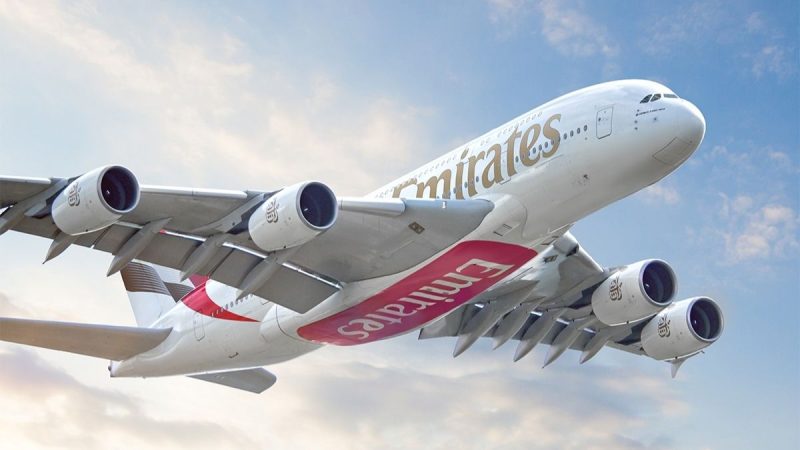
Recently, an Emirates flight, which was headed to Newcastle from Dubai, was diverted to Edinburgh. This happened on January 27th, Tuesday due to adverse weather conditions disrupting its approach into Northern England. As a result, this triggered an emergency alert, and the arrival of passengers was delayed. Here’s what happened during the landing of flight EK35.
An Emirates Flight To Newcastle Diverts To Edinburgh
EK35, which was being operated on Boeing 777-300 ER, was supposed to land in Newcastle just after 11:20 AM. However, the flight circled over Newcastle and Sunderland before abandoning its approach and was later diverted towards the north, to Scotland. This was revealed in the flight tracking data by FlightRadar24.
The Aircraft Landed Safely At Edinburgh Airport
As it happens, the aircraft landed safely at Edinburgh Airport. There it continued to remain grounded for two hours before it could continue to Newcastle and finally arrived at the destination, three hours behind schedule.
The Gulf News report further mentions a statement by the airline, which reveals how the challenging weather conditions were the primary factor behind the diversion. It is mentioned that safety considerations guided the decision of the crew throughout the flight. At this point, it’s worth mentioning that the flight carrying several passengers and crew members safely landed in Newcastle later.
Also Read: Waldorf Astoria Dubai Palm Jumeirah Opens YU, A Refined Modern Chinese Restaurant
The Aircraft Arrived At Newcastle Over 3 Hours Behind Schedule
The emergency code 7700 was triggered when the aircraft made two unsuccessful landing attempts in Newcastle. The emergency code 7700, which is a standard aviation signal used to indicate a general or urgent situation, was issued. However, this code does not point towards a single cause. It can be activated for a variety of scenarios, which include technical concerns or even medical situations onboard. It allows the air traffic control and emergency services to respond quickly and prioritise the aircraft. So, the aircraft later abandoned its approach to Newcastle and headed to Scotland, touching down in Edinburgh without an incident.
It should be noted that the flight later resumed its original destination with a delay of three hours and fifteen minutes.
Cover Image Courtesy: Emirates/X
For more such snackable content, interesting discoveries and the latest updates on food, travel and experiences in your city, download the Curly Tales App. Download HERE. First Published: January 28, 2026 11:24 AM