

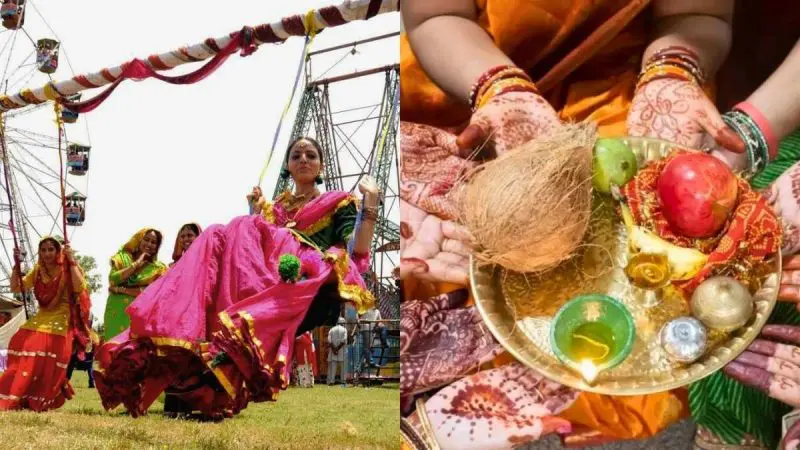
Teej is one of the most popular festivals during the monsoon but do you know that Hariyali Teej and Hartalika Teej are two different festivals? Both are dedicated to Goddess Parvati and celebrate her union with Lord Shiva but they differ in dates, traditions and significance. From when they are celebrated to the rituals associated with them, here’s everything you need to know about the two Teej festivals.
Hariyali Teej: Sawan’s Vibrant Festival
Hariyali Teej is celebrated on the third day of the Shukla Paksha in the Hindu month of Sawan or Shravan, usually falling in July or August. The festival gets its name from the lush greenery that surrounds the landscape during the monsoon season.
The festival is particularly popular in Rajasthan, Uttar Pradesh, Haryana, Punjab, Delhi and parts of Madhya Pradesh and Bihar. Women dress up in green outfits, wear bangles, apply mehendi and come together to celebrate the occasion.
Hariyali Teej is associated with Goddess Parvati’s reunion with Lord Shiva after her long penance. According to Hindu belief, Parvati undertook severe penance to prove her devotion to Shiva and was eventually accepted as his wife.
For married women, the festival is also associated with prayers for the well-being and long life of their husbands, while unmarried women may observe the festival hoping for a suitable life partner.
Also Read: Teej 2026: Significance Of Sindhara, Ghewar, Colour Green & Age-Old Traditions
What Is Hartalika Teej?
Hartalika Teej is observed on the third day of the Shukla Paksha in the Hindu month of Bhadrapada, usually a month after Hariyali Teej. It is especially significant in North India, particularly Rajasthan, Uttar Pradesh, Bihar, Jharkhand, Madhya Pradesh and Chhattisgarh.
The word Hartalika is believed to come from the Sanskrit words harat, meaning abduction, and aalika, meaning female friend. Legend says that Goddess Parvati’s father wanted her to marry Lord Vishnu but she was devoted to Lord Shiva. Parvati’s friend took her to a secluded forest to help her escape the marriage where she performed intense penance and prayed to marry Lord Shiva.
Parvati eventually won Lord Shiva as her husband after her penance, which is why Hartalika Teej celebrates her devotion and determination.
How Are These Two Festivals Different?
Despite being festivals dedicated to Goddess Parvati and celebrating her union with Lord Shiva, both festivals are observed on different dates and have different mythological associations.
Hariyali Teej is celebrated in Shravan and has a strong connection with the monsoon, greenery and the reunion of Shiva and Parvati. Hartalika Teej falls in Bhadrapada and focuses more specifically on Parvati’s penance and determination to marry Lord Shiva.
Also Read: Sawan Shivratri 2026: Date, Significance, Rituals, Muhurat, Fasting & All You Need To Know
Both festivals celebrate love, devotion and marital happiness, while holding a special place in Hindu traditions.
Cover Image Courtesy: X/prokerala & X/lovenheal
FAQs
What is the difference between Hariyali Teej and Hartalika Teej?
Hariyali Teej is celebrated during Shravan and is closely associated with the monsoon, greenery and the union of Lord Shiva and Goddess Parvati. Hartalika Teej is observed in Bhadrapada and commemorates Goddess Parvati’s penance and devotion to Lord Shiva.