

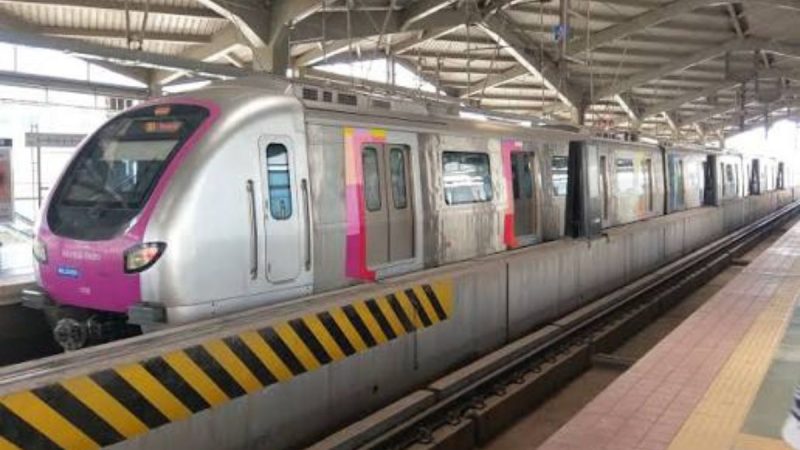
The first of 39 six-car driverless trainsets for Mumbai Metro Lines 4 and 4A was unveiled by train manufacturer Alstom on Thursday. Connecting Wadala in central Mumbai to Kasarvadavali in Thane, the 35.3-km Green Line will have 32 stations. The first trainset is expected to arrive in Mumbai in the first or second week of December 2026. Read on to know more.
Mumbai To Get First Driverless Metro In December
According to reports by Midday, Alstom plans to ship the trainset by the end of November, with the journey to Mumbai expected to take seven to 10 days. However, as the dedicated carshed for the corridor at Mogharpada is not yet available, the trains will be temporarily stationed at two existing depots.
The first 20 trainsets will be parked at Mandale depot near Mankhurd, which can accommodate more than 72 rakes. The remaining 19 will be stationed at Kasheli depot on Metro Line 5, which has a direct connection to Line 4. Together, the 39 trainsets will comprise 234 metro cars.
Also Read: Mumbai-Bengaluru NH-48 Hit By Karnataka Protest; Check These Alternative Routes Before You Go
Under the Make in India initiative, the Alstom Metropolis trains have been designed at the company’s engineering centre in Bengaluru and are being manufactured at its facility in Sri City, Andhra Pradesh. Propulsion systems are being produced in Coimbatore, Tamil Nadu, while bogies are being manufactured at Savli, Gujarat.
Alstom said the trainsets were engineered and built within a record 14 months under an integrated systems contract awarded to Larsen & Toubro by the Mumbai Metropolitan Region Development Authority (MMRDA).
Key Features Of The Driverless Metro
The trains will feature airflow-based cooling, wheelchair accessibility and dedicated bicycle racks to support last-mile connectivity. Alstom said the bicycle racks would be a first for its trains in India. Other features include electrical braking, cybersecurity measures and materials selected to meet fire-safety and environmental requirements.
Designed for a maximum safe speed of 90 kmph, the trains will operate at speeds of up to 80 kmph. They will use the Urbalis Forward Communications-Based Train Control (CBTC) signalling system and Grade of Automation 4 technology, enabling fully driverless operations. The system will manage train intervals and safety, with the operations control centre located at Mandale depot and a backup control centre planned at Mogharpada.
Also Read: No More Squeezing Into Crowded Metro Trains! Mumbai Metro One Plans 22 New Coaches
Alstom will also provide five years of FlexCare Perform maintenance covering all 234 metro cars and the signalling system.
What are your thoughts about this?
Cover Image Courtesy: Wikimedia Commons
FAQs
Which is the longest metro network in India?
Delhi Metro is the longest metro network in India.