

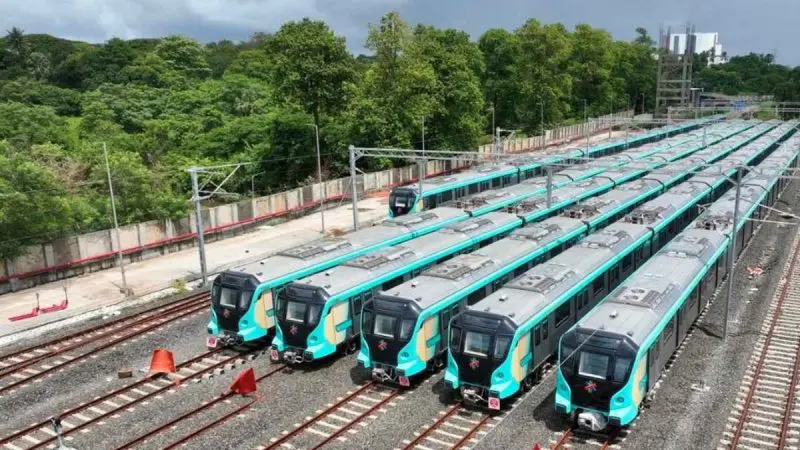
Mumbai Metro 3, also known as the Aqua Line, is Mumbai’s first fully underground metro corridor, connecting Cuffe Parade in south Mumbai to Aarey Colony in the north. Since its launch, it has made commuting more convenient for Mumbaikars. However, some challenges remain. According to a study by the non-profit Moneylife Foundation, the metro has several accessibility gaps that affect passenger convenience. Here’s everything you need to know.
Is Mumbai Metro 3 Falling Short On Accessibility?
According to Hindustan Times, the study by Moneylife Foundation has identified several accessibility gaps on Mumbai Metro 3 that hamper passenger convenience. Titled Accessibility and User-Friendliness of Mumbai Metro Aqua Line, the study was conducted by Ashoka University interns Agamya Jain and Mihika Omseema.
The duo surveyed all 27 stations along the 33.5-km corridor from a commuter’s perspective and found that accessibility varies significantly across station exits. At several stations, passengers have to climb long flights of stairs, while downward escalators are available only at a limited number of exits.
According to the report, this makes entering and exiting stations particularly challenging for senior citizens, people with disabilities, passengers carrying luggage and families travelling with young children.
The study also identified poor last-mile connectivity as one of the metro’s biggest shortcomings. It noted that these accessibility gaps impact not only vulnerable commuters but also the wider travelling public, reducing the overall convenience of using the Aqua Line.
Here’s What MMRC Has To Say…
Reportedly, the non-profit has recommended several measures and accessibility-focused design principles in future metro projects to the Mumbai Metro authorities.
According to HT, the study has been shared with the Ministry of Housing and Urban Affairs, the Mumbai Metro Rail Corporation (MMRC), Maha Mumbai Metro Operation Corporation Ltd, the Mumbai Metropolitan Region Development Authority, the Maharashtra government, the Brihanmumbai Municipal Corporation, and other concerned authorities.
An MMRC spokesperson said the report is not yet available to them and that it would be premature to comment on its findings. They, however, added that Mumbai Metro 3 stations were designed with a combination of lifts and escalators based on site conditions, while space constraints prevented the installation of twin escalators at every entrance and exit. Additional escalators may be added in the future wherever feasible.
Also Read: Is Mumbai’s CSMT Leaking? Heavy Rainfall Puts UNESCO Landmark At Risk
Let us know your thoughts on this in the comments.
Cover Image Courtesy: Reddit/TransitIndia
FAQs
Why is accessibility important in metro systems?
Accessible metro systems make commuting safer and more convenient for everyone, including senior citizens, persons with disabilities, families with children and travellers carrying luggage.
What did accessibility study find for Mumbai Metro 3?
A study by the non-profit Moneylife Foundation has highlighted several accessibility gaps that may affect passenger convenience.
Who is most affected by the accessibility gaps?
According to the report, senior citizens, persons with disabilities, families with young children, passengers carrying luggage and other commuters are among those most affected.