

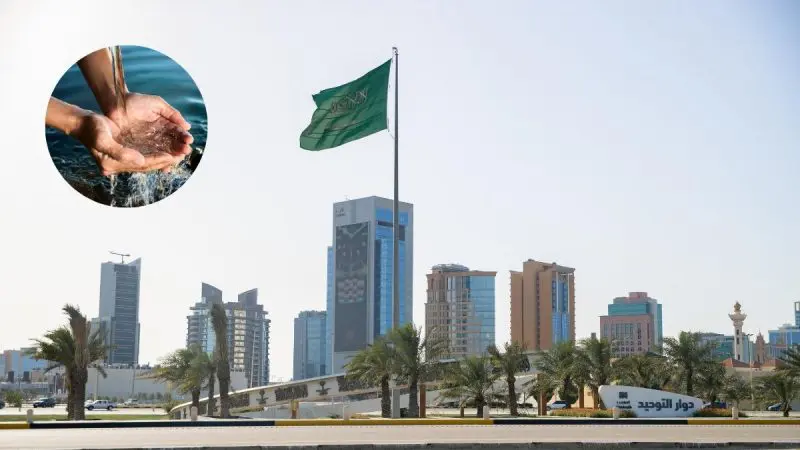
Saudi Arabia has approved a fresh set of water efficiency and conservation regulations, and the fines involved are enough to make anyone double-check their taps. The Ministry of Environment, Water and Agriculture confirmed that the updated executive regulations hand the National Water Efficiency and Conservation Center full authority to investigate breaches, act on violations, and enforce conservation standards across the urban, agricultural, and industrial sectors.
What The New Rules Actually Say
The rules aren’t landing immediately; they’re set to take effect on March 21, 2027. That gives residents, property owners, and businesses a runway to get their fixtures and systems in check before enforcement kicks in. But once it does, the penalty structure is designed to escalate fast for repeat offenders.
How The Fines Break Down
The regulations cover several categories of water waste, each with its own tiered fine structure that gets steeper with every repeat offence.
Using sanitary fixtures that don’t meet water-efficiency standards is treated as a violation in the urban sector, starting at SR1,000 for a first offence, climbing to SR2,000 for a second, and SR10,000 for a third. Tampering with or removing water-saving components from fixtures carries smaller but still real penalties: SR500, SR1,000, and SR2,000 across three offences.
Where it gets serious is drinking water waste caused by faulty storage. Leaks from cracked tanks, poor insulation, malfunctioning equipment, or a missing float valve will cost SR5,000 the first time, SR10,000 the second, and SR50,000 the third.
Also Read: 1,293 Underwater Heritage Sites Documented In Saudi Arabia, Recovering 1,000+ Artefacts!
The steepest fines, though, are reserved for misusing drinking water when a suitable alternative is already available. For example, using potable water for purposes it wasn’t intended for, despite access to treated wastewater, a treated-water network, or a licensed well. That starts at SR25,000 for a first offence, and a second or third violation can push the fine all the way up to SR200,000.
Also Read: World’s Largest Turtle-Shaped Floating City, Pangeos To Hit Saudi Waters Soon!
Why This Matters For The Region
This isn’t a one-off policy. It follows Saudi Arabia’s decision to shut down 12 water bottling plants in Jeddah earlier this year over serious violations, and it lines up with the Kingdom naming 2027 its official “Year of Water”, a signal that conservation is becoming a genuine national priority, not just a talking point.
For a region where water scarcity is a real, long-term concern, moves like this tend to ripple outward.
Cover Image Courtesy: CanvaPro/Buthaynah AlHarthi from Scopio
FAQs
Do these fines apply to tourists, or only residents and businesses?
The regulations are framed around the urban, agricultural, and industrial sectors.
What counts as misuse of drinking water under the new rules?
Using potable water for purposes it isn't intended for, despite having access to alternatives like treated wastewater, a treated-water network, or a licensed well.
What's the highest fine under the new regulations?
Repeat misuse of drinking water when an alternative supply is available can carry a fine of up to SR200,000.