

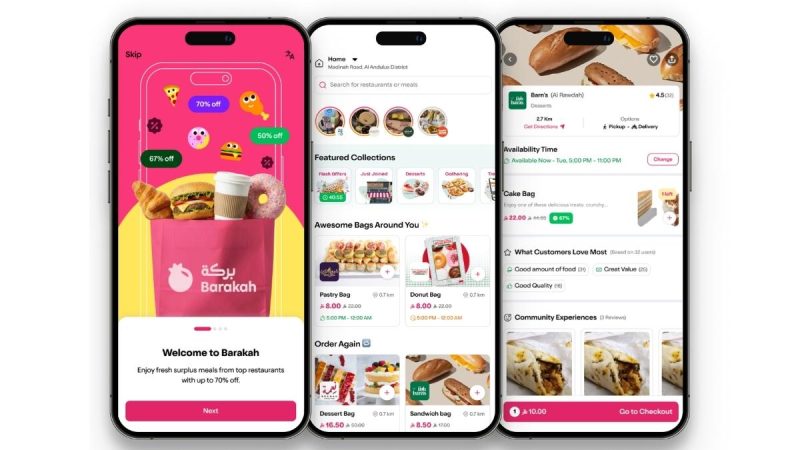
If you haven’t come across it yet, the Barakah app is essentially a middleman between restaurants with unsold food at closing time and customers who’d rather pay less for a still-good meal than watch it get binned.
What Barakah Actually Does
Founded in Jeddah in 2021 by Rabah Habiss, Munira Al Muammar, and Abdulaziz Al Saud, the app lets restaurants, cafes, bakeries, and grocery stores list their surplus fresh food and unsold products at discounted prices, sometimes as much as 50 to 70 per cent off, instead of throwing it out at the end of the day. Since launch, the platform has grown into one of Saudi Arabia’s most downloaded food apps, working with well over 800 merchants, including global names like Starbucks, Dunkin’ and Tim Hortons. It has also saved close to a million meals from ending up in the bin.
The Move Into Bahrain
The Bahrain launch, announced on Barakah’s Instagram, marks the app’s first step outside Saudi Arabia since it started operating across Riyadh, Jeddah, Dammam, Khobar, Mecca and Medina. It’s a natural next stop. Bahrain’s food and retail scene shares a lot of the same rhythm as Saudi’s biggest cities, and the app’s model doesn’t need much reinventing to work there.
Also Read: 9 Best Events In Bahrain This August, From The Matcha Museum To Sports City
For Bahrain-based restaurants, cafes and grocery stores, it means a new channel to shift surplus stock and pick up some extra revenue instead of writing it off entirely. For customers, it means genuinely good deals on food that would otherwise have gone straight into the bin, including coffee, bakery items, meal boxes, and grocery surplus, all at a fraction of the original price.
Also Read: Craving Chaat In Bahrain? This 44-Year-Old Manama Café Has Your Indian Street-Food Fix Sorted
Why It Matters Beyond The Discount
There’s a bigger number sitting behind this expansion. Saudi Arabia alone wastes an estimated 33 per cent of its food every year, a loss valued at more than $10 billion, and the wider GCC region isn’t far behind. Food waste remains one of the region’s least talked-about sustainability problems despite the scale of it.
Apps like Barakah don’t fix the whole supply chain, but they do chip away at the retail end of it, where a huge share of waste actually happens. We’re talking about food that’s perfectly fine to eat but gets thrown out because of freshness policies or simply not selling in time.
For merchants, there’s also a practical upside baked into the platform: a dashboard showing impact analytics, so businesses can actually track how much they’re saving in waste-management costs and how that ties into their ESG reporting.
Cover Image Courtesy: Barakah App/Website
FAQs
Which cities does Barakah operate in?
Barakah operates across major Saudi cities including Riyadh, Jeddah, Dammam, Khobar, Mecca and Medina, and has now expanded into Bahrain.
How much can customers save using Barakah?
Discounts on surplus food and products through Barakah can range from around 50 to 70 percent off the original price, depending on the merchant.