

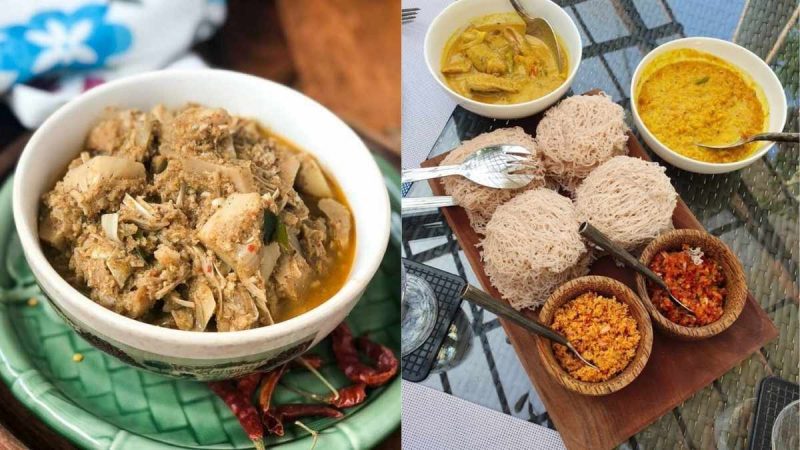
There’s a moment in a Sri Lankan meal when you realise nothing on the plate is there just to “fill space.” Even the smallest spoon of coconut or the sharpest pickle has a job to do. This isn’t accidental; the cuisine grew out of a landscape where coconut trees outnumber cooking oils, rice is non-negotiable, and vegetables aren’t supporting actors, they’re the plot. So, if you thought that the country’s cuisine was all about meat, here are some vegetarian dishes in Sri Lanka that are a major star.
From Pol Sambol To Kottu: 11 Sri Lankan Veg Dishes To Try
1. Rice And Curry
Start here, because everything else eventually circles back to Rice and Curry. It looks simple, with rice in the middle and small portions around it, but the structure is deliberate. You’re not meant to eat each component separately; you mix and you adjust. One bite leans creamy, the other a bit sharper, and the next suddenly fiery.
The format echoes South Asian thali traditions, but Sri Lanka pushes coconut much harder. Coconut milk seeps into multiple dishes on the same plate, creating richness that would feel heavy if not constantly interrupted by something acidic, bitter, or spicy. That balancing act is the real technique here, not any single recipe.
Also Read: This Bandra Restaurant Serves Authentic Sri Lankan Food In Mumbai & Their Maggi Is A Must-Try!
2. Polos Curry

Polos Curry is where things get serious! It uses young jackfruit, before it sweetens and has this fibrous and almost stubborn texture. It holds onto spice like it’s meant to. The curry itself is dark, thanks to roasted curry powder rather than the brighter, raw spice blends you see across much of India.
It uses cinnamon, garlic, curry leaves, and sometimes a hint of pandan. It cooks slowly, and it tastes like it. People outside Sri Lanka call it a “meat substitute,” but that misses the point. It was never replacing anything; it was always enough on its own.
3. Kiri Kos
Then you run into Kiri Kos, and it feels like the same ingredient decided to behave differently. Yes, it is the same jackfruit, but now it’s simmered in coconut milk with a lighter hand on the spices.
The result is softer and almost calming. It has a slight sweetness and barely any aggression. If polos is the dish that holds attention, kiri kos is the one that resets your palate without you noticing. Sri Lankan cooking does this often, taking one ingredient and showing you two completely different personalities.
Also Read: From Ahmedabad To Tel Aviv: 15 Cities In The World Made For Vegetarians
4. Batu Moju
And then comes Batu Moju, which doesn’t care about subtlety at all. Eggplant gets fried until it collapses into itself, then tossed in vinegar, sugar, mustard seeds and onions.
It hits sweet, then sour and then sharp all at once. This is where history sneaks in; those vinegar-heavy notes aren’t native. They trace back to Portuguese and Dutch influences, when pickling techniques entered local kitchens and refused to leave. Batu moju doesn’t blend into the meal; it interrupts it, and that’s exactly why it is a star dish.
5. Gotu Kola Sambol
After that, something like Gotu Kola Sambol feels almost necessary. It has finely chopped pennywort leaves, coconut, onion, and lime.
It’s fresh in a way that cuts through everything else. It has a slight bitterness, a citrus edge and a clean finish. There’s also a quiet medicinal logic to it; gotu kola has long been tied to Ayurvedic ideas of cooling and digestion. Whether you care about that or not, your palate definitely does!
Also Read: 10 Must-Try Vegetarian Dishes In Thailand That Go Beyond The Usual Street Food
6. Mallum (Mukunuwenna Mallum)
With Mukunuwenna Mallum, the approach shifts again. There is no heavy gravy and no dramatic spice base, just shredded greens, coconut and chillies.
It’s dry, crumbly and almost understated. But that texture is all that matters. When everything else on the plate is saucy or rich, mallum gives you something to anchor the bite. It also reflects something very practical: using whatever greens are available, cooking them quickly and wasting nothing.
7. Pol Sambol
Then there’s Pol Sambol, which shows up everywhere and refuses to be a background dish. It uses fresh coconut, chilli, onion and lime; it is all pounded together and not delicately mixed.
It’s sharp, hot, and slightly coarse. You don’t eat it on its own; you drag it through rice, smear it onto hoppers and mix it into everything. It’s the thing that keeps coconut-heavy dishes from becoming too comfortable. Without it, the meal would feel flat.
Also Read: 10 Vegetarian Dishes You Need To Try On Your Next Trip To Vietnam
8. String Hoppers
String Hoppers don’t try to impress you! They’re soft, neutral, and almost blank. It has steamed rice flour pressed into fine noodles, arranged into little nests.
And that’s the point! They exist so everything else can speak louder on the plate. Pour a curry over them, add sambol, and suddenly they’re doing their job of absorbing, balancing, and disappearing into the meal while holding it together. There’s a clear South Indian lineage here, but Sri Lanka has made them entirely its own.
9. Hoppers
Fermentation changes the tone with Hoppers. A thin rice batter, left to develop a slight sourness, is cooked into a bowl shape; it has crisp edges and a soft centre.
That texture alone makes them addictive, but it’s the subtle tang that keeps them interesting. You tear into the edges, scoop up sambol and maybe crack an egg into the centre! It’s breakfast, dinner, street food and home food, depending on where you are and what time it is.
10. Vegetable Kottu Roti
Then everything gets messier with Vegetable Kottu Roti! It is flatbread chopped on a hot griddle with vegetables, spices, and sauces. This one is a fast and aggressive cooking option.
You hear it before you see it! It has metal blades hitting the griddle in a steady rhythm. This is Sri Lankan street food at full volume.
Also Read: CT Review: I Strolled Through Pune’s 1st Southeast Asian Street, Chasing Sushi Runs & Matcha Breaks
11. Kiribath
Finally, Kiribath slows everything down! It is rice cooked in coconut milk, pressed into neat shapes, and often served at the start of something new, like the New Year, celebrations and beginnings.
It’s mild and almost plain if you eat it alone. But you’re not meant to! Pair it with something spicy, something sharp, and it clicks. There’s symbolism here of prosperity and ritual, but also a very practical understanding of contrast that runs through the entire cuisine.
Sri Lankan vegetarian food doesn’t try to impress with complexity on paper. It builds it on the plate, in real time and bite by bite. So, which of these dishes tempts you the most?
Cover Image Courtesy: cookingwe/X and snsalgado/X
For more such snackable content, interesting discoveries and the latest updates on food, travel and experiences in your city, download the Curly Tales App. Download HERE.FAQs
What are the most popular Sri Lankan vegetarian dishes?
Popular dishes include Rice and Curry, Polos Curry and Pol Sambol.
Is Sri Lankan food good for vegetarians?
Yes, Sri Lankan cuisine has a wide variety of vegetarian dishes using coconut, rice, vegetables and spices.