

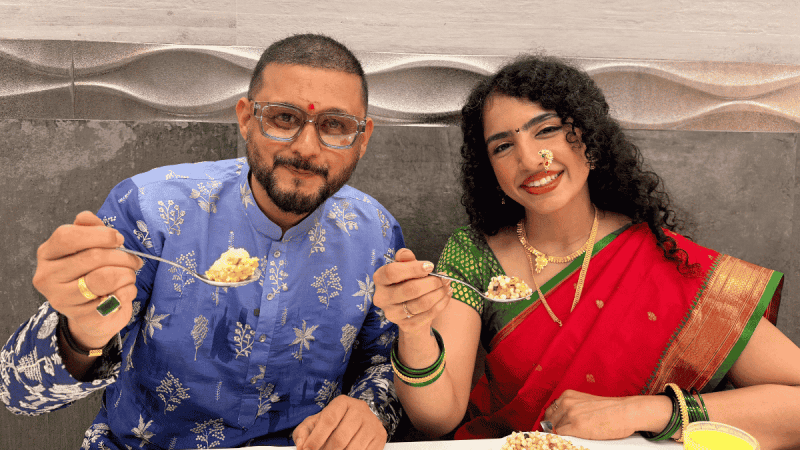
Mumbai has a very particular way of making you notice the little things. A steaming plate of Ukadiche Modak, a bowl of Sabudana Wada and a sea of people outside a Ganpati mandal. And somewhere in between all of this, hundreds of unmistakable white caps bobbing through the crowd. On the latest episode of Tere Gully Mein by Curly Tales, Swapnil Joshi joined us for a proper Mumbai day out. We ate our way through some Maharashtrian favourites, visited one of Mumbai’s iconic Ganpati mandals and, naturally, got talking about the things that make the city what it is. That’s when the conversation turned to the white topi.
Why Does The White Topi Mean So Much To Maharashtra?
Why do so many Mumbaikars, especially the city’s famous dabbawalas, wear that distinctive white cap?
Swapnil Joshi had a rather beautiful answer: “Ye shaan hai Maharashtra ki.”
And suddenly, the cap felt like much more than an accessory. He explained that wearing the topi is particularly significant during auspicious occasions. When Bappa is being brought home, when people gather for celebrations or when the idol is being taken for visarjan, the white topi becomes part of the occasion.
It is almost like dressing up for the moment, except this particular dress code has been passed down through generations.
And during Ganpati, you really see it. Put a white topi on thousands of people, add a dhol-tasha procession, saffron flags, flower-covered idols and Mumbai’s famously chaotic streets, and you get a picture that is instantly, unmistakably Maharashtrian.
Also Read: ₹1.01 Crore For A 5-Kg Laddu: Why Hyderabad’s Ganesh Auction Tradition Keeps Getting Bigger
Why Mumbai’s Dabbawalas Made The White Cap Iconic
The white Gandhi cap has roots in India’s freedom movement and became closely associated with Mahatma Gandhi and the idea of simplicity, self-reliance and nationalism.
Over time, the cap found a distinct place in Maharashtra’s public and cultural life. Its association with the state’s political, social and community traditions helped turn it into something far more familiar than just a piece of headwear.
The dabbawalas made the look iconic in another way. Their white outfits and caps have become almost inseparable from Mumbai’s legendary lunchbox delivery network.
But perhaps that is what makes Sunil Joshi’s explanation so interesting. The topi isn’t trying to be fashionable. It doesn’t need to be. It is worn because it belongs.
Because when Bappa comes home, when the drums start playing and when an entire neighbourhood steps out together, some traditions simply feel right. And in Maharashtra, apparently, the white topi is one of them.
Also Read: A Giant Modak For Bappa! Pune’s Dagdusheth Ganpati Gets A 251 Kg Modak-Shaped Rasmalai Cake
Watch the full Sunday Brunch episode on the Curly Tales App or Curly Tales YouTube Channel.
Cover Image Courtesy: Internal
FAQs
Why do Maharashtrians wear white topis?
The white topi has historical and cultural associations with Maharashtra. It is also worn during important occasions and celebrations, including Ganpati festivities, where it can become part of traditional attire.
Why do Mumbai dabbawalas wear white caps?
The white cap has become a recognisable part of the traditional dabbawala appearance. Along with their white clothing, it has become closely associated with Mumbai’s famous lunchbox delivery network.
What is the history of the Gandhi cap?
The Gandhi cap became associated with Mahatma Gandhi and India’s freedom movement, particularly ideas of simplicity, self-reliance and nationalism. It later developed associations with political and public life in different parts of India.