

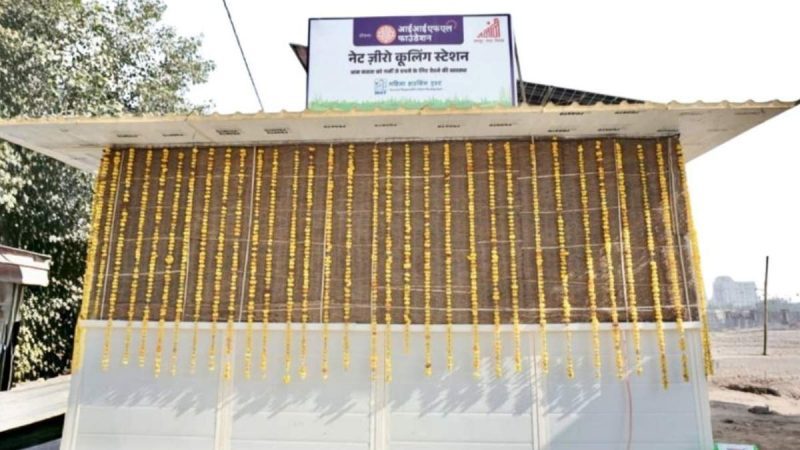
By 2 PM in Jaipur, the city starts feeling less like the Pink City and more like somebody left the entire place inside an air fryer. Roads shimmer, scooters burn your palms, and even the wind feels harsher by the minute. So the idea that there’s now a space in the city where people can walk in from 40° heat and instantly feel cooler, without a single air-conditioner running, sounds slightly unreal. But that’s exactly what has come up on VT Road near City Park, Jaipur’s first Net Zero Cooling Station.
This Jaipur Cooling Station Uses Khus Curtains To Beat 40° Heat
Frankly, the most surprising part is that the cooling trick isn’t futuristic technology, it’s khus.
Yes, the same earthy-smelling vetiver grass that Indian homes have used for generations in desert coolers before sleek split ACs took over every wall. The station’s walls are lined with khus panels, while fine mist sprays soak khus curtains every few minutes. Hot air passes through the damp layers and enters cooler.
Step inside and the temperature reportedly drops by around 5 to 6 degrees. In Jaipur’s summer terms, that difference feels massive. It’s the gap between “I need to sit down immediately” and “Okay, maybe I’ll survive this afternoon.”
The cooling station has been built by the Jaipur Municipal Corporation along with Mahila Housing Trust, an organisation that has been working on climate-resilient urban spaces across Indian cities. This isn’t their first experiment either! They’ve previously worked on passive cooling projects and even India’s first cool bus stop in Ahmedabad. Jaipur’s version feels like that idea evolved for a harsher future.
The structure uses a wind-tower ventilation system inspired by traditional desert architecture. Hot air naturally rises and escapes upward while cooler air circulates below.
Even the energy running the place comes from rooftop solar panels powering the fans, lights, and sprinkler system, which is why the project is being called “net zero.” In a country where every summer now comes with power-cut anxiety, building cooling spaces that don’t overload electricity systems suddenly feel more like survival planning.
Smart Use Of Vetiver Grass & Solar Power
The station can seat around 30 people and stays open from 7 AM to 5:30 PM. But it’s not just a shaded waiting area. There’s drinking water, ORS, first-aid support, and resting space designed especially for delivery workers, gig workers, drivers, street vendors, pedestrians, commuters, and senior citizens, basically the people who can’t escape the heat by entering an office lobby or switching on central AC.
And maybe that’s the part that makes all the difference.
Because the heat in Indian cities has become very unequal. Some people experience summer through cab windows and climate-controlled rooms, while others experience it standing on traffic signals with a delivery bag on their back.
Also Read: This Jaipur Hotel Turns Leftover Food Into Happiness! Viral Video Shows Staff Feeding The Needy
Jaipur’s cooling station doesn’t pretend to solve climate change. But it does something rare; it treats heat relief like public infrastructure instead of private privilege.
Cover Image Courtesy: mahilahsg/X
For more such snackable content, interesting discoveries and the latest updates on food, travel and experiences in your city, download the Curly Tales App. Download HERE.FAQs
What is Jaipur’s Net Zero Cooling Station?
The Net Zero Cooling Station is a public cooling space near City Park designed to reduce heat naturally without using traditional air-conditioners.
How does Jaipur’s cooling station work without ACs?
The cooling station uses khus (vetiver grass) panels, mist sprays, passive wind-tower ventilation, and solar-powered systems to lower temperatures naturally.
What is khus and why is it used for cooling?
Khus, also called vetiver grass, has been traditionally used in Indian desert coolers because hot air passing through wet khus becomes significantly cooler.
Who built Jaipur’s Net Zero Cooling Station?
The project was developed by the Jaipur Municipal Corporation in collaboration with Mahila Housing Trust.