

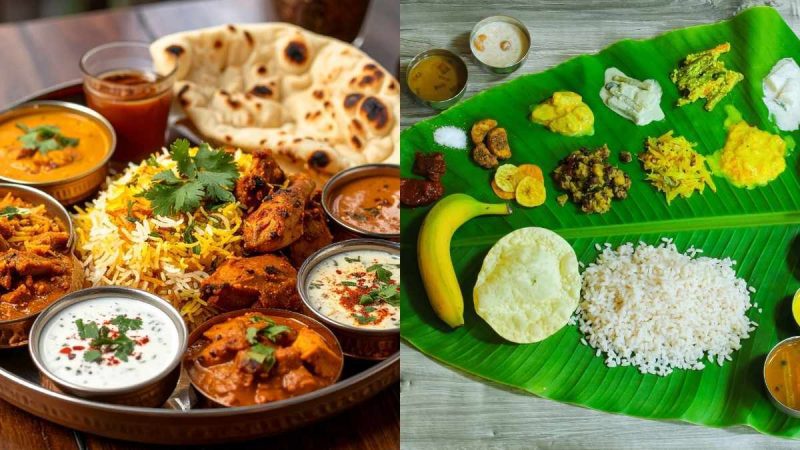
Food is never just food in India. It’s family memory, geography, weather, agriculture, spice logic, and centuries of tradition stacked onto a single plate. That’s why comparing a North Indian thali to a South Indian thali isn’t about ranking, it’s about understanding how two cuisines built around the same idea, an all-in-one, complete meal served on one plate, can look so dramatically different.
North Indian Thali VS South Indian Thali: The North Charmer

A North Indian thali almost feels engineered for winter evenings and road trips. The plate is anchored by wheat, not rice, with rotis, naans, and parathas, soft, chewy or crisp depending on where you eat it. The gravies are thick, sometimes creamy, sometimes tomato-forward, and often fulfilling enough that a spoon stands up on its own.
People don’t just eat this thali, they surrender to it.
Components Of North Indian Thali
A typical North Indian thali may include:
- A mix of rotis/naan/parathas
- A heavy dal: dal tadka or dal makhani (the second one could win a butter consumption competition by itself)
- Two curries: often paneer in some form and a seasonal sabzi
- Jeera rice or pulao
- Raita to cool things down
- Papad, pickle, maybe salad that you’ll pretend you’ll eat
- A dessert, gulab jamun if the cook wants you to cry happy tears or kheer if it’s a festive mood
Also Read: This Restaurant In Bangalore Serves Authentic Gujarati Thali For Just ₹150; Bahut Saru Che!
Who Will Love North Indian Thali?
It is comforting, has regal flavours, and can range from mild to heavy. The main character remains butter of ghee, which is unapologetically invited to every platter on the table.
People who love soul-filling food! People who appreciate food that feels “complete,” and anyone who thinks skipping ghee is a tragic lifestyle choice, should definitely go for this thali.
Best Places For North Indian Thali
- Punjab AM/PM Highway Dhabas, where the rotis are bigger than your face
- Delhi’s old-school restaurants, Pandara Road-style Dal Makhani supremacy
- Rajasthan, especially if you stumble into a thali featuring dal baati churma or gatte ki sabzi
A good North Indian thali doesn’t just fill you up. It quiets conversation and demands you bow down to its regional textures and pure flavours.
North Indian Thali VS South Indian Thali: The Southern Magic
If the North Indian thali feels like winter, the South Indian version feels like sunlight; it is gentle, grounded and intentional.
Everything has a place. Everything has a reason! Rice isn’t a supporting act here; it’s the base note. And instead of two or three gravies, you’re handed a sequence: sambar → rasam → curd. Like a multi-course tasting experience disguised as everyday lunch.
Components Of South Indian Thali
A South Indian thali often includes:
- Unlimited rice (always unlimited in spirit, usually in reality too)
- Sambar, tangy, warm, and lentil-rich
- Rasam, pepper-heavy or tomato-forward, depending on region
- Kootu, that quiet star, vegetables + dal + coconut
- Poriyal or thoran, subtly-fried vegetables with mustard seeds and curry leaves
- Curd or buttermilk
- Appalam (papad), chutney, pickles
- And if the universe is kind: Payasam
Who Will Love South Indian Thali?
It is layered rather than loud; it is well-spiced, not spicy. It is tangy but can’t be called sharp and is nourishing without being heavy. It’s a meal where the final spoonful of curd rice isn’t optional; it’s more like closure.
People who appreciate structure crave rice, but someone who believes good food shouldn’t leave them immobile.
Also Read: Billionaire Harsh Goenka Raves About Uppu In Mumbai For Its “Soulful South Indian Food”
Best Places For South Indian Thali
- Chennai’s mess-style meals, where everything tastes like somebody’s grandmother still supervises the kitchen
- Karnataka’s Udupi restaurants are humble, predictable and flawlessly comforting
- Kerala sadyas, especially during Onam, where the banana leaf becomes a geography lesson in sweetness, crunch, and mouth-watering contrasts
A South Indian thali feels like it evolved from Ayurvedic calm and everyday logic; it uses fuel for work, not food for hibernation.
Hold On, Are Unlimited Thalis Actually A Thing?
Yes, and they are glorious!
Across India, there are restaurants where the thali isn’t just a meal, it’s a negotiation of stamina.
In the South, waiters roam with buckets of sambar, rasam, and rice, silently judging whether you’ve earned a second refill or deserve a full reset. In the North and West, particularly in Gujarat and Rajasthan, unlimited thalis come as organised and bottomless flavours: twenty-plus little bowls and a parade of servers offering more kadhi, more rotis, and more desserts, it’s hospitality as a competitive sport.
The philosophy behind all-you-can-eat thalis isn’t gluttony, it’s abundance. It’s “you shouldn’t leave the table still thinking about food.”
Also Read: Shankar Mahadevan Brings Authentic South Indian Flavours To Chembur With Malgudi’s 2nd Outlet
North Indian Thali VS South Indian Thali: So… Which Plate Wins?
Depends on what your soul wants that day! If you want warmth, richness, and butter-soaked celebration, go North. If you want balance, rhythm, and a meal that feels restorative, go South. Some days we crave a heart-filling meal, other days we want balance. India gives us both. Maybe the real answer is this:
The best thali is the one placed in front of you when you’re hungry, and the best version of you is the one who says yes when someone walks by and asks, “Aur thoda daal?”
Cover Image Courtesy: vm2002/CanvaPro and indahlestar29/CanvaPro
For more such snackable content, interesting discoveries and the latest updates on food, travel and experiences in your city, download the Curly Tales App. Download HERE.