

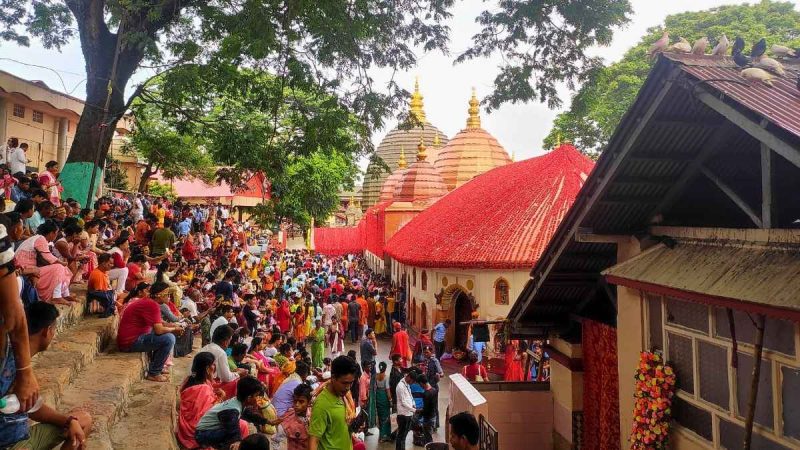
Ambubachi Mela, one of India’s largest and most significant religious gatherings, is set to begin at the revered Kamakhya Temple on June 22. As hundreds of thousands of devotees gather to celebrate this unique festival dedicated to menstruation, fertility, and feminine power, we have listed five lesser-known facts about the 4-day celebration that you should know.
5 Lesser-Known Facts About Ambubachi Mela
1. It Is Also Called The ‘Mahakumbh Of Tantrics’
The Ambubachi Mahayog, or Ambubachi Mela, is one of the largest gatherings of Tantric practitioners in the world, which is why it is often referred to as the Mahakumbh of Tantrics. Devotees believe that cosmic energies are at their peak around the temple during the festival. As a result, Tantric practitioners, Aghoris, and sadhaks from across the country gather at the Kamakhya Temple to take part in the mela.
Also Read: When Is Ambubachi Mela At Assam’s Kamakhya Temple? Why It Remains Closed For 3 Days?
2. Unique Prasad : Angodak & Angabastra
Every year around this time Ambubachi Mela happen in Guwahati, Assam and the doors of Kamakhya Temple remain closed for three days.
It is believed that during this time, Maa Kamakhya enters Rajaswala Avastha the sacred period of rest observed by the Devi herself.
A cloth is… pic.twitter.com/D5FvNZRCdS
— Bhavesh Bhimanathani (@bhavesh_yuj) June 23, 2025
Unlike the usual prasad offerings of sweets, flowers, or fruits, devotees receive two unique sacred items after the Kamakhya Temple reopens following Ambubachi Mela. These include Angodak, holy spring water believed to symbolise the goddess’s sacred fluid, and Angabastra or Rakta Bastra, a piece of red cloth said to have covered the Goddess’s yoni during her annual menstruation.
3. People Don’t Read Any Holy Books, Perform Puja Or Work
According to devotees, Maa Kamakhya is believed to be menstruating during this period, making it a time of sacred seclusion, rest, and purification. As a result, many refrain from reading holy scriptures, studying, performing pujas, cooking, farming, or engaging in physical labour. Just as the Earth is believed to be resting and renewing itself, devotees too observe this period as a time for pause and reflection.
4. Why The Brahmaputra River Turns Red During Ambubachi Mela?
It is believed that Maa Kamakhya menstruates during the four-day Ambubachi Mela, and many devotees associate this with the Brahmaputra River appearing reddish near the temple during the festival. However, many have pointed to a natural explanation.
Since the mela coincides with the onset of the monsoon, heavy rains are believed to wash large amounts of iron oxide and laterite-rich red soil from the surrounding hills and riverbanks into the river, giving the water its reddish hue.
5. Kamakhya Temple Is The Oldest Shakti Peetha
The Kamakhya Temple, where the annual Ambubachi Mela takes place, is believed to be the oldest and most sacred of the primary Shakti Peethas. Located in Assam, it is believed to be the site where Devi Sati’s yoni (womb) fell during Lord Shiva’s Tandava dance of destruction.
Also Read: 68% Of Gen Z Indian Women Like Going On Solo Trips By Bus; Assam & Kerala Top Spots
Let us know in the comments if you knew about these facts.
Cover Image Courtesy: Wikimedia Commons
For more such snackable content, interesting discoveries and the latest updates on food, travel and experiences in your city, download the Curly Tales App. Download HERE.
FAQs
What is Ambubachi Mela?
Ambubachi Mela is an annual four-day festival held at the Kamakhya Temple in Assam. It celebrates the fertility, creative power, and annual menstruation of Goddess Kamakhya.