

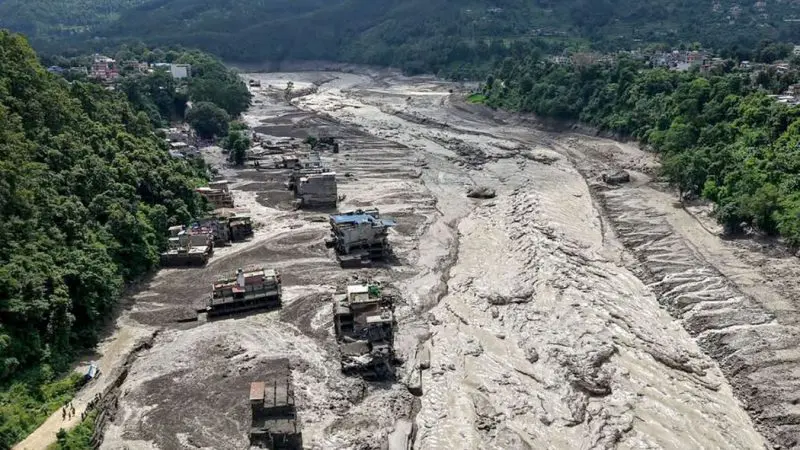
Nepal has urged international travellers not to cancel their Himalayan trips, assuring tourists that the country remains open for visitors as authorities assess the human and economic impact of catastrophic floods that have killed hundreds and left thousands missing. Tourism Minister Khadak Raj Paudel appealed to travellers in a video message on Facebook, saying Nepal’s mountain trails and trekking routes remain open.
Nepal Urges Tourists To Visit Mountain Trails Amid Heavy Floods
According to a report by NDTV, the minister advised tourists to continue visiting, stressing that their presence would provide much-needed support to a country dealing with the aftermath of the disaster. The appeal comes as images of destroyed villages, roads and bridges, along with reports of widespread deaths, raise concerns that tourists could avoid Nepal altogether, including areas that have largely escaped the floods.
The disaster was caused by a glacial collapse that sent ice, mud, rocks and water rushing through a valley, destroying settlements and infrastructure. Videos from the affected areas showed residents fleeing as powerful waves of water and debris swept away buildings, bridges, power lines, trees, vehicles and boulders. According to Nepal’s foreign ministry, around 590 foreigners from 39 countries remain missing. The overall death toll in Nepal had reached at least 1,010 by Tuesday afternoon, while rescue operations continued across affected areas.
Also Read: What Triggered Deadly Flash Floods In Nepal? ISRO Satellite Images Reveal Reason!
Nepal Floods Caused Significant Infrastructure Damage
Specialist teams from Nepal, India, China and South Korea are assisting with rescue efforts at hydropower projects where hundreds of workers remain trapped inside tunnels. Home Minister Sudan Gurung reported that rescuers had reached the upper section of one tunnel and were attempting to dig down from above the powerhouse to reach those trapped inside. He said authorities had “not lost hope” of finding survivors.
The floods and landslides have also caused significant infrastructure damage, with at least 12 hydropower projects affected in the Nuwakot and Rasuwa districts, according to the Independent Power Producers’ Association Nepal. Nepal’s Ministry of Foreign Affairs said the full scale of the destruction was becoming clearer as access to affected areas improved. The government expects to need significant international assistance for rehabilitation and reconstruction.
Also Read: How Kailash Mansarovar Yatra Will Be Impacted By Nepal Floods & What Pilgrims Should Know
At least 11,993 people have been rescued so far, with helicopters and other aircraft being used to reach communities cut off after roads and bridges were destroyed. The disaster comes at a difficult time for Nepal’s economy, which is already facing higher fuel costs, weaker tourism and slowing growth, making the country’s recovery effort even more challenging.
We hope and pray that everything goes back to normal in Nepal soon.
Cover Image Courtesy: X/MarioNawfal
FAQs
What is Nepal's current situation?
Nepal is currently facing a catastrophic humanitarian and infrastructure crisis following a massive high-altitude glacial outburst and severe flash floods along the Bhote Koshi and Trishuli rivers near the Nepal-Tibet border.