

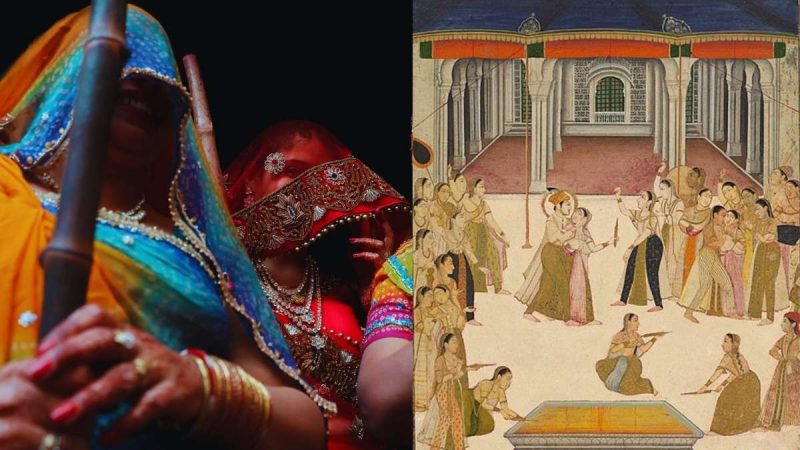
Holi did not begin as a colour riot in the streets. The version that fills Instagram feeds every March represents only the most recent layer of a festival that has moved through Vedic seasonal rites, Puranic theology, medieval devotional movements, Mughal courtly culture, colonial reform debates, and 19-century migration routes. Early Sanskrit references to spring fire rituals appear in texts such as the Kathaka Grihya Sutra. By the 7th century CE, courtly literature like Ratnavali, attributed to King Harsha, describes aristocratic spring celebrations involving coloured powders and scented water. The festival that now appears spontaneous and playful has always been structured by belief, power, and social order. Here are 10 lesser-discussed Holi facts that complicate the popular narrative.
10 Unique Holi Facts That May Surprise You!
1. Widows In Vrindavan Were Historically Barred From Playing Holi
Vrindavan became, from the early modern period onward, a major settlement site for Hindu widows, particularly from Bengal. Many arrived after being displaced from marital homes where widowhood imposed social austerity.
Custom dictated white clothing, dietary restrictions, and withdrawal from celebration. Holi, associated with fertility, sensuality, and romantic Krishna devotion, stood in sharp contrast to widowhood’s imposed restraint. Exclusion from Holi, therefore, reinforced a broader social logic that widows symbolised ritual inauspiciousness.
In 2013, Sulabh International organised a widely documented Holi event for widows inside temple grounds. Photographs from that year circulated nationally, and the event did not just invent inclusion but publicly reversed a long-entrenched practice.
Also Read: Holi 2026: 12 Holi Parties In Bengaluru For Rain Dance, Live DJ, Thandai & More
2. Holika Dahan Once Functioned As Seasonal Protection

The bonfire on Phalguna Purnima predates, in some regions, its later embedding in the Holika-Prahlada narrative. Agrarian communities treated late winter as epidemiologically dangerous. Seasonal transitions brought respiratory illness, crop vulnerability, and uncertainty.
Fire rituals like burning dry wood, grain husks, and agricultural residue operated as communal purification. Ash from the bonfire was applied to foreheads or stored in homes. The ritual expressed both cosmology and sanitation. Only later did Puranic storytelling fully standardise the connection with Holika’s death.
Also Read: No Changes In Maharashtra’s Dry Days; Liquor Ban On Holi & Muharram Not Revoked
3. Colour Throwing Emerged From Agrarian Fertility Symbolism
North India’s wheat harvest ripens in early spring. Mustard fields turn yellow, Palash trees ignite into orange-red bloom, while the colour in this landscape is not metaphorical; it is an agricultural fact.
Scholars of seasonal festivals note that many early spring rites involve bodily marking, smearing with ash, turmeric, or pigment, to symbolise regeneration. Red signified vitality while yellow suggested auspicious abundance. Before factory-made gulal, communities dried tesu flowers, ground turmeric, and mixed sandalwood paste. The playful assault of colour likely evolved from ritual marking tied to fertility and crop optimism rather than mere entertainment.
4. Lathmar Holi Institutionalises Controlled Social Inversion
In Barsana, women strike men with lathis while men shield themselves as a popular Holi tradition. The event draws on Krishna lore, as he visits Radha’s village and teases her companions, and they retaliate.
Anthropologists identify this as ritualised inversion or a temporary redistribution of authority. For a few hours, women occupy visible, physical dominance in public space. The inversion remains controlled, theatrical, and rule-bound.
5. Early Holi Observances Centered On Married Women’s Domestic Rites
Regional folklore and early ethnographic accounts describe Holi fire rituals performed by married women seeking household prosperity. These rites emphasised marital stability, agricultural security, and protection from misfortune.
Public colour play likely expanded later, especially in urban courts and Bhakti devotional centres. What began as a domestic ritual gradually shifted into a communal spectacle.
Also Read: Holi 2026: Vrindavan’s Flower Holi Attracts 126% Rise In Travel Interest; Mathura Sees 109% Hike
6. The Name “Holi” Derives From The Holika-Prahlada Narrative
The Bhagavata Purana and Vishnu Purana recount the story of Hiranyakashipu and his son Prahlada. When Prahlada refused to abandon devotion to Vishnu, his aunt Holika, protected by a boon against fire, sat with him on a pyre, intending his death. The boon failed; she burned while he survived.
The narrative’s theological weight lies in bhakti triumphing over authoritarian ego. ‘Holika Dahan’ ritual dramatises that reversal annually. The festival’s name preserves the antagonist, not the hero, as a linguistic reminder of moral inversion.
7. Mughal Courts Publicly Celebrated Holi
Miniature paintings from the reigns of Akbar and Jahangir depict colour play in palace gardens. Persian chronicles reference spring festivities that were sometimes called “Eid-e-Gulabi.” Court participation signaled political accommodation and cultural synthesis. Rajput alliances within the Mughal court likely facilitated this exchange, and Holi entered imperial space not as a concession, but as a shared seasonal celebration.
8. Traditional Holi Colours Carried Medicinal Logic
Ayurvedic seasonal theory describes spring as a time when accumulated winter phlegm (kapha) destabilises the body. Turmeric acts as an antiseptic here, while neem contains antimicrobial compounds. Palash flowers possess mild skin-friendly properties too.
Natural colours did not merely decorate; they were aligned with preventive health reasoning. Industrial dyes introduced in the 20th century severed that connection, often replacing plant extracts with synthetic pigments that carry dermatological risk.
Also Read: Holi 2026: Which Special Trains And Buses Are Running In India For Holi? Routes, Dates & More Here!
9. Dhundh Ceremony Protects Infants During Seasonal Transition
In parts of Rajasthan, families observe Dhundh for children born in the preceding year. Community members gather, sing, and perform symbolic gestures intended to shield infants from seasonal harm. The practice appears in regional traditions linked to the Bhavishya Purana. It reflects a cosmology in which transitional periods expose the vulnerable to unseen forces. Holi thus becomes protective, and not merely celebratory.
10. Holi Is Celebrated Outside India, Too
In Mathura and Vrindavan, Holi centres on Krishna’s playful colouring of Radha. Medieval Bhakti poets expanded this imagery into theology with colour as surrender and love as transcendence. The emphasis rests less on spectacle and more on divine intimacy.
In Europe and North America, secular “Festival of Colours” events further transformed Holi into a cultural export. The core survives, but its meanings shift with geography. “Desert Holi” is quite common in Dubai, where camels are very much part of this celebration of colours. In Guyana, it is called “Phagwa,” and features special songs called Chowtaals.
Also Read: Will Chandra Grahan Affect Holi Dahan Date & Timings This Year? Here’s What We Know
Holi’s present form conceals centuries of negotiation between devotion and discipline, gender and hierarchy, court and village, medicine and ritual, and homeland and diaspora. It has been excluded and included, it has healed and inverted and it has absorbed an empire and survived migration.
This rich festival has a history that is only richer in context.
Cover Image Courtesy: ahmadali/X and roshagulla16/X
For more such snackable content, interesting discoveries and the latest updates on food, travel and experiences in your city, download the Curly Tales App. Download HERE.
FAQs
What is the real origin of Holi?
Holi began as a spring fire ritual linked to seasonal change and later became associated with the Holika–Prahlada story from the Puranas.
Why is Holika Dahan celebrated?
Holika Dahan symbolises the victory of devotion (Prahlada) over ego and tyranny (Holika and Hiranyakashipu).
Did Mughal rulers celebrate Holi?
Yes. Historical records and miniature paintings show Mughal emperors like Akbar and Jahangir participating in spring colour celebrations.
Why were widows not allowed to play Holi in Vrindavan?
Widowhood was historically associated with austerity and ritual inauspiciousness, leading to their exclusion from festivals like Holi.