

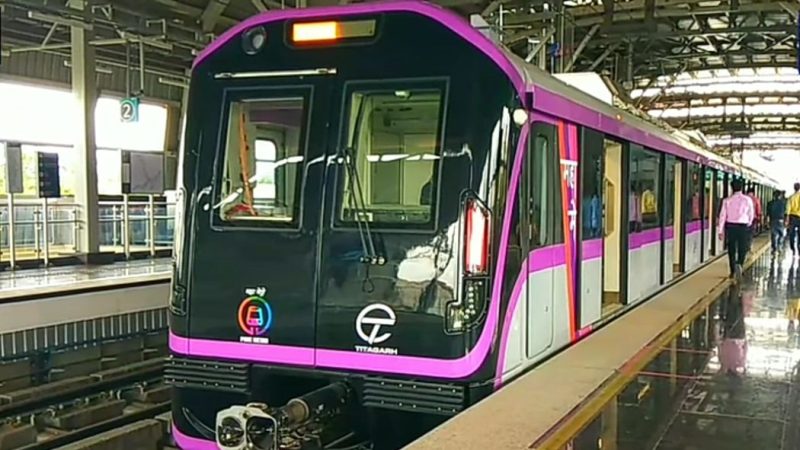
Pune Metro is set to increase train frequency on its two operational corridors, Swargate–PCMC and Vanaz–Ramwadi, during peak hours. Trains will run every five minutes, compared to the current six-minute interval, to manage the expected rise in passenger traffic during the Ganesh festival. Want to know more about it? Read on!
Pune Metro To Increase Frequency During Ganesh Festival
According to reports by The Indian Express, the Pune Metro currently operates on two routes. The 17.5-km PCMC–Swargate corridor has 14 stations and takes around 34 minutes to cover. The 14.5-km Vanaz–Ramwadi corridor has 16 stations, with a journey time of around 37 minutes. Services operate from 6 am to 11 pm on both routes. At present, trains run every six minutes during peak hours, from 8 am to 11 am and 4 pm to 8 pm, and every 10 minutes during the remaining operating hours. Maha Metro is also preparing a wider crowd-management plan for Ganeshotsav. During peak hours, trains will run every five minutes instead of the current six-minute interval, with the enhanced frequency particularly aimed at handling the heavy rush expected during the final days of the festival.
Daily Metro ridership is already around 2.5 lakh, and officials expect it to rise further during Ganeshotsav. Maha Metro plans to deploy all 33 three-coach rakes to increase the number of services, with 17 assigned to the Vanaz-Ramwadi corridor and 16 to the PCMC-Swargate corridor. The Metro is also expected to extend services later into the night, following the extended operating hours introduced during the previous Ganeshotsav. Additional crowd-control measures are being planned at busy stations, particularly Mandai. Separate entry and exit gates may be used to manage the crowds, while commuters could be directed towards nearby stations such as PMC, Kasba Peth, Swargate and Civil Court to reduce pressure at Mandai.
Also Read: Good News, Punekars! Pune Metro Plans To Add 15 New Trains With 3 Coaches Each; Details Inside
To reduce queues at ticket counters, commuters are being encouraged to book tickets online. Maha Metro is also working to address connectivity issues at underground stations such as Mandai and Swargate, where weak mobile signals can make digital ticketing difficult. Passengers will also be subject to additional security checks and crowd-management measures during the festival.
Pune Metro To Introduce Six-Coach Trains
Pune Metro is also preparing to introduce six-coach trains to accommodate the expected increase in ridership as the network expands. The existing services primarily use three-coach trains. Pune Metro stations have already been designed to accommodate six-coach trains. The upgrade will require necessary changes to the signalling system before the longer trains can be introduced.
Meanwhile, work is underway on extensions of both operational corridors. The 4.4-km PCMC–Nigdi extension, with four stations, is expected to become operational next year. Work has also begun on the 5.46-km underground Swargate–Katraj extension. All approvals have been received for the proposed 25.52-km Line 4 connecting Kharadi and Khadakwasla, which will have 22 stations. Approval has also been granted for the 6.12-km Nal Stop–Manikbaug spur via Warje, which will have six stations.
Good news for Pune commuters.
Cover Image Courtesy: Wikimedia Commons
FAQs
What is the current status of the Pune Metro?
The Pune Metro currently has two operational lines (the Purple Line and Aqua Line) spanning about 33 km, with the Hinjewadi to Civil Court Line 3 in its final phase and phased openings expected through mid-2026.