

Every list of UNESCO heritage sites online feels like déjà vu: Machu Picchu. Petra. The Great Wall. Click, scroll, yawn. But somewhere between the well-photographed monuments and over-visited ruins are places you probably can’t pronounce, sitting in rainforests, deserts, quiet islands, or under the earth. They’re spectacular, not because they’re hidden, but because somehow we simply didn’t look. So let’s change that!
10 Lesser-Known UNESCO World Heritage Sites That Deserve The Hype
1. Nan Madol, Micronesia

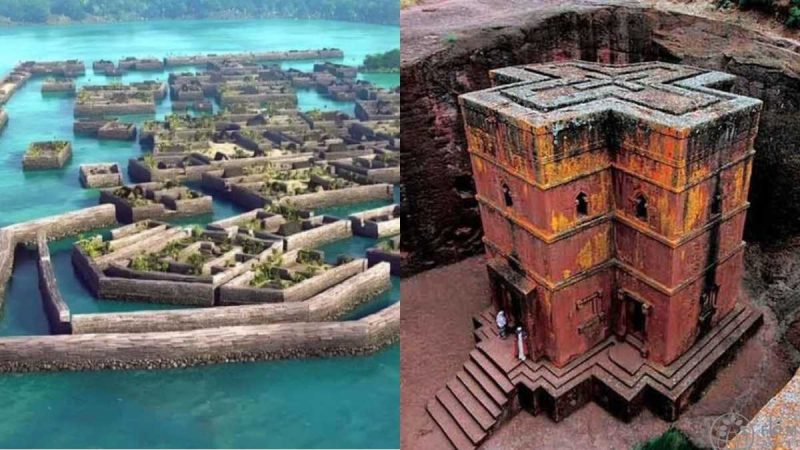
Off the coast of Pohnpei, in the middle of the Pacific, sits a ruined royal capital built on nearly a hundred artificial islets constructed from basalt columns and coral. Scholars say Nan Madol once hosted the Saudeleur dynasty around 1200–1500 CE, it has priests, elites, rituals and ancestor worship. Today? It has no overwhelming crowds, just wind, water and stone, and a quiet sense that someone forgot to tell the world this place exists.
2. Vallée de Mai, Seychelles
Most national parks feel “protected,” but Vallée de Mai feels ancient. Located on Praslin Island, it shelters coco de mer palms with seeds so enormous (and oddly shaped) they almost feel mythical. The forest also protects several palm species that grow nowhere else, not in Seychelles, not in Africa, nowhere.
3. Chitwan National Park, Nepal
Most travellers associate Nepal with peaks, prayer flags and altitude sickness. Meanwhile, Chitwan hides in the lowlands with dense forests, elephant grass, marshes and the rare one-horned rhinoceros grazing calmly as crocodiles warm themselves on sandbanks. Tigers still roam here, not hypothetically, but actually. The park was established in 1973 and became a World Heritage Site in 1984. It’s wild enough to feel thrilling, gentle enough to sit still and watch a rhino blink.
4. San Agustín Archaeological Park, Colombia
In southern Colombia, the hills are full of carved stone statues with jaguar-fanged guardians, avian gods and fierce figures holding weapons or babies, some dating back to roughly 5–400 CE. The people who made them left no written record. So historians guess, compare, and theorise, and visitors wander through grinning stone sentinels, wondering how a site this extraordinary can be so overlooked.
5. The Kii Mountain Pilgrimage Routes, Japan
Far from Tokyo neon and Kyoto tea rooms, the Kii Peninsula holds ancient trails connecting sacred mountains, shrines, forests and waterfalls. Pilgrims have walked here for more than 1,200 years, weaving together Shinto reverence for nature and Buddhist spiritual practice. The moss-covered stones, the wooden shrines, the rhythm of walking, nothing feels staged for tourism; it feels lived.
6. Namhansanseong Fortress, South Korea
Just outside Seoul, Namhansanseong sits quietly above a modern skyline, its 12-kilometre defensive wall curving along mountain ridges. Built as a refuge for the Joseon dynasty during invasions, it mixes Korean, Chinese and Japanese military architecture. Today it’s a favourite hiking route, but many hikers may not realise they’re walking through a former emergency capital.
7. Rani-ki-Vav, India
Gujarat’s Rani-ki-Vav doesn’t tower. It descends, seven elaborately carved tiers disappearing into the earth like an inverted temple. Queen Udayamati commissioned it in the 11th century in memory of her husband, King Bhima I. More than 500 sculptures and over 1,000 miniature carvings line its walls with deities, apsaras and mythic narratives. It’s functional water engineering disguised as devotion and beauty.
8. Al-Maghtas, Jordan
Near the Dead Sea, on the eastern bank of the Jordan River, Al-Maghtas marks the likely site of Jesus’s baptism. Archaeological remains, with baptism pools, hermit caves, and early churches, sit quietly in the desert, absorbing sunlight and silence. Despite its spiritual significance, it remains far less visited than other biblical landmarks.
9. Lalibela, Ethiopia
In Lalibela, eleven medieval churches were carved downward from a single slab of volcanic rock. They’re connected by tunnels and trenches that symbolically mirror Jerusalem. The Church of St. George, cross-shaped and cut deep into the ground, might be one of the most striking religious structures ever built. And yet, outside Ethiopia, many have never heard of it.
10. Tsingy de Bemaraha, Madagascar
Imagine a forest made not of trees, but of razor-sharp limestone pinnacles, that’s Tsingy de Bemaraha! Bridges and ladders help travellers navigate the labyrinth, while lemurs jump effortlessly across the jagged towers (which humans absolutely cannot walk barefoot on, its Malagasy name literally warns you). It feels prehistoric, wild, and unapologetically difficult.
Also Read: Lucknow Is Now The UNESCO City Of Gastronomy; 5 Kebabs That Have Helped Earn Its Title
These places aren’t “hidden gems.” They’ve been here longer than most civilisations, we just haven’t been paying attention. If the world feels too mapped, too seen, too crowded, remember this list. There are still places that can surprise you.
Cover Image Courtesy: saltymemesmith/X and sailko/Wikipedia
For more such snackable content, interesting discoveries and the latest updates on food, travel and experiences in your city, download the Curly Tales App. Download HERE.