

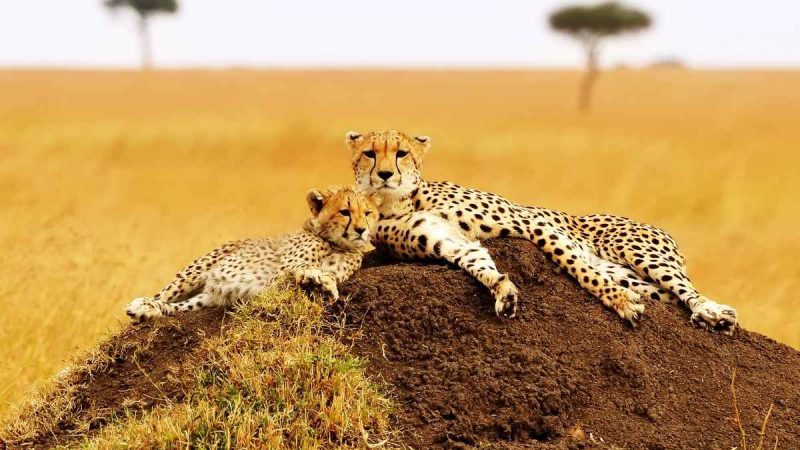
You know that moment in a wildlife documentary when the narrator suddenly whispers because something is moving through the bushes? That’s the feeling every wildlife traveller spends years chasing. So if your idea of a perfect holiday starts with sunrise safaris, muddy boots and binoculars hanging around your neck, these eight wildlife destinations deserve a lifetime spot on your bucket list.
8 Wildlife Destinations In The World Every Nature Lover Should Visit
1. Ranthambore National Park, Rajasthan, India

If there is one place that has turned tiger-spotting into a national obsession, it is Ranthambore. This isn’t just another forest. It is a former royal hunting ground where crumbling palace ruins, ancient temples and the magnificent 10th-century Ranthambore Fort now belong to the animals more than they do to people. There are very few places on Earth where you can watch a Bengal tiger stroll past a 1,000-year-old fort as though it owns the kingdom. Because the forest is relatively open compared to reserves like Corbett or Kanha, wildlife sightings here can be oh-so-spectacular.
Also Read: Planning Ranthambore Tiger Safari? Be Ready To Pay A Little Extra Now
2. Maasai Mara National Reserve, Kenya
The Great Migration isn’t called the greatest wildlife spectacle on Earth because it sounds dramatic. It genuinely is! Between July and October, nearly two million wildebeest, zebras and gazelles begin an exhausting journey from Tanzania’s Serengeti into Kenya’s Maasai Mara in search of greener grass. The most nerve-racking part comes at the Mara River, where enormous Nile crocodiles wait below the surface while predators circle above. Every crossing becomes a matter of survival. Even if you visit outside migration season, the Mara refuses to disappoint. Lions laze beneath acacia trees after successful hunts, cheetahs scan the grasslands for unsuspecting prey, elephants march across the plains in family herds and endangered black rhinos still roam protected pockets of the reserve.
3. Galápagos Islands, Ecuador
The Galápagos don’t feel like a destination. They feel like another version of Earth where animals never learned to fear humans. Giant tortoises graze lazily beside walking trails, blue-footed boobies perform awkward little dances that somehow make complete sense to potential mates, and marine iguanas casually sunbathe on black volcanic rocks after diving into the ocean to feed on algae. Nowhere else on the planet will you find penguins living almost on the equator or flightless cormorants that abandoned flying because they simply didn’t need to.
This remarkable isolation is precisely what fascinated Charles Darwin during his famous voyage aboard HMS Beagle in 1835, eventually helping shape the theory of evolution.
Also Read: Good News For Wildlife Lovers! West Bengal To Get A New Tiger Safari Hub In Jhargram
4. Yellowstone National Park, USA

Yellowstone often gets introduced through Old Faithful, the famous geyser that erupts with remarkable regularity. The real magic, though, happens miles away from the crowds. Dawn breaks over mist-covered valleys where bison graze like they have for thousands of years. Wolves move silently through Lamar Valley, one of the few places in America where their successful reintroduction completely transformed an ecosystem. Elk bugle across open meadows, grizzly bears forage for berries before winter arrives and bald eagles circle above rushing rivers.
5. Pantanal, Brazil
Everyone dreams of seeing a jaguar in the wild, but surprisingly, the Amazon isn’t your best bet. The Pantanal is! Covering parts of Brazil, Bolivia and Paraguay, this enormous tropical wetland transforms dramatically with the seasons. During the dry months, receding floodwaters gather wildlife along rivers and lakes, creating one of the highest concentrations of animals anywhere in South America. Jaguars here have become unusually comfortable around safari boats, meaning sightings are far more common than in dense rainforest. Watching one emerge from thick vegetation before diving into the water after a caiman is the kind of scene that barely seems real until you’re witnessing it yourself.
6. Churchill, Manitoba, Canada
Every autumn, a small town on the edge of Hudson Bay suddenly becomes one of the most stunning wildlife destinations on the planet. Churchill earns its nickname, the Polar Bear Capital of the World, because hundreds of polar bears gather here while waiting for sea ice to freeze over. Once winter comes, they head onto the frozen bay to hunt seals, but before that happens, they can often be seen wandering the tundra, sometimes with curious cubs trailing behind. Churchill refuses to be a one-season wonder, though. Summer brings around 60,000 beluga whales into the Churchill River, creating opportunities to kayak or even snorkel alongside these remarkably social marine mammals.
Also Read: Kerala Houseboats Too Expensive? 7 Budget-Friendly Waterfront Escapes Across India To Explore
7. Borneo, Malaysia
Some rainforests are ancient, but wait, Borneo’s rainforest is prehistoric. Scientists estimate parts of it have existed for over 130 million years, making it one of the oldest surviving tropical forests on Earth. Every corner seems alive. Along the Kinabatangan River, strange-looking proboscis monkeys leap between trees with noses so oversized they almost look fictional. Tiny pygmy elephants wander through dense vegetation, hornbills soar overhead carrying fruit in enormous beaks and crocodiles wait almost invisibly beneath muddy water.
8. South Georgia Island, Southern Atlantic Ocean
Reaching South Georgia is an expedition in itself. There are no airports, no luxury resorts and certainly no quick weekend trips. Most travellers spend days crossing the notoriously rough Drake Passage before the island finally appears through mist and towering glaciers. What waits onshore is almost impossible to prepare for. Massive elephant seals battle for territory while Antarctic fur seals race across the sand with surprising rush. You will encounter wandering albatrosses too. Offshore, humpback whales and orcas regularly surface beside expedition ships.
So, which of these wildlife destinations excites you the most?
Cover Image Courtesy: anharris/Canva Pro
FAQs
Which is the best wildlife destination in the world?
There is no single answer, but Maasai Mara in Kenya, the Galápagos Islands, Yellowstone National Park and Ranthambore National Park consistently rank among the world's best wildlife destinations because of their incredible biodiversity and unforgettable animal sightings.
Where can I see Bengal tigers in the wild?
Ranthambore National Park in Rajasthan is one of India's top destinations for spotting Bengal tigers, thanks to its healthy tiger population and relatively open landscape.
When is the best time to visit Maasai Mara for the Great Migration?
The Great Migration is typically at its peak between July and October, when millions of wildebeest, zebras and gazelles cross the Mara River into Kenya.
Which wildlife destination is best for photographers?
The Pantanal in Brazil, Maasai Mara in Kenya, Yellowstone National Park in the USA and South Georgia Island offer exceptional opportunities for wildlife photography due to frequent animal sightings and dramatic landscapes.