



Picture this. It is an evening in 18th-century England. Crystal glasses sparkle under candlelight, silver platters line an impossibly long dining table, and aristocrats dressed in silk gather for a feast. At the centre of the table sits the evening’s most admired guest. It is not a duke and not a prince, but a pineapple!
Pineapple: The Edible Gold

That sounds absurd today, but for nearly two centuries, pineapples were among the most coveted luxury items in Europe. In certain social circles, they were worth more as symbols than as food. Isn’t that bizarre?
The pineapple’s journey to celebrity status began thousands of kilometres away in South America, where Indigenous communities had cultivated the fruit long before Europeans arrived. When Christopher Columbus encountered pineapples in the Caribbean during his second voyage in 1493, he reportedly became fascinated by their sweetness and aroma. Because who wouldn’t?
Europe had never seen anything quite like them. They looked exotic, tasted unlike any known fruit, and held the scent of the tropics in an era when most people never travelled beyond their own region. The real challenge wasn’t finding pineapples; it was getting them to Europe alive.
Before refrigeration, crossing the Atlantic was slow and brutal. Fresh fruit spoiled quickly aboard ships and most pineapples began rotting long before they reached European ports. The rare few that survived came as precious cargo. A fresh pineapple instantly became a luxury available only to monarchs, nobles, and the exceptionally wealthy.
Soon, a peculiar obsession swept through Europe!
World Pineapple Day: Before Luxury Cars, Rich Showed Off Pineapples
Royal courts competed to acquire the fruit. Wealthy merchants displayed them as proof of their global connections. So yeah, the spiky sensation became shorthand for wealth, influence, and access to faraway colonies. Owning one announced that you belonged to a world inaccessible to ordinary people!
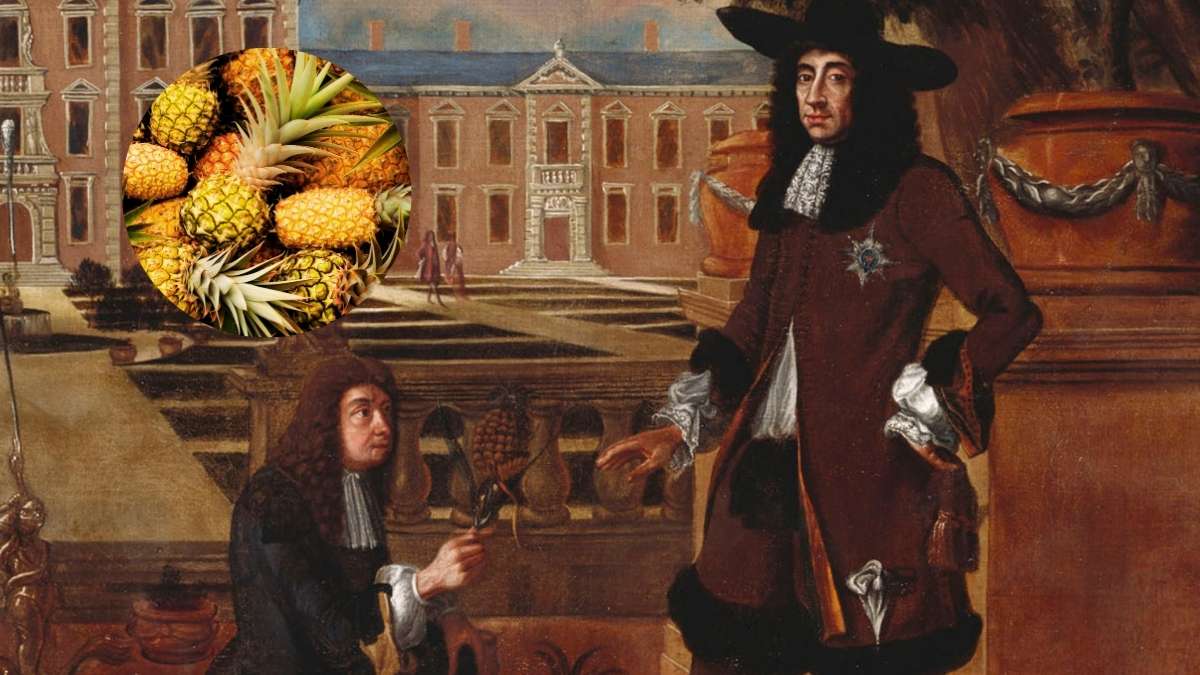
No one embraced the craze more enthusiastically than Britain. King Charles II became one of the fruit’s most famous admirers. A celebrated painting from the 1670s shows the monarch receiving a pineapple from his gardener, John Rose. The image wasn’t really about gardening. It was about power! Growing a pineapple in England was considered such an achievement that it deserved to be immortalised in royal portraiture.
And growing them was astonishingly difficult.
England’s weather was hopelessly unsuitable for tropical fruit. To overcome this problem, wealthy estate owners built specialised structures called pineries, or elaborate glasshouses heated through ingenious but expensive methods. Gardeners often relied on decomposing horse manure, which generated warmth as it broke down. Producing a single pineapple could take two to three years and cost what many working families earned in months.
Naturally, people became terrified of eating them. A pineapple represented too much money and prestige to disappear after a few bites. Instead, hosts displayed the fruit at banquets as the ultimate conversation starter. Some pineapples reportedly travelled from one party to another, hired out repeatedly until they finally began to decay.
Also Read: Japan Has A Juicy Dessert Beer Packed With Indian Mangoes, Pineapple Puree, And Coconut Cream!
The Pineapple Craze That Swept Across Europe’s Elite
Yes, rented pineapples were a real business.
The fruit’s influence escaped the dining room and invaded architecture, art, and design. Pineapple motifs appeared everywhere; they were carved into gateposts, woven into textiles, painted onto walls, and sculpted into furniture. Across Britain and Europe, the pineapple became a visual shorthand for prosperity, hospitality, and elite taste.
Perhaps the most extravagant example still standing today is Scotland’s Dunmore Pineapple, a massive stone structure crowned with a giant pineapple dome that looks as though a tropical fruit crash-landed on a country estate. Yet the pineapple’s reign as Europe’s most glamorous fruit was way too fragile.
For a brief, fascinating, and yes, weird chapter of history, Europe’s wealthiest people treated a tropical fruit the way modern society treats superyachts, rare watches, or limited-edition luxury cars. A pineapple wasn’t dessert, it was a declaration. A carefully displayed symbol that announced, without a single word, that its owner possessed something almost nobody else could.
Cover Image Courtesy: shulevich/Canva Pro and hendrickdanckerts/Wikipedia
For more such snackable content, interesting discoveries and the latest updates on food, travel and experiences in your city, download the Curly Tales App. Download HERE.FAQs
Why were pineapples considered luxury items in Europe?
Pineapples were difficult to transport from the Caribbean and South America to Europe before refrigeration. Their rarity made them symbols of wealth and prestige.
Did people really rent pineapples?
Yes. During the 17th and 18th centuries, wealthy individuals rented pineapples to display at social gatherings and banquets as status symbols.
Who introduced pineapples to Europe?
Christopher Columbus encountered pineapples during his second voyage to the Caribbean in 1493 and helped introduce Europeans to the fruit.
What is the Dunmore Pineapple?
The Dunmore Pineapple is a famous 18th-century architectural structure in Scotland topped with a giant stone pineapple dome.
When is World Pineapple Day?
World Pineapple Day is celebrated annually on June 27, honouring the fruit's cultural significance, history, and global popularity.


