

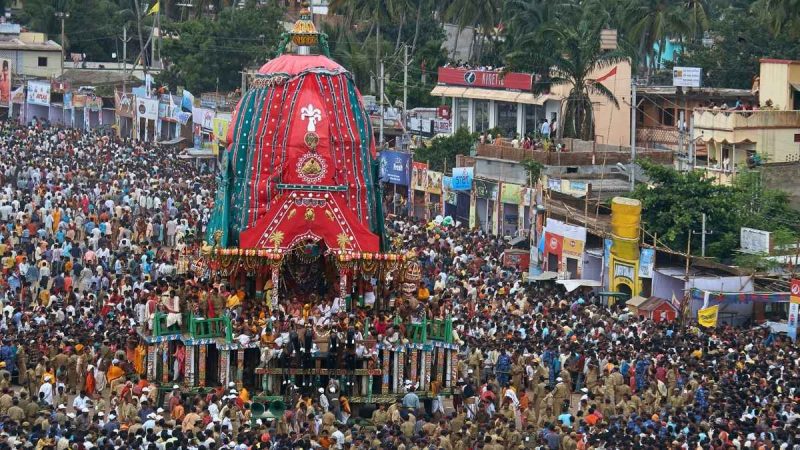
Puri’s Rath Yatra is one of India’s most eagerly awaited festivals, drawing devotees from across the world every year. The grand celebration marks the annual journey of Lord Jagannath, Lord Balabhadra, and Goddess Subhadra from the Jagannath Temple to the Gundicha Temple, a symbolic visit to their aunt’s home. As the festivities begin, here are five fascinating Rath Yatra traditions that everyone should know about.
5 Interesting Traditions Around Puri’s Rath Yatra
1. From Sacred Wood Selection To Chariot Building
The construction of the three chariots begins on the auspicious occasion of Akshaya Tritiya. As fresh chariots are built every year for the Rath Yatra, new wood is used for the process. According to tradition, logs of the sacred Dhaura tree are ceremonially cut only after receiving the Agyanmala, garland of permission, from the Shree Jagannath Temple in Puri.
These logs are then used to build the three chariots: Nandighosa for Lord Jagannath, Taladhwaja for Lord Balabhadra, and Darpadalana for Goddess Subhadra.
Also Read: Rath Yatra 2026: Indian Railways To Run 300 Special Trains To Ensure Smooth Travel For Devotees
2. Anasara: 15 Days When The Deities Fall ‘Ill”
Also known as Anavasara, this is a sacred 14 or 15-day period during which Lord Jagannath, Lord Balabhadra, and Goddess Subhadra are believed to fall ill after their ceremonial bath on Snana Purnima.
During this time, the deities are kept away from public view in a private chamber, where they are said to be treated with herbal medicines and repainted before reappearing for the grand Rath Yatra. In their absence, devotees offer prayers to sacred cloth paintings of the deities, known as Patti Dian, instead of the idols.
3. Chhera Pahanra Ritual
One of the most unique Rath Yatra traditions is Chhera Pahanra. During this ritual, the Gajapati Maharaja, the ceremonial King of Puri, sweeps the platforms of the three chariots with a golden broom and sprinkles sandalwood water and flowers. The ritual symbolises humility and conveys that everyone is equal in the eyes of the divine.
Also Read: Did You Know Odisha Has A 3-Day Festival That Celebrates Womanhood & Menstruation?
4. Hera Panchami: Goddess Lakshmi’s Confrontation
The wait becomes unbearable!
Just 48 hours to go. Preparations are in their final stage. Soon, the wheels will turn, the chants will rise, and millions will witness the divine procession that connects Earth to the eternal.#JagannathYatra🛕 pic.twitter.com/s6HksyBxrY
— Tulla Veerender Goud (@TVG_BJP) July 14, 2026
Hera Panchami is celebrated on the fifth day of the Rath Yatra and marks Goddess Lakshmi’s symbolic visit to the Gundicha Temple after Lord Jagannath leaves for his annual journey without her. In a playful expression of displeasure, she confronts the Lord, and as part of the ritual, her attendants break a small piece of wood off Lord Jagannath’s chariot before she quietly returns to the Jagannath Temple through a different route. The tradition beautifully depicts the divine bond between the deities through affection, love, and playful banter.
5. Niladri Bije
Niladri Bije marks the grand conclusion of the Rath Yatra, when Lord Jagannath, Lord Balabhadra, and Goddess Subhadra return to the Jagannath Temple. According to tradition, Goddess Lakshmi playfully refuses to let Lord Jagannath enter the temple because he left her behind during the journey. To win back her favour, Lord Jagannath offers her rasgulla, after which she opens the temple doors. This cute ritual is why Niladri Bije is also celebrated as Rasagola Dibasa across Odisha.
Also Read: From Dalma To Kakara Pitha: 5 Odisha Dishes Bhumi Pednekar Loved In Rourkela & You Shouldn’t Miss
We can’t wait for this year’s Rath Yatra! Jai Jagannath!
Cover Image Courtesy: Wikimedia Commons
FAQs
What is Puri's Rath Yatra?
Puri's Rath Yatra is an annual Hindu festival in Odisha during which Lord Jagannath, Lord Balabhadra, and Goddess Subhadra are taken in grand wooden chariots from the Jagannath Temple to the Gundicha Temple.
What is Hera Panchami?
Hera Panchami is a ritual observed on the fifth day of Rath Yatra, during which Goddess Lakshmi symbolically visits Lord Jagannath at the Gundicha Temple in a playful expression of displeasure.
What is Niladri Bije?
Niladri Bije is the concluding ritual of Rath Yatra, marking the return of the deities to the Jagannath Temple. It is associated with the tradition of Lord Jagannath offering rasgulla to Goddess Lakshmi.