

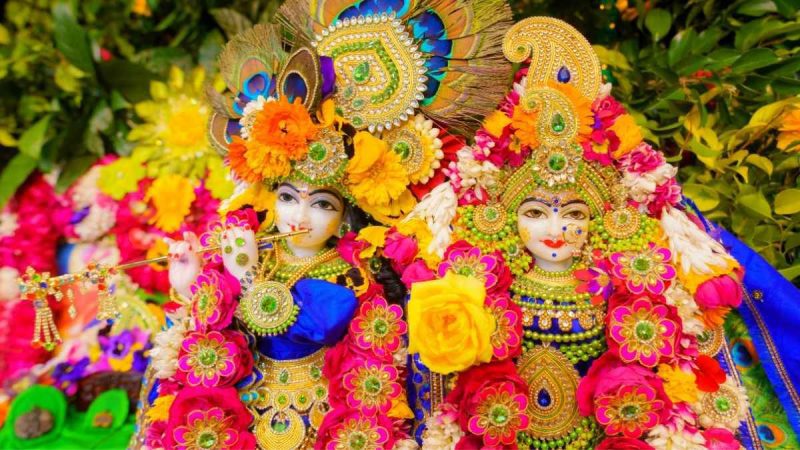
There are birthdays, and then there is Krishna’s birthday. Janmashtami is one of those festivals that refuses to fit into a single template. In one part of India, people spend the day fasting and wait for midnight prayers. In another, young men form human pyramids to smash a pot hanging several feet above the ground. Somewhere, tiny footprints are drawn across a freshly cleaned floor. Elsewhere, a temple prepares an enormous feast or an entire community stages stories from Krishna’s childhood. The common thread is Krishna, but the celebrations are purely local.
10 Janmashtami Traditions That Show How India Celebrates
1. Midnight Is When The Real Celebration Begins
Krishna did not exactly make an easy entrance into the world. According to Hindu tradition, he was born at midnight in a prison in Mathura, where his parents Devaki and Vasudeva were held captive by Kansa. That is why Janmashtami is more about staying awake until the clock approaches midnight.
Devotees gather in temples, sing bhajans and kirtans, listen to readings and wait for the moment believed to mark Krishna’s birth. At midnight, the infant Krishna’s idol is ceremonially bathed, dressed and placed in a cradle. Bells ring, conches blow and devotees offer prayers before breaking their fast. In Mathura and Vrindavan, the anticipation can become especially intense, with temples illuminated, decorated with flowers and packed with devotees.
Also Read: Janmashtami 2026: 8 Trips In India For An Unforgettable Midnight Celebration Of Lord Krishnas Birth
2. Some Families Literally Leave A Trail For Baby Krishna

One of the most charming Janmashtami customs requires no giant temple, elaborate procession or competitive athleticism. Just a little rice flour and some imagination. In many homes, tiny footprints are drawn from the entrance towards the puja room, symbolising baby Krishna walking into the house.
The footprints are deliberately small because the idea is not to depict the adult deity, but the mischievous little boy devotees imagine arriving home. It turns an everyday doorway into part of the celebration.
3. Dahi Handi Is Basically Krishna’s Childhood Mischief Turned Into A Sport
Krishna’s love for butter has given Indian festivals one of their most recognisable spectacles. In the Dahi Handi tradition, a pot containing curd, butter, milk and other offerings is suspended high above the ground. Groups of participants, popularly known as Govindas, form human pyramids to reach it and smash it.
The story behind the ritual comes from Krishna’s childhood, when he and his friends were said to have stolen butter and curd from pots kept out of reach. Today, particularly in Maharashtra, the tradition has grown into a huge public event, complete with teams, music, crowds and prize money. The pot is sometimes suspended at considerable heights, turning a childhood tale about stealing butter into a somewhat serious exercise in balance, coordination and teamwork.
Also Read: From Goa To Bali, Where Are Indians Heading For Rakshabandhan And Janmashtami Long Weekends?
4. Kerala Has Its Own Version Of The Pot-Breaking
If you thought Dahi Handi belonged exclusively to Maharashtra, Kerala has entered the chat. During Krishna Jayanti, known locally as Ashtami Rohini, Kerala celebrates Uriyadi, another pot-breaking game inspired by Krishna’s fondness for butter and ghee.
An earthen pot filled with offerings is suspended from a rope, and participants attempt to break it while people around them may splash water to make the task harder. In some versions, the player even has to deal with a blindfold.
5. Tamil Nadu Welcomes Krishna With Tiny Feet And Traditional Snacks
In Tamil Nadu, Krishna Jayanti, often called Gokulashtami, has a distinctly homely feel. Homes are decorated with kolams, devotional verses are recited, and little Krishna footprints may be drawn from the entrance towards the puja area. The footprints are especially significant because Krishna is imagined as a child entering the home.
Food is another major part of the celebration, with families preparing traditional offerings and festive snacks.
6. Krishna’s Birthday Can Come With A 56-Dish Menu
A birthday feast is mandatory in most Indian households. Krishna’s version simply takes the concept to another level. Chhappan Bhog, meaning an offering of 56 food items, is prepared for Krishna in several traditions. The spread can include sweets, savouries, fruits and dairy-based preparations, with butter getting an obvious place of honour because of Krishna’s famous childhood relationship with makhan.
At the Jagannath Temple in Puri, for example, the tradition of offering an elaborate variety of food is deeply embedded in temple worship.
7. Braj Turns The Entire Region Into A Krishna Storybook
Mathura and Vrindavan do not really “decorate for Janmashtami”. They transform themselves. Temples are covered in flowers and lights, streets are filled with devotees, and Krishna’s childhood stories appear through jhankis, processions, music and performances.
Mathura, traditionally regarded as Krishna’s birthplace, becomes the focus of midnight celebrations, while Vrindavan brings its own enormous devotional energy to the festival. The current Braj celebrations include bhajans, kirtans, Ras Leela performances, tableaux and special prayers, with major temples becoming centres of activity.
Also Read: Masik Krishna Janmashtami 2026: When Is It, Why It Matters & Rituals To Follow
8. Ras Leela Turns Mythology Into Live Theatre
Long before mythology became something you scrolled through on a screen, communities were performing it. Ras Leela and Krishna Leela bring episodes from Krishna’s life to the stage through music, dance, dialogue and elaborate costumes.
The tradition is particularly associated with the Mathura region, but forms of Krishna-centred performance are also important in places such as Manipur and Assam.
Instead of simply hearing about Krishna as a child, audiences watch actors recreate episodes from his life in front of them. It is devotional storytelling, but with costumes, choreography and an audience that already knows exactly what happens next.
9. In Kerala, Krishna’s Birthday Is Called Ashtami Rohini
Same Krishna, different calendar vocabulary. In Kerala, the festival is widely known as Ashtami Rohini, linking the eighth lunar day, Ashtami, with Rohini, the star associated with Krishna’s birth. Ashtami and Rohini coincide. The occasion is considered especially auspicious. Devotees may fast, stay awake through the night, chant hymns and make offerings, including fruit and butter. Children dressed as Krishna also appear in colourful processions, while temples conduct special ceremonies.
At Guruvayur, one of Kerala’s most important Krishna temples, Ashtami Rohini is among the major annual festivals. The name changes, the rituals have their regional accents, but the central celebration remains Krishna’s birth.
Also Read: 6 Different Ways In Which Janmashtami Is Celebrated Across India
10. In Aranmula, Krishna’s Birthday Comes With A Massive Feast
If there is one Janmashtami tradition that proves Indian festivals can turn devotion into an extraordinary food experience, it is the Ashtami Rohini Valla Sadya at Kerala’s Aranmula Parthasarathy Temple. On Krishna’s birthday, snake boats known as palliyodams arrive at the temple, and the boatmen participate in rituals before a grand vegetarian feast is served on banana leaves.
There is even a fascinating musical element; the boatmen sing Vanchi Paattu and traditionally call out for dishes during the feast.
And that is perhaps what makes Janmashtami so fascinating. India does not celebrate Krishna’s birthday in just one way because Krishna himself occupies so many different spaces in the cultural imagination: mischievous butter thief, beloved child, divine figure, dancer, musician, warrior and friend. So his birthday becomes whatever a community makes of it. A midnight prayer in Mathura, tiny footprints in a Tamil home, a human pyramid in Mumbai, Uriyadi in Kerala or a feast beside the Pamba River can all tell the same story. Different rituals, different regions, same birthday. And still, there is always room for one more sweet.
Cover Image Courtesy: universalnatureconnections/Canva Pro
FAQs
How is Janmashtami celebrated across India?
Janmashtami is celebrated through fasting, midnight prayers, temple rituals, Dahi Handi, devotional performances, tiny Krishna footprints, traditional food and regional festivities.
Why is Krishna’s birth celebrated at midnight?
According to Hindu tradition, Krishna was born at midnight in Mathura while his parents, Devaki and Vasudeva, were imprisoned by Kansa.
What is Dahi Handi?
Dahi Handi is a popular Krishna Janmashtami tradition in which groups form human pyramids to break a pot filled with curd, butter and other offerings.
What is Ashtami Rohini in Kerala?
Ashtami Rohini is the name widely used for Krishna’s birthday celebration in Kerala, referring to the eighth lunar day and the Rohini star associated with Krishna’s birth.