

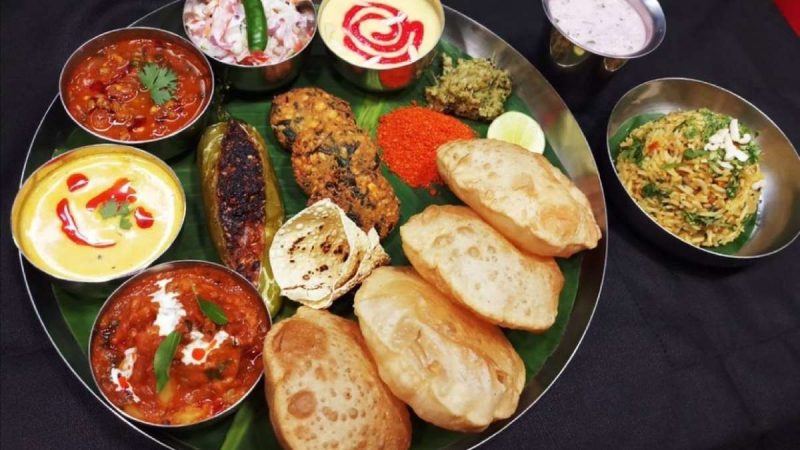
On Gudi Padwa morning, kitchens in Maharashtrian homes are the main juncture of celebration. Someone is grinding spices, another is stirring dal, and the smell of jaggery melting into warm lentils slowly fills the house. By the time the gudi, or the silk cloth and garlanded bamboo staff symbolising victory, is hoisted outside the door, the kitchen is already halfway through preparing the day’s most anticipated ritual— the festive thali!
Gudi Padwa Thali: Dishes Defining Maharashtrian New Year
A traditional Gudi Padwa meal rarely relies on one showstopper dish. Instead, it spreads itself across the plate; sweet beside spicy, and light beside heavy. Coconut, peanuts, jaggery, yoghurt, lentils, and seasonal vegetables all find a place here. Below are the dishes that often appear together on a traditional Gudi Padwa thali, each carrying its own flavour and story.
Sweets In Gudi Padwa Thali
1. Puran Poli

If there is one dish that claims the centre of a Gudi Padwa table, it’s Puran Poli. At first glance, it looks like a simple flatbread, but the magic sits inside. The filling, called puran, is made by cooking chana dal with jaggery, then blending it with cardamom and nutmeg until it forms a dense and fragrant mixture.
The flavour leans warm and mellow rather than too sugary.
Cooking Puran Poli is a small exercise in patience. The dal must soften completely before being mashed and simmered again with jaggery until thick enough to hold its shape. That mixture is tucked inside wheat dough, rolled carefully, and roasted on a hot griddle with ghee.
In Maharashtra, Puran Poli appears whenever the calendar calls for celebration on Holi, Ganesh Chaturthi, and especially Gudi Padwa, where sweetness is meant to mark the beginning of a prosperous year.
2. Shrikhand
Where Puran Poli is warm and comforting, Shrikhand is the opposite; it is cool, silky, and almost airy. It begins with yoghurt that has been hung in a cloth for several hours until the whey drains out, leaving behind a thick base known as chakka.
That yoghurt is whisked with powdered sugar, saffron, cardamom, and chopped pistachios or almonds. The result is creamy but never heavy.
Shrikhand carries a gentle tanginess from the yoghurt, which keeps the sweetness balanced.
This dessert has long belonged to western India’s dairy traditions, especially in Maharashtra and Gujarat, where strained yoghurt sweets evolved as a way to transform fresh milk into festive desserts suited for warm weather.
3. Coconut Karanji
Coconut Karanji is one of those festive sweets that people immediately recognise by shape alone. Each piece is folded into a half-moon, sealed along the edges, and fried until the outer pastry turns crisp and golden.
Inside sits a mixture of grated coconut, jaggery, cardamom, poppy seeds, and chopped dry fruits. When cooked, the coconut softens while the jaggery melts into a slightly caramel-like sweetness.
Stuffed pastries like karanji appear across India, but in Maharashtra, they have become firmly tied to festival cooking, often prepared in advance so guests can be offered sweets throughout the day.
4. Aamras
The arrival of Aamras signals something else besides the festival; it means mango season has begun. Made from ripe mango pulp, traditionally from Alphonso mangoes, Aamras celebrates the fruit without much interference.
Preparing Aamras hardly feels like cooking. Fresh mango pulp is whisked until smooth, adjusted with sugar if needed, and cooled before serving.
In Maharashtra and neighbouring Gujarat, Aamras often appears beside puri during festive meals; a pairing that likely developed when spring festivals coincided with the first mango harvests of the season.
Also Read: Tired Of Artificially Ripened Mangoes? This Startup Lets You Lease A Mango Tree!
Main Meal Staples In Gudi Padwa Thali
5. Puri And Batata Bhaji
Few combinations feel as instantly festive as Puri and Batata Bhaji. Puris, or small rounds of wheat dough fried until puffed, arrive hot, golden and unapologetically yummy! The bhaji beside them is a potato preparation cooked with mustard seeds, turmeric, curry leaves, onions, and green chillies.
The bhaji begins with a tempering of mustard seeds and curry leaves. Boiled potatoes are added, lightly mashed, and tossed with turmeric and chillies. Puris, meanwhile, puff dramatically in hot oil within seconds.
Also Read: Finally! Rameshwaram Cafe Opens In Mumbai With Dhol-Tasha; Timings, QSR, Dine-In & Deets Here!
6. Varan Bhat
Among richer dishes, Varan Bhat feels almost understated. It’s simply steamed rice served with a dal made from toor dal, turmeric, and ghee, occasionally brightened with lemon.
Cooking varan involves boiling toor dal until soft and whisking it smooth with turmeric before finishing with ghee. Spoon it over hot rice and it’s ready!
Despite its simplicity, Varan Bhat has deep cultural importance in Maharashtra. Many ceremonial meals begin with it because the dish is considered pure and auspicious.
7. Masale Bhat
Rice cooks alongside mixed vegetables, peanuts, grated coconut, whole spices, and goda masala to make the earthy Maharashtrian spice blend.
Goda masala brings roasted coconut notes, while peanuts add texture. Preparation begins with sautéing spices and vegetables before rice and masala are added to the pot.
Historically, Masale Bhat often appeared at community gatherings and temple feasts, where large batches could feed crowds.
Snacks & Side Dishes In Gudi Padwa Thali
8. Kothimbir Vadi
Kothimbir Vadi is built around an ingredient many kitchens have in abundance: fresh coriander leaves. The chopped herbs are mixed with gram flour, sesame seeds, ginger, green chillies, and spices to form a thick batter.
The result is a snack that smells strongly of coriander, with sesame adding a nutty undertone. Kothimbir Vadi likely began as a home kitchen improvisation, a clever way to use leftover herbs before evolving into a beloved Maharashtrian snack.
9. Sabudana Khichdi
Sabudana Khichdi looks simple but requires a careful hand. The dish uses soaked tapioca pearls, roasted peanuts, potatoes, cumin seeds, and green chillies.
When cooked correctly, the pearls turn translucent and separate rather than being sticky. The peanuts provide crunch while cumin and chilli offer gentle warmth. Preparing the dish starts with soaking sabudana until soft, then sautéing it with potatoes and spices.
Sabudana became common in western India’s fasting cuisine, eventually finding its way into festive spreads as well.
Also Read: Best Airplane Food I’ve Ever Had”: Air India’s Kachori Breakfast Impresses Influencer
10. Bharli Mirchi
Bharli Mirchi, or stuffed chillies, add a sharper note of flavour to the thali. Large green chillies are slit and filled with a mixture of coconut, peanuts, sesame seeds, jaggery, tamarind, and goda masala.
Once stuffed, the chillies cook slowly in a pan until softened and aromatic. Stuffed vegetable preparations like Bharli Mirchi have long shaped Maharashtrian home-style cooking, where ground nut mixtures are frequently used to build luxe flavour.
Also Read: Watch: To Save Gotham City, Even Batman Needs Pani Puri! Netizens Call Him “Pani Puri Paglu”
Cooling & Digestive Sides In Gudi Padwa Thali
11. Kakdi Chi Koshimbir
Kakdi chi Koshimbir is refreshingly straightforward! Cucumber, yoghurt, roasted peanuts, green chillies, and mustard seeds come together to form a salad that cuts through the richness of the meal. Preparation involves mixing chopped cucumber with yoghurt and finishing it with a quick mustard seed tempering.
In Maharashtrian meals, koshimbir salads play a practical role, as they bring freshness and balance to plates filled with heavier dishes.
12. Taak
A thali this elaborate usually ends with taak, or spiced buttermilk. Yoghurt is diluted with water and seasoned with roasted cumin powder, ginger, curry leaves, salt, and coriander. The drink feels light and cool. To prepare it, yoghurt is whisked with water until it turns smooth and is then flavoured with spices; some households also add a quick mustard seed tempering.
Across western India, taak has long been valued for its digestive qualities, making it the final, refreshing note after a celebratory Gudi Padwa meal.
Also Read: 12 Harvest Festivals Of India That Mark The Season Of Abundance & Celebrate Its Crops
So, which of these dishes excites you the most?
Cover Image Courtesy: csmia_official/X
For more such snackable content, interesting discoveries and the latest updates on food, travel and experiences in your city, download the Curly Tales App. Download HERE.FAQs
What dishes are traditionally served in a Gudi Padwa thali?
A traditional Gudi Padwa thali usually includes dishes like puran poli, shrikhand, aamras, sabudana khichdi, varan bhat, masale bhat, poori with batata bhaji, and kothimbir vadi, along with refreshing sides like taak and koshimbir.
Why is puran poli important during Gudi Padwa?
Puran poli is one of the most iconic Gudi Padwa sweet dishes, made with chana dal, jaggery, cardamom, and nutmeg stuffed inside a soft wheat flatbread.
What desserts are eaten during the Gudi Padwa festival?
Popular Gudi Padwa desserts include shrikhand, coconut karanji, puran poli, and aamras, which reflect the sweet beginning of the Maharashtrian New Year.