

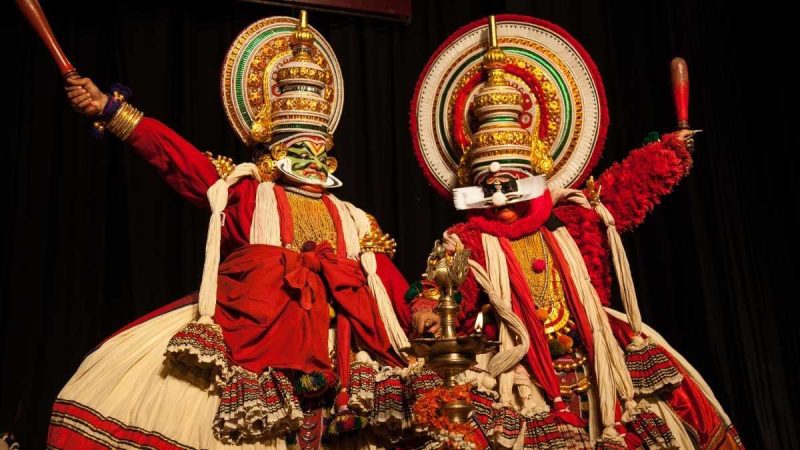
What if an entire state threw a ten-day celebration every year because its favourite king was coming home? That is, in its simplest form, the story of Onam. And no, this is not just a tale about a king returning from the netherworld. It is a story involving Lord Vishnu in one of his most fascinating avatars, a ruler whose popularity apparently made the gods nervous, an impossible three-step bargain, and a promise that turned an ancient myth into one of Kerala’s biggest cultural celebrations.
In 2026, Thiruvonam, the most important day of Onam, falls on August 26. The festival begins with Atham and unfolds over ten days in the Malayalam month of Chingam, traditionally associated with harvest, prosperity and the beginning of a new year. And yes, there will be flowers, kasavu, boat races and enough food to make the concept of portion control feel offensive.
The King Who Was Too Popular For His Own Good

Long before Onam became synonymous with Pookkalams and Sadya, there was Mahabali, also known as Maveli. According to the most popular Onam legend, Mahabali was an Asura king who ruled Kerala during a golden age. He was generous, powerful and, most importantly, loved by his people. There was, however, one small problem. Mahabali was becoming way too powerful.
The devas grew concerned about his influence and approached Lord Vishnu. Vishnu decided to intervene, but instead of arriving with thunderbolts and divine drama, he appeared as Vamana, a dwarf Brahmin. Mahabali was performing a yagna when Vamana approached him and asked for three paces of land. Three!
For a king with an entire kingdom at his disposal, it sounded almost absurdly easy. Mahabali agreed. Then Vamana grew into a cosmic form.
His first step covered the earth. His second covered the heavens. With nowhere left for the third, Mahabali realised what had happened. He bowed his head and offered himself as the final measure. Vishnu placed his foot on Mahabali’s head and sent him to Pathala, the netherworld. But Mahabali had not been forgotten.
Moved by his devotion and generosity, Vishnu granted him permission to return once every year and visit his people. That annual visit became Onam!
Also Read: Do You Know A Onam Sadya Meal Brings Shad-Rasa Or Six Tastes Together? Here’s How!
Kerala Basically Throws Him A Welcome-Home Party
This is where the mythology gets wonderfully literal. If Mahabali is coming home, you prepare the house. The ten-day celebration begins with Atham, when the first Pookkalam, or floral carpet, is created. As the days progress, the designs become increasingly elaborate, filling courtyards with flowers arranged in intricate patterns. By Thiruvonam, the entrance is ready for the king’s arrival.
There is something charmingly old-school about the idea. Just flowers on the floor saying, essentially, Maveli, we are ready for you.
Then There Is The Sadya, Which Deserves Its Own Story
If the Pookkalam is the welcome sign, the Onam Sadya is the grand banquet. Traditionally served on a banana leaf, the feast brings together an extraordinary range of vegetarian dishes, including avial, thoran, sambar, pachadi, pickles, pappadam and payasam. It is a celebration of abundance, and the meal is traditionally enjoyed together, often with family and community.
The genius of the Sadya is that it does not ask you to choose. Something creamy, spicy, tangy or oh-so-comforting? The banana leaf has already handled it.
Onam Is Also Kerala At Its Most Dramatic
The festival does not stay confined to homes.
Kerala’s waterways become arenas for Vallam Kali, the famous snake boat races, where long boats move to the rhythm of coordinated rowing and traditional chants. Streets come alive with Pulikali, in which performers painted as tigers dance to traditional percussion. Other celebrations feature folk dances, music, games and regional art forms.
At Thrikkakara, near Kochi, the connection to the Mahabali-Vamana story is particularly strong. The Vamana Moorthy Temple is closely associated with Onam celebrations, with a ten-day festival beginning on Atham and culminating on Thiruvonam.
Also Read: Onam Sadya: Why Is It Mandatory To Relish These Flavours With Our Hands?
But Onam Is Not Only About A Mythical King
Onam is also a harvest festival. It arrives after the monsoon-heavy month of Karkidakam and with Chingam, a period traditionally associated with prosperity and agricultural abundance.
So the festival carries two ideas at once. There is the mythical return of Mahabali, and there is the very real arrival of a season when the land has something to celebrate. That combination may explain why Onam feels so rooted in everyday life. It belongs equally to mythology, agriculture, food, family and community.
Also Read: Onam Sadya: 10 Ayurvedic Health Benefits Of Kerala’s Vegetarian Festive Meal
The Most Beautiful Part Of The Story Is The Waiting
The Mahabali story could easily have been remembered as a tale of defeat. A powerful king is challenged. His kingdom disappears. He is sent away. Instead, Kerala remembers him through his return.
Every year, homes are cleaned and decorated. The state essentially gets ready for the same guest to arrive all over again.
And that is the clever emotional trick at the centre of Onam. It is not really about remembering a king who lost his kingdom. It is about remembering a king who was loved enough for his people to keep a place for him.
Cover Image Courtesy: jai767/Canva Pro
FAQs
Why is Onam celebrated?
Onam is traditionally associated with the annual return of King Mahabali, a legendary ruler whose reign is remembered as a golden age of prosperity and equality.
Who was King Mahabali?
Mahabali, also known as Maveli, was a powerful and generous Asura king who is central to the traditional legend behind Onam.
Who is Vamana in the story of Onam?
Vamana is the dwarf Brahmin avatar of Lord Vishnu who approached Mahabali and asked for three paces of land.
What is the connection between Mahabali and Onam?
According to the traditional legend, Lord Vishnu allowed Mahabali to return once every year and visit his people. This annual homecoming is associated with the celebration of Onam.