

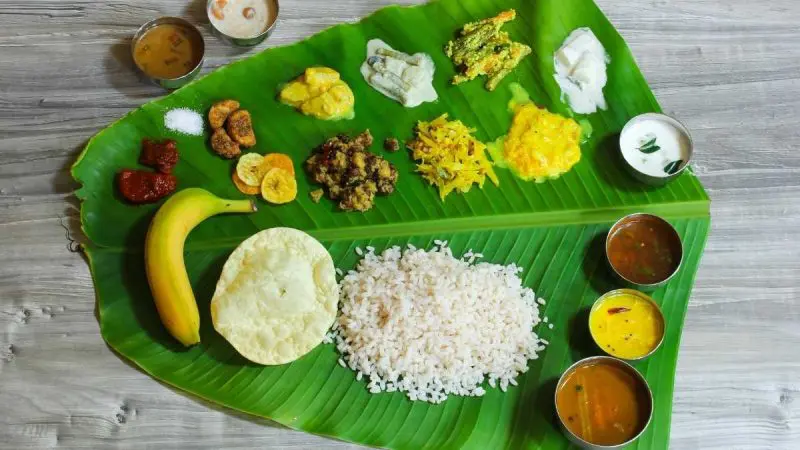
If your first Onam Sadya leaves you staring at a banana leaf as you have walked into a very delicious examination, relax. Nobody expects you to identify 20-plus dishes on sight. A traditional Sadya is an elaborate vegetarian feast served on a banana leaf, usually featuring rice, curries, vegetable preparations, pickles, crunchy accompaniments and desserts. Among the many dishes making an appearance, four names are especially useful for beginners to know: Avial, Thoran, Olan and Pachadi.
Avial To Pachadi: A Beginner’s Guide To The Onam Sadya
Avial: The Vegetable Medley You’ll Keep Coming Back To

Avial is one of those dishes that looks simple until you realise how much is happening in it. It is traditionally prepared with a mix of vegetables such as raw banana, yam, drumstick and carrots, although the combination can vary. The vegetables are cooked with coconut and green chilli and finished with coconut oil and curry leaves. The result is thick and wonderfully earthy, with each vegetable retaining enough personality to make the dish feel textured rather than mushy. Avial also has an interesting place in Kerala food history, with several stories attached to its origin, but on a Sadya leaf, its most obvious achievement is bringing an entire vegetable drawer together and somehow making it taste like it was planned that way.
Also Read: Onam & Raksha Bandhan Travel: 69% Rise In Kerala Hotel Bookings, Lucknow Air Bookings Soar 96%
Thoran: When Coconut Meets Crunch
Thoran is considerably easier to spot because it is a dry vegetable preparation rather than a gravy. Finely chopped vegetables are stir-fried with grated coconut, chilli, turmeric and the familiar tempering of curry leaves and mustard seeds. Cabbage, beans, carrot, beetroot and other vegetables can be used, depending on the recipe. Unlike the richer curries on the leaf, Thoran does not try to overwhelm you. It lets the vegetable do most of the talking, while the coconut adds a pleasant bite and nuttiness. It is also the dish you will appreciate when your banana leaf starts becoming a complicated geography of gravies, and you desperately need something that is not going to run into its neighbour.
Also Read: Onam Sadya: 10 Ayurvedic Health Benefits Of Kerala’s Vegetarian Festive Meal
Olan: Creamy And Easy To Miss
Olan is probably not the dish that will grab your attention first, and that is precisely its charm. Traditionally made with ash gourd and red gram cooked in coconut milk, it is delicate, lightly seasoned and far gentler than some of the sharper flavours elsewhere on the leaf. Olan works because it provides a softer note in a meal that can otherwise move rapidly between chilli, tamarind, yoghurt, coconut and spice. Give it a little rice, and you will understand why subtle food can hold its own in a feast this crowded.
Pachadi: The Sweet-Tangy Curveball
Pachadi brings a completely different mood to the meal. It is generally a yoghurt-based preparation made with fruits or vegetables, and pineapple Pachadi is a popular version. The combination of creamy yoghurt, sweet pineapple and spices gives it a distinctive sweet-and-sour personality. If you are new to Kerala cuisine, Pachadi can be confused with Kichadi because both are yoghurt-based accompaniments. They are not interchangeable, though. Kichadi is generally more savoury and spicy, while Pachadi can lean sweeter, particularly when fruit is involved. On the Sadya leaf, Pachadi is essentially there to make sure your meal never settles into one predictable flavour.
The Banana Leaf Has Its Own Logic
There is a reason a Sadya feels different from an ordinary thali. The banana leaf itself is part of the tradition, and the dishes are traditionally arranged in specific places rather than being thrown onto the leaf at random. The tapering end of the leaf generally points towards the diner’s left, while rice is served closer to the diner. The accompaniments usually arrive before the rice, and the meal progresses through different combinations, beginning with preparations such as Parippu and ghee and moving through Sambar and other courses.
Payasam eventually enters the picture, followed by later courses that can include Rasam and buttermilk. Exact serving practices can differ between households, communities and regions, so there is no need to treat one particular arrangement as the Sadya constitution.
Also Read: INSIDE Kerala’s 100-Year-Old Ayurvedic Banana Leaf Ritual
The Real Trick Is In The Combinations
The fun begins once you stop thinking of the dishes as isolated items. Avial can be mixed with rice for a creamy, vegetable-heavy bite. Thoran adds texture. Pachadi cuts through stronger flavours with its tangy sweetness, while Olan provides a mellow coconut-milk note.
Then come the Sambar, Parippu, Rasam, pickles and all the other accompaniments, each changing what the next mouthful tastes like. You are not expected to eat 20 dishes in 20 separate bites.
The Sadya encourages combinations, and the banana leaf gives you plenty of space to experiment without needing a plate with compartments. It is less about finding one “correct” bite and more about discovering which combination makes you pause halfway through chewing because, frankly, that was unexpectedly excellent.
Also Read: Kerala’s Karimeen Pollichathu Shines On TasteAtlas’ Top Seafood Dishes; What Makes It Special?
And that is probably the only Sadya rule a first-timer truly needs to remember; never underestimate how much space you need for dessert.
Cover Image Courtesy: vm2002/Canva Pro
FAQs
What are the four important dishes to know in an Onam Sadya?
Avial, Thoran, Olan and Pachadi are four popular Sadya preparations that are useful for anyone trying a traditional Kerala feast for the first time.
What is Avial made of?
Avial is generally made with mixed vegetables such as raw banana, yam, drumstick and carrots, cooked with coconut and green chilli and finished with coconut oil and curry leaves.