

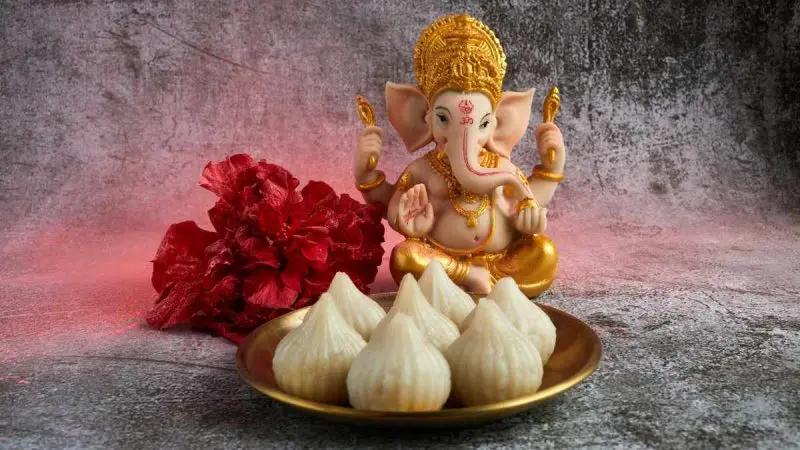
Every Ganesh Chaturthi, there is one very specific instruction that seems to travel from one generation to another: make modaks for Bappa, and make 21 of them. Not 20, not 22, and definitely not “however many are left after everyone in the kitchen has eaten two”. Twenty-one! But why? The answer is tucked inside one of the sweetest, and slightly hilarious, stories associated with Lord Ganesha.
Ganesh Chaturthi: It All Started With A Hungry Ganesha
According to a popular traditional story, Lord Shiva, Goddess Parvati and young Ganesha once visited Anusuya, the wife of sage Atri. Shiva was hungry and expected to be served, but Anusuya had a condition: she would first feed little Ganesha until he was completely satisfied. Only then would Shiva be served.
There was just one tiny problem. Ganesha was not getting full. Anusuya kept serving him food, but the little god continued eating. More food came and more disappeared. Shiva, meanwhile, was waiting for his meal. Finally, Anusuya realised that perhaps a sweet was what would do the trick. She gave Ganesha a modak.
And that did it. After eating it, Ganesha finally indicated that he was full with a loud burp. Lord Shiva is said to have burped 21 times, signalling that he too was completely satisfied. When Parvati learnt that the little sweet had finally managed to satisfy her son, she asked what it was.
The answer was Modak! And, according to this popular legend, Parvati then expressed the wish that devotees should offer 21 modaks to Ganesha. So, yes, one traditional explanation for that oddly specific number essentially comes down to 21 divine burps.
But 21 Means More Than Just “Shiva Burped 21 Times”
The burp story is the most popular explanation, but it isn’t the only way the number is understood. In Hindu ritual traditions, 21 is also associated with completeness. One traditional interpretation connects it with the different aspects that make up human existence: the five organs of perception, five organs of action, five vital energies, or pranas, five elements of nature and the mind. Together, these are counted as 21.
That gives the offering a much deeper meaning. The 21 modaks symbolically represent offering one’s whole self- body, senses, mind and life energies – to Ganesha. And the number doesn’t randomly appear only on the modak plate. Twenty-one durva blades are also traditionally offered to Ganesha, reinforcing the importance of the number in his worship.
Also Read: For First Time In 9 Years, Why Will Ganesh Chaturthi Be Celebrated For 12 Days?
And What Exactly Is A Modak?
The classic Maharashtrian ukadiche modak is made with a steamed rice-flour outer layer and a filling of coconut and jaggery, often flavoured with cardamom. Other parts of India have their own versions, including fried varieties and regional sweets known by different names.
The word modak is also associated with happiness and sweetness, which makes it a rather perfect offering for Ganesha, the deity devotees turn to before beginning something new and when asking for obstacles to be cleared.
Also Read: Nagpur’s Dakshinamurti Ganeshotsav Mandal: 107 Years Of Tradition And Legacy
So the next time you see those 21 perfectly arranged modaks in front of Bappa, remember, you’re looking at a tradition carrying several layers of meaning, a legendary feast, Shiva’s 21 legendary burps, a symbol of completeness and, most importantly, an offering made with devotion.
Cover Image Courtesy: vetrestudio/Canva Pro
FAQs
Why are 21 modaks offered to Lord Ganesha?
A popular legend connects 21 modaks to the story of Ganesha’s appetite and Lord Shiva’s 21 burps after Ganesha finally felt full.
What is the story behind Ganesha and the 21 modaks?
According to the legend, Ganesha was finally satisfied after eating a modak. Shiva then burped 21 times, which became linked to the tradition of offering 21 modaks.
What does the number 21 mean in Ganesha worship?
Traditionally, 21 is associated with completeness and is said to represent the body, senses, mind, vital energies and elements that make up human existence.
What is an ukadiche modak made of?
Ukadiche modak is made with a steamed rice-flour covering and a sweet filling of coconut and jaggery, usually flavoured with cardamom.