

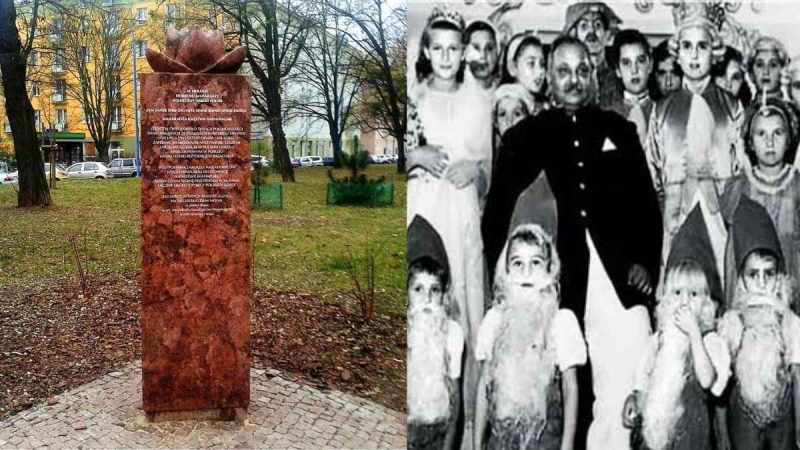
History seldom places Poland and Gujarat in the same sentence. By the time a group of poor children reached India in 1942, they had already survived what most adults would struggle to comprehend. Their journey had begun years earlier in Poland, a country crushed between two invading powers when Nazi Germany attacked from the west and the Soviet Union from the east in September 1939. Wonder how this led to a glorious Good Maharaja Square in Poland? Here’s the tale!
The Story Behind The Good Maharaja Square In Poland
Entire families were uprooted overnight. Hundreds of thousands of Polish citizens were packed into trains and deported to Siberia and remote Soviet territories. Hunger became common, and so did grief. Many parents never made it out.
Children watched disease, starvation, brutal winters, and forced labour tear families apart. Some lost both parents, others lost one and spent years wondering what had happened to the other. They were too young to understand geopolitics, but old enough to understand loss.
When Germany invaded the Soviet Union in 1941, alliances changed, and thousands of Polish civilians were finally allowed to leave Soviet territory. A desperate exodus began. Through Kazakhstan and Central Asia, across harsh landscapes and unknown borders, Polish refugees made their way towards Persia, present-day Iran. Among them were hundreds of children who were exhausted, malnourished, traumatised, and effectively stateless!
The world was at war. Countries were overwhelmed and few were willing to take responsibility for refugees. One man was!
Thousands of kilometres away, Digvijaysinhji Ranjitsinhji Jadeja, the Maharaja of Nawanagar in present-day Gujarat, heard about the children. The ruler, who had succeeded the famous cricketer Maharaja Ranjitsinhji and served as one of India’s most respected princely leaders during the war years, decided that the children would not be left to fend for themselves.
Near the coastal town of Jamnagar, he established a settlement at Balachadi for hundreds of Polish refugee children. Survivors would later recall a sentence that stayed with them for the rest of their lives. The Maharaja reportedly told them, “You are no longer orphans. You are now Nawanagaris.”
The settlement, which came to be known as Little Poland in India, offered food, clothing, healthcare, education, and safety. And wait, that’s not even the most wholesome and heartwarming part of the story; Balachadi was determined to preserve the children’s identity.
How Gujarat Became A Safe Haven For Polish Kids
Polish teachers taught classes in their native language. Libraries stocked Polish books and religious and cultural traditions continued there as is.
The Maharaja did not remain a distant benefactor. He visited frequently, attended events, spoke with the children, and became a reassuring presence in their lives. Many began calling him “Bapu” or father.
The camp moved like this throughout the war years. Later, some refugees moved to larger Polish settlements elsewhere in India, including Valivade near Kolhapur. After the war, many eventually settled in countries such as the United Kingdom, Australia, Canada, the United States, and Poland itself. Yet decades later, memories of Balachadi remained vivid.
The children grew up. They became teachers, engineers, parents, grandparents. But they never forgot the Indian ruler who welcomed them when they had nowhere else to go.
Poland certainly did not forget either. Today, schools bear his name, and yes, a square in Warsaw honours his memory. In 2011, he was posthumously awarded the Commander’s Cross of the Order of Merit of the Republic of Poland. Documentaries such as A Little Poland in India continue to tell the story to new generations.
Also Read: Did You Know Vindaloo Was Portuguese Vinha d’Alhos Before Goan Spices Changed It?
It is a story that proves that, at times, the most enduring acts of courage are not carried out on battlefields, but in the simple decision to open a door and say, “You are welcome here.”
Cover Image Courtesy: glitchy_shine/X and interestingasfuck/Reddit
FAQs
What was Little Poland in India?
Little Poland in India was a refugee settlement established at Balachadi near Jamnagar, Gujarat, where hundreds of Polish children found shelter during World War II.
Who was Maharaja Digvijaysinhji Jadeja?
Maharaja Digvijaysinhji Ranjitsinhji Jadeja was the ruler of Nawanagar in present-day Gujarat who provided refuge, food, education and care to Polish children displaced during World War II.
Why did Polish refugees come to India during World War II?
One of the most famous Polish refugee settlements was located in Balachadi near Jamnagar in Gujarat. Later, many refugees also moved to Valivade near Kolhapur in Maharashtra.
What honours did Poland give Maharaja Digvijaysinhji?
In 2011, Maharaja Digvijaysinhji was posthumously awarded the Commander's Cross of the Order of Merit of the Republic of Poland for his humanitarian contributions.