

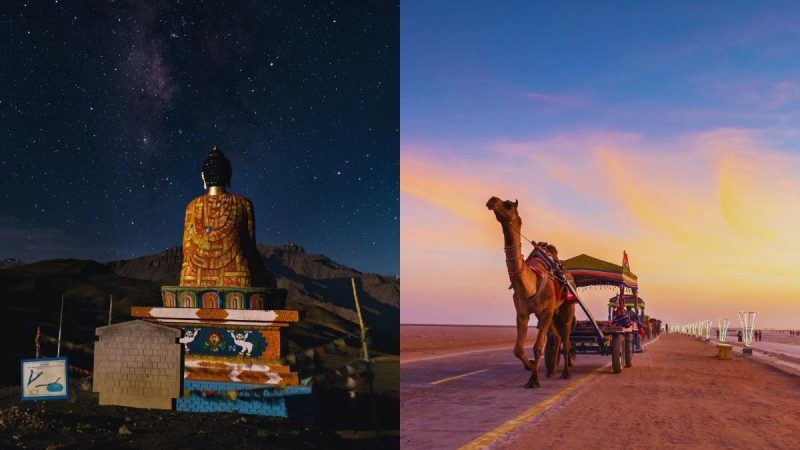
Some landscapes demand a certain season, and India’s deserts fall squarely into that category. Visit them in May, and you’ll probably swear never to travel again; visit them in winter, and you’ll wonder why you didn’t come sooner. The heat backs off, the skies clear out, and suddenly these rugged places feel welcoming and almost theatrical. Below are five desert destinations that come alive only when the temperature drops, each with its own kind of winter personality.
5 Must-Visit Desert Destinations In India That Slap In Winter
1. White Rann of Kutch, Gujarat

The easiest way to understand the White Rann is to imagine a landscape made of salt instead of sand. In winter, that salt turns icy white, and under the moonlight it practically glows. No photograph prepares you for this; your eyes struggle to decide whether they’re looking at land or some enormous silver sheet.
This is also the only season when village life around Kutch becomes colourful and loud. The Rann Utsav takes over the region, and suddenly you’re surrounded by dhol beats, tie-dye fabrics, copper bells, camel carts, and food stalls selling everything from bajra rotla to hot malpuas. Wandering through artisan villages like Bhujodi and Nirona, you see looms, potters, and copper bell makers, and you actually understand why “handicraft hub” isn’t just a brochure phrase here. And because the weather finally allows it, you can drive up to Kala Dungar, the highest point in the district, for a sweeping view of the salt flats.
Also Read: 10 Indian Destinations That Look Better In Winter Than Summer
2. Thar Desert, Rajasthan
The Thar in summer is unforgiving; the Thar in winter feels almost cinematic. You can finally walk on the sand without burning your feet, sit on a camel without feeling faint, and watch the sun slide behind dunes without desperately searching for shade.
What winter unlocks here is time, time to explore Jaisalmer’s narrow lanes, the ancient havelis with their over-carved balconies, and the desert villages that sit miles away from the touristy centres. Activities like dune bashing, camel safaris, and desert camping actually become enjoyable once the heat steps down. In places like Osian and Khimsar, you stumble onto smaller communities that practise traditional crafts or herding, and you see the quieter side of the desert most people miss.
The season also happens to coincide with the Jaisalmer Desert Festival, which is honestly what it sounds like: music, costumes, camel races, and an energy that makes the cold evening air feel warmer.
Also Read: Is It A Rajasthani Palace? An Ancient Fort? No, It’s The Billionaire Udaipur Wedding Cake!
3. Nubra Valley, Ladakh
Nubra always looks like two worlds stitched together, Himalayan peaks on one side and sand dunes on the other. In winter, that contrast sharpens. Frost settles on the dunes near Hunder, the sky turns a deep, varnished blue, and the cold desert air bites in a way that somehow feels invigorating rather than harsh.
The double-humped Bactrian camels, remnants of the old Silk Route, look unexpectedly elegant against this backdrop. You won’t find crowds this time of year, which means you can wander through Diskit Monastery, explore Turtuk’s apricot orchards (now leafless, but still beautiful), and sit by the river listening to the wind roll through the valley. There’s a sense of quiet here in winter that no other season provides.
The only thing to keep an eye on is the Khardung La Pass, the gateway to Nubra. When the road is open and safe, which often depends on snowfall, you get to experience the valley in its purest and slowest rhythm.
4. Spiti Valley, Himachal Pradesh
Spiti’s winter is not a gentle suggestion; it’s a full takeover. When snow spreads across the villages of Kibber, Langza, and Kaza, the valley feels like a world that has paused. The locals retreat indoors, monasteries stay warm with butter lamps, and the landscape turns into something you’d expect in a graphic novel.
This is also the season when the elusive snow leopard becomes active in the higher ridges. Wildlife trackers often camp in the cold for days, hoping for a sighting. Even without wildlife, winter in Spiti has its own charm: frozen waterfalls, frozen rivers, frozen everything. But behind this stillness is a strong sense of community. If you stay in a homestay, you’ll see families gathering around a single bukhari (wood stove), sharing stories as they wait for water to boil in a room that’s slightly warmer than the outdoors.
The roads are unpredictable thanks to snowfall, so reaching Spiti in winter is not the typical tourist holiday, it’s more of a raw, immersive experience that rewards anyone who isn’t afraid of cold toes.
Also Read: Himachal Pradesh Monsoon Fury: 386 Dead, Over 8,000 Homes Damaged, And Thousands Of Villages Cut Off
5. Jaisalmer & the Sam Sand Dunes, Rajasthan
Although technically part of the Thar, the Sam Sand Dunes deserve their own space because they offer the desert picture people carry in their minds: tall, curving dunes that look golden in the afternoon and almost bronze at sunset.
Winter here is a season of stories. The nights get just cold enough for blankets and bonfires, the folk musicians tune their instruments by lantern light, and the camps glow softly against the dark sky. Stargazing is unexpectedly beautiful, no humidity, almost no cloud cover, and crisp desert air mean you can actually see the Milky Way.
The nearby Desert National Park also becomes lively with migratory birds, especially around the Gadsisar region. And because the weather is forgiving, you can enjoy long camel rides, jeep safaris, or simply climb a dune and sit there until the wind erases your footprints.
Also Read: Jaipur Vs Udaipur: Which Royal City In Rajasthan Should You Choose To Visit This Winter?
Winter does more than make these places bearable, it makes them meaningful. You’re not just escaping heat; you’re stepping into the version of the desert that locals themselves prefer. You get festivals, better wildlife sightings, night skies polished clean, and landscapes that feel larger than they do in any other season.
If deserts are about emptiness, winter is the season that fills that emptiness with texture, colour, and just the right amount of chill.
Cover Image Courtesy: schita/CanvaPro and harinipanda/CanvaPro
For more such snackable content, interesting discoveries and the latest updates on food, travel and experiences in your city, download the Curly Tales App. Download HERE.