

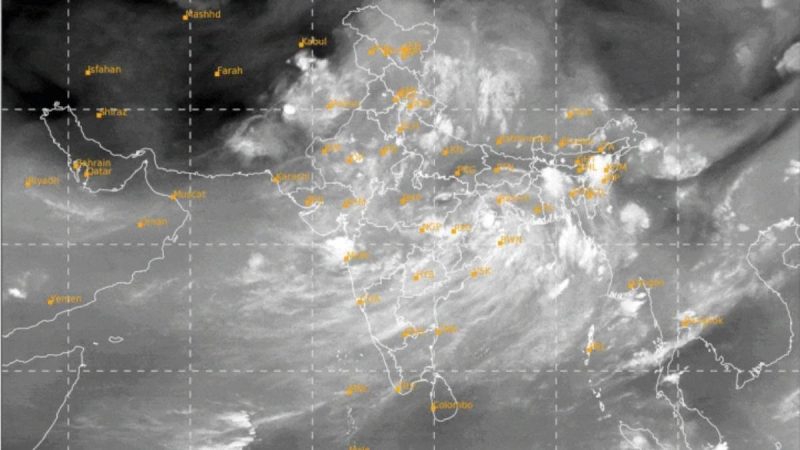
After a short pause, the southwest monsoon has become active once again, with the India Meteorological Department (IMD) predicting widespread rainfall across several parts of the country over the next few days. Fresh satellite images shared by the IMD show heavy cloud cover spread across almost the entire Indian subcontinent. Read on to know more.
IMD Predicts Heavy Rainfall Across India
As per a report by NDTV, the images were captured by ISRO’s INSAT-3DS weather satellite on July 22, 2026, between 3 pm and 3.27 pm IST. According to the IMD, active monsoon weather patterns are likely to continue over the northwest, central and neighbouring north peninsular India, as well as eastern and northeastern regions, for the next three to four days.
The thermal infrared imagery shows a broad band of clouds extending from the north Bay of Bengal across Odisha, Chhattisgarh and Madhya Pradesh before crossing Gujarat and the Arabian Sea. The IMD clarified that different cloud types appear differently on satellite images based on their density and composition. The dense thunderstorm clouds, known as cumulonimbus, appear brightest, while thinner high-altitude clouds look comparatively darker.
Also Read: What Is Delhi-Dehradun Expressway Wildlife Corridor & How Does It Help Animals?
High Alert From July 22 to 24 In Several Parts
As per the news portal, the weather department has forecast heavy to very heavy rainfall from July 22 to July 24, with extremely heavy rain expected at remote places in Jammu and Kashmir, Ladakh, southwest Madhya Pradesh, southeast Rajasthan, Konkan and Goa.
The southwest monsoon is India’s primary rainy season, contributing nearly 75% of the country’s annual rainfall. It plays a significant role in agriculture, drinking water supply and hydropower generation. A healthy monsoon is especially important for kharif crops such as rice, cotton and sugarcane, while any long-term disruption can affect food production and rural livelihoods.
Also Read: Pune To Bengaluru In 7 Hours? New Expressway Project Moves Closer To Approval
In view of the expected rainfall, the IMD has also issued advisories for farmers. Growers in Jammu and Kashmir have been advised to postpone the sowing of kharif pulses such as green gram and black gram until weather conditions get better. Similar advice has been issued for farmers in Punjab, while cultivators across several states have been asked to maintain proper field drainage in crops such as rice, maize, soybean, pigeon pea and groundnut, along with fruit orchards, to minimise waterlogging and crop damage.
What are your thoughts about this?
Cover Image Courtesy: Website/IMD
FAQs
Who established ISRO in India?
The Indian Space Research Organisation (ISRO) was established on August 15, 1969, by the visionary scientist Dr. Vikram Sarabhai.