
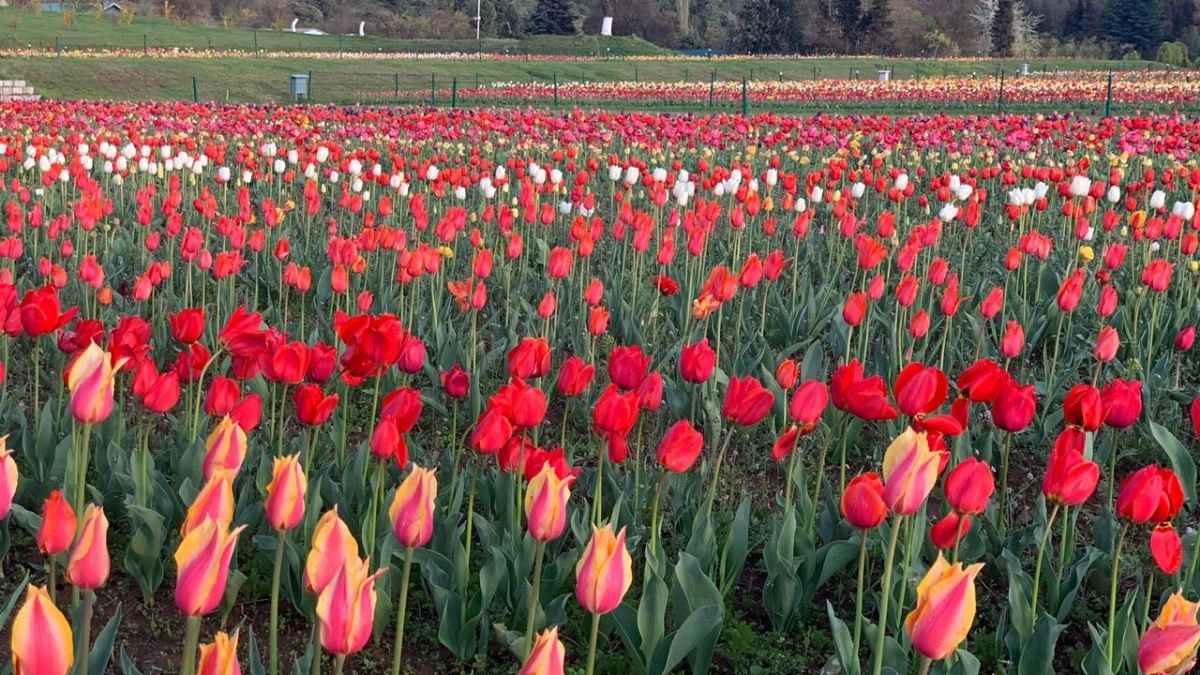



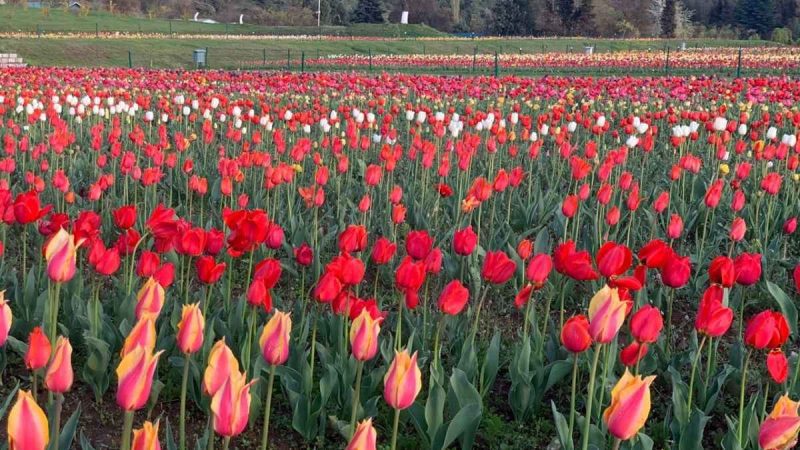
Tulips are supposed to wait for spring. In Kashmir, they usually do. But this winter, inside a carefully controlled research space at SKUAST’s Shalimar campus, the flowers didn’t follow the calendar.
Kashmir Scientists Achieve First-Ever Winter Tulip Bloom
According to The New Indian Express, for the first time in the Valley, scientists have successfully induced tulips to bloom in December, months ahead of their natural season, using advanced horticultural methods that could reshape Kashmir’s floriculture economy.
The breakthrough was achieved by researchers at the Sher-i-Kashmir University of Agricultural Sciences and Technology (SKUAST-K), who managed to trigger flowering through a process known as bulb programming and forcing, techniques widely used in countries like the Netherlands but never before implemented in Kashmir at this level.
Prof. Imtiyaz Nazki, Head of SKUAST’s Floriculture Department, said the experiment was designed as an early trial to see whether locally grown tulip bulbs could be manipulated for off-season flowering.
Nazki explained that there is a scientific process called bulb programming, which ensures that bulbs grow out of season, The New Indian Express reported. He further added that the team had timed the flowering deliberately around Christmas and New Year.
Out of nearly 5,000 tulip bulbs across five varieties, around 70 to 75% bloomed successfully under winter conditions. Some bulbs experienced flower abortion, an issue Nazki acknowledged, but the overall response marked what researchers are calling a significant first-year success.
Also Read: Assamese Til Pitha To Kashmiri Apple Cake: Inside President’s ‘At Home’ Reception Menu
All You Need To Know About This Bloom
The process itself is meticulous and infrastructure-heavy. Bulbs are kept inside temperature-regulated programming chambers for 12 to 18 weeks, sometimes stretching up to 20 weeks, where they are exposed to precisely calibrated environmental cues.
As per The New Indian Express reports, once the programming phase ends, the bulbs are shifted into greenhouses maintained at 18 to 20 degrees Celsius, where flowering begins within roughly 20 days.
The tulip bulbs used in the trial were fourth and fifth-generation stock originally sourced from Holland and later grown in Kashmir, a detail that strengthens the case for scaling the experiment locally.
Beyond the scientific milestone, the implications are commercial too.
Tulips are traditionally tied to spring, drawing crowds to Srinagar’s famous Tulip Garden in March and April. But winter flowering opens a different market window entirely, one that includes Christmas, New Year, Valentine’s Day, and other high-demand occasions when flower prices peak.
Nazki noted that while bulb programming is routine in Holland due to advanced infrastructure, Kashmir is only beginning the journey.
He believes this will be a gradual process for Kashmir but mentioned that this experiment shows that the potential exists to scale up and target different occasions and markets in the future, as stated by The New Indian Express.
Also Read: Delhi Teen Packs Snow From Kashmir; Charges ₹20 To Let People Touch It
If developed further, the technique could extend Kashmir’s floriculture season beyond its usual spring burst and offer growers, exporters, and even tourism planners something new: tulips in the Valley when nobody expects them.
Cover Image Courtesy: airnewsalerts/x
For more such snackable content, interesting discoveries and the latest updates on food, travel and experiences in your city, download the Curly Tales App. Download HERE. First Published: February 11, 2026 2:30 PM