



The newest episode of Sunday Brunch chooses a more devotional rhythm. Instead of a restaurant first, the camera follows Kamiya Jani, our editor-in-chief, and sitarist Rishab Rikhiram Sharma up the 108 stone steps of Babulnath Temple, a number that, in Hindu philosophy, represents spiritual completion.
Why Did Rishab Rikhiram Sharma Climb 108 Steps At Babulnath Temple?
Inside the temple, the energy changes. Rishab settles with his sitar and begins a Shiv Kailash bhajan. It was an absolute delight to the ears. Before entering the sanctum, Rishab pauses at the mandir ghanti. He doesn’t treat it as a ritualistic prop, but explains it as preparation. The bell, he says, is not noise, it recalibrates the mind. It clears what he calls “aura” before you step inside.
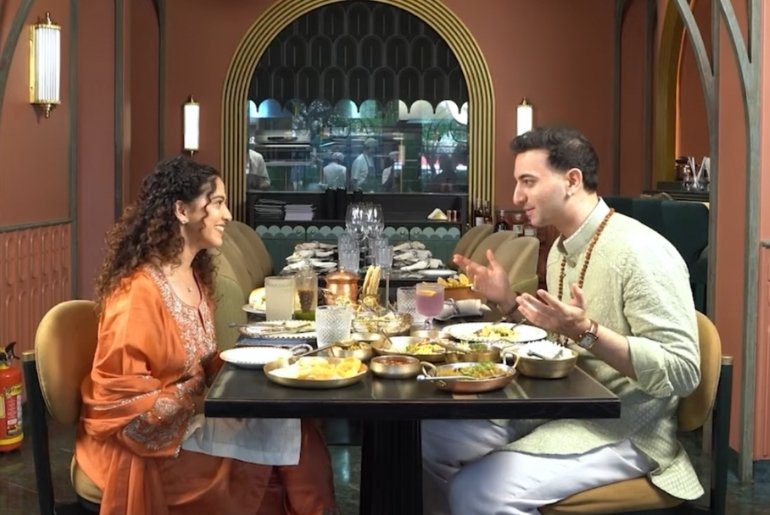
From Babulnath, the duo move to Nksha Restaurant for brunch, and the table arrives with unapologetic abundance. There’s Chur Chur Naan, Golgappe that crack decisively, Palak Patta Chaat layered with chutneys, Dal Makhani with the depth it demands, Hara Bhara Kebab, Paneer Tikka and more.
Rishab speaks about inheritance, not financial, but musical. He grew up in a home where maestros would say, almost casually, “Yeh sargam utha lo, yeh raag utha lo.”
For a child, that wasn’t instruction; it was atmosphere. He didn’t discover music later in life, he absorbed it before he could intellectualise it, and perhaps that’s the beauty of it.
Also Read: Rashmika Mandanna & Vijay Deverakonda Announce Sweet Distributions & To Offer Food At Temples
Views On Sitar & Love
He acknowledges something else with refreshing candour, that the sitar’s global journey hasn’t been linear. Its last seismic international wave came in the 1960s. He never predicted another, yet today, he performs across continents, in concert halls far removed from temple courtyards.
When the conversation deepens, he speaks about sound itself. He describes it as a divine endowment or a gift of god. When he performs devotional music, he doesn’t see it as a presentation; he sees it as a return, offering creation back to its source.
After concerts, people approach him with stories they don’t share lightly. They tell him his music saved their lives; this kind of power is truly something rare. Then comes a question that shifts the register entirely, romance!
Rishab doesn’t romanticise the answer. When he commits, he commits fully, or goes “all in,” as he puts it. But at this point in his life, he recognises his limitations. He cannot promise someone a hundred percent if his art already demands it. So he chooses focus, not because love is fleeting, but because half-presence feels dishonest.
Also Read: Breathtaking! Viral Video Shows BAPS Akshardham Temple Wrapped In Snow Like A Winter Dream
What stays after this episode isn’t just the temple visuals or the indulgent spread, it’s the tension between stillness and ambition, between inheritance and individuality and between devotion and desire.
Cover Image Courtesy: Internal
For more such snackable content, interesting discoveries and the latest updates on food, travel and experiences in your city, download the Curly Tales App. Download HERE. First Published: March 03, 2026 1:10 PMFAQs
Who is Rishab Rikhiram Sharma?
Rishab Rikhiram Sharma is an Indian sitarist known for blending classical music with contemporary global stages. He comes from a rich musical lineage and has performed devotional as well as international concert music across continents.
Which temple did Rishab Rikhiram Sharma visit on Sunday Brunch with Curly Tales?
He visited Babulnath Temple in Mumbai, climbing its symbolic 108 steps before performing a Shiv Kailash bhajan inside the temple premises.
What is the significance of the 108 steps at Babulnath Temple?
In Hindu philosophy, the number 108 represents spiritual completion and cosmic alignment. Climbing 108 steps symbolises a journey toward spiritual fulfilment.