
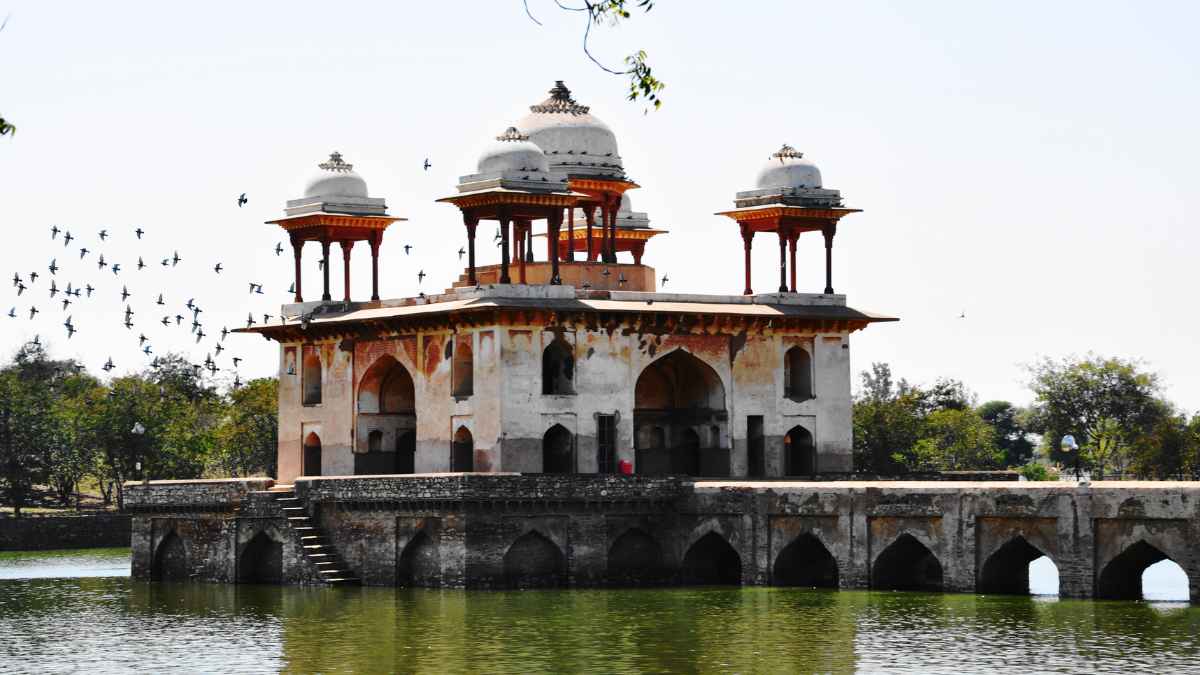

After remaining dry for nearly a decade, Narnaul’s historic Jal Mahal has once again been surrounded by water, restoring a key feature of the 16th-century monument’s original landscape. The revival is also expected to support Haryana’s plans to develop Narnaul as a prominent heritage and cultural tourism destination. Scroll down to know more.
Historic Jal Mahal Gets Restored By Water Nearly After A Decade
As per a report by the Hindustan Times, the restoration was carried out jointly by the Buildings and Roads (B&R) and Irrigation departments of the Haryana Government. Major work began in 2023-24 and was completed last year at an estimated cost of ₹70 lakh. The restoration included reviving the water channels, improving the surrounding infrastructure and constructing protection and boundary walls around the reservoir. The water body has now been filled to a depth of around five feet using nearly 170 million litres of water, sourced from rainwater and an irrigation canal.
Mahendragarh Deputy Commissioner Anupama Anjali told the portal that the revival would help strengthen Narnaul’s position as a heritage destination. The administration is also exploring the possibility of organising evening musical performances and cultural programmes at the monument, subject to the required approvals and conservation guidelines.
Built in 1591 AD, Jal Mahal was commissioned by Nawab Shah Quli Khan, the governor of Narnaul during the reign of Mughal emperor Akbar. Designed as a royal pleasure pavilion surrounded by water, the monument is now a Monument of National Importance protected by the Archaeological Survey of India (ASI). The reservoir was also an important part of the region’s traditional water-management system, with monsoon runoff channelled through natural slopes into the central basin.
Also Read: 8 Heritage Destinations To Visit In Kochi, Kerala | Curly Tales
Revival Could Boost Narnaul’s Heritage Tourism
Archaeologist Dr Banani Bhattacharyya, Program Manager at Haryana Heritage Museum, said restoring the water body was significant because Jal Mahal represents the historic relationship between architecture, water management and Narnaul’s cultural landscape. She told that the revived site could support heritage walks, traditional performances and educational programmes, provided these activities follow scientific conservation and visitor-management practices. Narnaul is home to nearly 16 state- and centrally protected monuments, including havelis, baolis, palaces and other water structures. According to Bhattacharyya, these sites could eventually form a wider heritage and water-heritage circuit.
The monument itself features a 16-arched-bay causeway, an ornamental northern gateway, a square central hall, corner chambers, a large octagonal dome and semi-circular cupolas. Officials have stressed that maintaining the restored water body will be as important as bringing it back. Future monitoring will focus on structural stability, water quality, seepage, vegetation and visitor impact.
The administration has also urged visitors to maintain cleanliness, follow safety guidelines and keep a safe distance from the water while treating Jal Mahal as a protected national heritage site.
Have you ever visited the Jal Mahal?
Cover Image Courtesy: Wikimedia Commons
FAQs
Who built Jal Mahal in Narnaul?
The Jal Mahal in Narnaul, Haryana, was built in 1591 AD by Shah Quli Khan, the Mughal governor of Narnaul and a prominent military commander under Emperor Akbar.
What is the story behind Jal Mahal?
Jal Mahal, or the Water Palace, sits in the middle of Man Sagar Lake in Jaipur, Rajasthan.
Why can't we go inside Jal Mahal?
You cannot go inside Jal Mahal in Jaipur because entry is banned by the government to protect the fragile heritage structure, prevent accidents on the water, and manage ongoing legal and conservation restrictions.


