

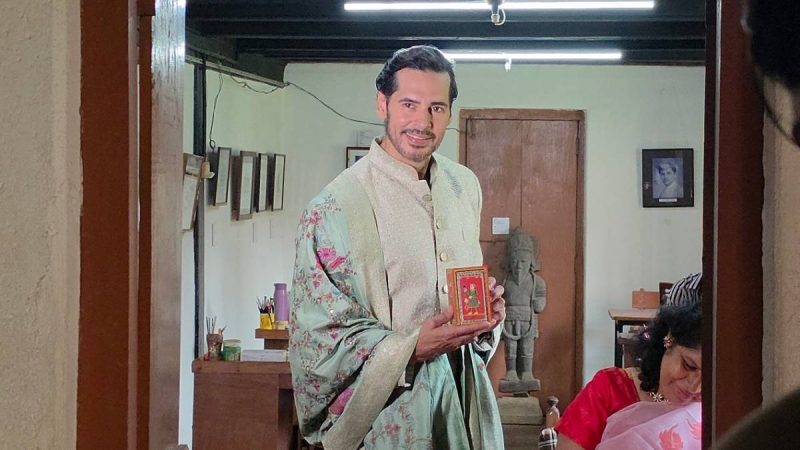
It is easy to get distracted inside Sawantwadi Palace. In our latest Palaces in India episode, we witness royal thrones command attention, the hunting trophies sway conversation, and the centuries-old halls carry the regal power of Maratha history. Then, tucked away among these larger-than-life reminders of royalty, sits something modest: a set of beautifully hand-painted circular cards. They are called Ganjifa!
How Sawantwadi Palace Gave Ganjifa Its Own Royal Identity
At first glance, they look like miniature paintings. Look closer, and you realise they hold the story of an art form that has travelled across continents, thrived in changing empires and, against all odds, continues to live on inside one of Maharashtra’s last inhabited royal palaces.
The word ‘Ganjifa’ comes from the Persian word ‘Ganj’, meaning treasure or khazana. The game made its way to India from Persia along with the Mughals. So yes, it began as a courtly pastime in imperial circles and gradually found new homes in royal kingdoms across the country. Every region left its own imprint on the game, turning it into something that reflected local traditions rather than simply preserving its Persian origins.
Sawantwadi Palace did that, with oh-so-stunning accuracy.
Dashavatar Ganjifa: Lord Vishnu’s Ten Incarnations On Circular Cards
During Curly Tales’ exclusive tour, Rani Sahiba Shubhada Devi Sawant Bhonsle introduced the palace’s prized Dashavatar Ganjifa collection. Instead of kings, queens or playing suits, these cards revolve around the ten incarnations of Lord Vishnu, transforming a royal game into a moving canvas of Hindu mythology.
The deck features Matsya, the fish who rescued life from the great flood; Kurma, the tortoise who steadied the mountain during the churning of the ocean; Varaha, the mighty boar who lifted the Earth from the cosmic waters; Narasimha, the fierce half-man, half-lion who defeated the tyrant Hiranyakashipu; Vamana, the dwarf who humbled the powerful king Bali with three measured steps; Parashurama, the axe-wielding warrior who fought arrogance and injustice; Rama, the embodiment of righteousness and duty; Krishna, whose wisdom continues to guide millions through the Bhagavad Gita; Buddha, who represents compassion, peace and enlightenment; and finally Kalki, the prophesied tenth avatar who is believed to appear at the end of the present age to restore balance and righteousness.
That is what makes Sawantwadi’s Ganjifa tradition so special. It refuses to exist merely as an object displayed inside a glass cabinet. The palace continues to preserve it as a living part of its regal heritage, reminding visitors that some of India’s richest stories were never written in books or carved into monuments. Sometimes, they were painted carefully by hand onto a deck of circular cards.
Watch the full Palaces in India episode for a fresh taste of regality, only on Curly Tales App and Curly Tales YouTube Channel.
Cover Image Courtesy: Internal
FAQs
What is Ganjifa?
Ganjifa is a traditional hand-painted card game that originated in Persia and later became popular in India, where different regions developed their own unique styles.
What is Dashavatar Ganjifa?
Dashavatar Ganjifa is a unique version of the game in which the cards depict the ten incarnations of Lord Vishnu instead of conventional playing suits.
Why is Sawantwadi Palace famous for Ganjifa?
Sawantwadi Palace has preserved the Dashavatar Ganjifa tradition for generations, making it one of the few places where this royal art continues to thrive.
Is Sawantwadi Palace open to visitors?
Yes. Visitors can explore sections of Sawantwadi Palace, admire its royal collections, and learn about traditions such as the famous Dashavatar Ganjifa cards.