
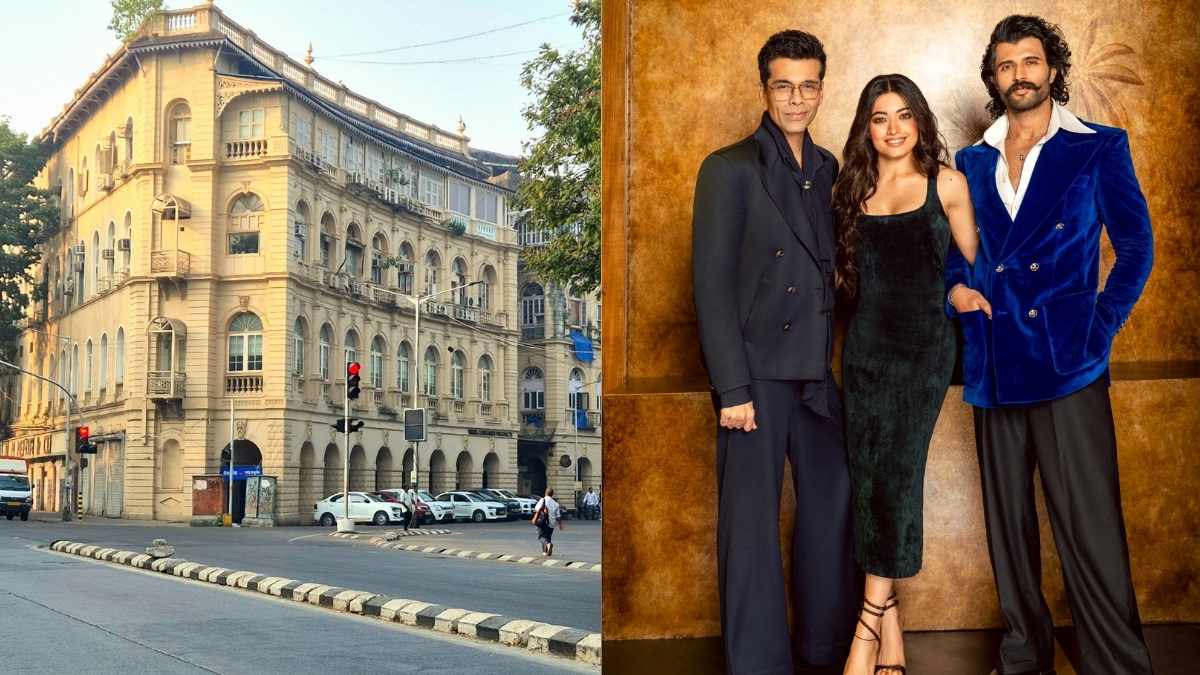

Karan Johar had a rather unexpected question for Vijay Deverakonda and Rashmika Mandanna on the latest episode of Koffee With Karan. When he asked the couple who they would find at Horniman Circle, the two were left confused. Vijay even came up with a cheeky answer before Karan explained that it was a roundabout in Fort, Mumbai. From its colonial-era architecture to its connection with Mumbai’s trading history, here’s why Horniman Circle deserves a closer look.
Horniman Circle Mumbai: A Look At Its History
While the exchange between the trio on Koffee With Karan made for a fun moment on the show, Horniman Circle is much more than just a roundabout. Tucked away in South Mumbai’s Fort area, this historic landmark has witnessed the city’s transformation from a trading hub into the financial capital it is today.
Horniman Circle was once known as Bombay Green, an open ground that served as a trading and storage space for goods such as cotton and other merchandise. Traders and merchants would gather here, making the area an important part of old Bombay’s commercial life.
As the city expanded, the space was redeveloped into a planned circular garden surrounded by buildings. The project began in 1869 and was completed in 1872, making it one of Bombay’s earliest major urban design schemes. The area was initially named Elphinstone Circle, after the then Governor of Bombay, Lord Elphinstone.
Following India’s Independence, the circle was renamed in 1947 in honour of Benjamin Guy Horniman, the editor of The Bombay Chronicle. Horniman was known for supporting India’s freedom movement and defending press freedom.
Also Read: Koffee With Karan S9: Salman Khan Ate Chocolates For Breakfast With Karisma Kapoor
What Makes Horniman Circle’s Architecture Special?
One of the first things you notice about Horniman Circle is the way its heritage buildings curve around the central garden. The coordinated stone facades, arched entrances and covered walkways give the entire stretch a distinctive old-Bombay character.
The buildings were designed by James Scott, chief engineer of the Elphinstone Land and Press Company. Their ground-floor arcades offered shade and shelter from the sun and rain, while the decorative stone faces above the arches, known as mascarons, add an interesting detail that is easy to miss if you’re simply passing by.
The circular garden at the centre brings the entire architectural ensemble together, with its greenery, pathways, seating areas and trees offering a break from the busy streets of Fort.
Horniman Circle’s Significance To Mumbai
Horniman Circle is closely linked to Mumbai‘s commercial history. The surrounding area grew into an important business district, with banks, trading firms and offices shaping the city’s economic life. The garden is also associated with the early trading activity that eventually led to the formation of the Bombay Stock Exchange.
Its location adds to its significance. The circle sits close to the Asiatic Society’s Town Hall, the Reserve Bank of India and other historic landmarks in Fort, making it an important stop on any heritage walk through South Mumbai.
Today, Horniman Circle continues to serve as a public garden and a reminder of the city’s layered past. It is where Mumbai’s old-world architecture meets its fast-paced business district, with a little greenery in between.
Also Read: 8 Best Heritage Walks In Mumbai Every History Lover Should Experience!
So, the next time you pass through Fort, take a moment to look beyond the traffic and the shops. Horniman Circle has a story that goes well beyond its name!
Cover Image Courtesy: X/@Sahilinfra2 & Instagram/karanjohar
FAQs
Where is Horniman Circle located?
Horniman Circle is located in the Fort area of South Mumbai.
What was Horniman Circle originally called?
It was originally known as Bombay Green and was later named Elphinstone Circle. It was renamed in 1947 in honour of journalist Benjamin Guy Horniman, who supported India's freedom movement.
What are some landmarks near Horniman Circle?
The Asiatic Society's Town Hall, the Reserve Bank of India and several heritage buildings in the Fort area are nearby.


