

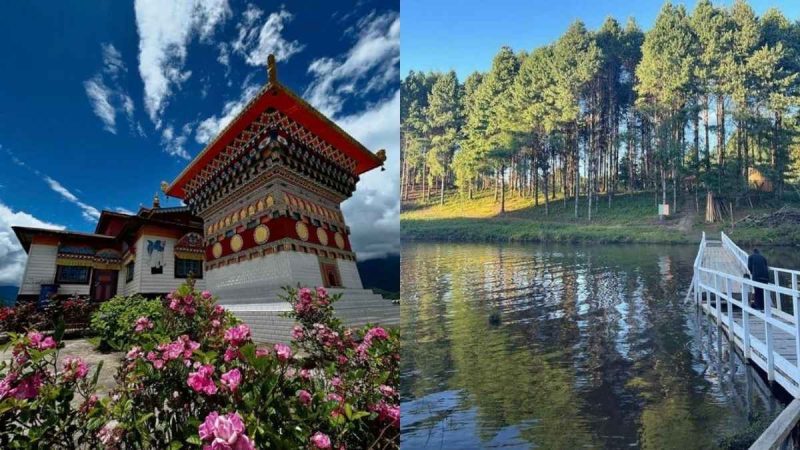
There’s a version of Northeast India that exists outside travel reels. It’s harder to get to, and far less interested in performing for visitors. Roads thin out, phone signals disappear, and what you’re left with is something far more memorable than a “trip,” you start noticing how people live, how landscapes in Northeast India breathe and how silence sounds different depending on where you are.
8 Hidden Gems In Northeast India Worth The Journey
1. Mechuka
Mechuka doesn’t reveal itself immediately. You drive for hours through terrain that keeps changing its mind; sometimes it’s dense forests, then sudden clearings and then patches of snow if you’re lucky with timing, and then the valley opens up like it’s been waiting for you to catch up. The Siyom River cuts through it; it is wide and unhurried, reflecting skies that feel closer than usual.
The 400-year-old Samten Yongcha Monastery sits slightly above it all, just quietly watching. You’ll probably reach there in the morning when the fog hasn’t fully lifted yet, and everything feels suspended in that half-awake state.
Walk across the old wooden hanging bridges; they creak, they sway, and they make you very aware of your own footsteps. Dorjeeling Village nearby gives you a window into the Memba tribe’s way of life. Winters here are harsh, yes, but they also turn the valley into something almost unreal, like a place that forgot it belongs to India.
2. Ziro Valley

Ziro is charming and how! Rice fields stretch out here in careful patterns, broken by bamboo houses and narrow paths that look like they’ve been walked on for generations. The Apatani tribe has been cultivating these lands in a way that doesn’t feel forced or modernised, as fish swim in the paddy fields, and nothing feels wasted.
Hong Village is where things slow down even more. You notice details here, of how houses are built, how conversations flow without urgency and how time feels less measurable. If you head towards Talley Valley Wildlife Sanctuary, the forest changes the mood entirely. It’s denser, quieter, and carries that faint unpredictability that forests tend to have.
And then there’s the Ziro Music Festival! It sounds like it shouldn’t belong here; it has indie bands, crowds and stages, but somehow it fits in Northeast India.
Also Read: Skip The Crowd: 5 Less Crowded Beach & Hill Getaways In India For A Peaceful Summer Escape
3. Dzukou Valley
Getting to Dzukou Valley requires effort, and that filters people out. The trek from Viswema or Jakhama isn’t impossible, but it demands patience because of its steep climbs, uneven paths, and stretches where you question why you started. Then the valley appears, and the question disappears with it!
It’s not a single dramatic view. It’s repetition again; rolling green hills, shallow streams weaving through them and flowers appearing in clusters depending on the season. The Dzukou lily blooms here quietly, not in overwhelming numbers, just enough to make you stop and look closer.
Stay overnight at the rest house. Nights are colder than expected, and mornings arrive calmly, with mist lifting layer by layer.
4. Mawlynnong
Mawlynnong gets introduced as “Asia’s cleanest village,” but that label barely scratches the surface. Cleanliness here isn’t a performance; it’s just how things are done. Bamboo dustbins are placed without making a statement out of them, and paths are swept because they always have been.
Walk through the village and you’ll notice how everything is built to blend, and not stand out! The Sky View Tower, made entirely of bamboo, lets you look out into Bangladesh without crossing a border. It’s a strange feeling, seeing another country so close, yet separated by something invisible.
A short walk away, the living root bridge in Riwai Village feels like something out of a different logic system altogether.
Stay in a homestay if you can! You’ll understand more over dinner conversations than any guidebook could tell you.
5. Unakoti
Unakoti feels like a place that wasn’t meant to be widely known. You walk down a series of steps, surrounded by thick forest, and then suddenly there’s a massive stone face staring back at you. And it is thirty feet high!
The Unakotiswara Kal Bhairava is the centrepiece, but it’s not alone. Sculptures appear as you move; some are half-hidden, some are eroded, while some are surprisingly intact. There’s no clear starting point or ending point; you just keep discovering.
The Ashokastami Mela brings people here in large numbers once a year, but outside that, it’s mostly quiet. You hear water trickling somewhere, leaves shifting, and your own footsteps again. It doesn’t feel like a tourist site, it feels like something paused in time.
Also Read: Northern Lights Guide: Where To See, Best Places, How To Reach, Budget & More
6. Dzongu
Dzongu isn’t somewhere you can casually drop into. You need permits, and that barrier changes the kind of traveller who ends up here. It’s a protected area for the Lepcha community, and the difference is noticeable almost immediately!
Tingvong Village is a good place to stay. Houses are simple, but views are not. Cardamom plantations stretch across slopes, and waterfalls appear to a traveller’s amusement. The Teesta River flows nearby; it is constant but never intrusive.
If you make your way to Tholung Monastery, you’ll notice how little it tries to explain itself.
7. Haflong
Haflong doesn’t compete with other hill stations, and that’s probably why it shines regardless.
Haflong Lake sits at the centre, reflecting whatever the sky decides to look like that day. You’ll see locals going about their routines around it.
Jatinga Village nearby carries a mystery that hasn’t been fully explained, with migratory birds behaving oddly during certain months. It’s been studied, debated and speculated on, but still holds onto its strangeness.
The Dimasa culture adds another layer. Markets here aren’t curated; they’re functional, real, and worth spending time in.
8. Reiek
Reiek sits quietly about 30 kilometres from Aizawl, close enough to access and far enough to feel like a whole new universe. The main draw is Reiek Tlang, a peak that doesn’t demand extreme effort but still makes you earn the view.
At the top, the landscape opens up in all directions. On clear days, you can see the plains of Bangladesh stretching out in the distance, which feels both surreal and grounding.
The heritage village nearby isn’t something ethereal. It’s a reconstruction of traditional Mizo homes, which feels humble.
If you happen to visit during the Anthurium Festival, the place shifts slightly into more colour and more movement, but it doesn’t lose its core stillness.
Also Read: Did You Know Mizoram’s Highest Waterfall Will Get Ropeway With ₹34.50 Crore Budget?
So, which of these underrated Northeast India gems will you explore first?
Cover Image Courtesy: rehnedetumm_/X and amarrrz/X
FAQs
What are the best offbeat places in Northeast India to visit?
Some of the best offbeat places include Mechuka, Ziro Valley, Dzukou Valley and Dzongu.
Why are offbeat places in Northeast India becoming popular?
Travellers are seeking less crowded, more authentic experiences, which Northeast India offers through its culture, landscapes and slower pace.