

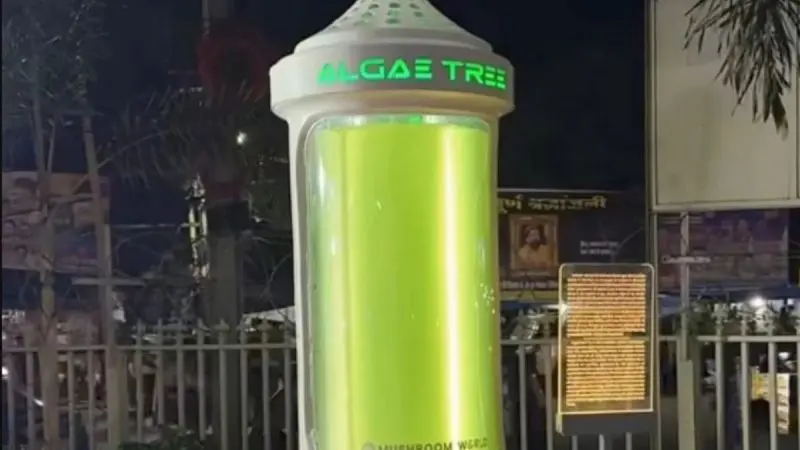
India’s first “algae tree”, which is a futuristic carbon-capturing device developed to reduce air pollution and absorb carbon dioxide, has been established in Bhopal. Want to know what exactly it is? Read on!
Bhopal Gets India’s First ‘Algae Tree’
As per a report by the Tribune, created by Mushroom World Group, the 3-metre-tall unit has a 1.5-tonne carbon absorption capacity and was installed at Swami Vivekananda Park on May 1. The new technology operates on a photobioreactor system, and it can remove around 1.5 tonnes of carbon dioxide from the atmosphere yearly.
The project was designed over two years by more than 50 experts and is a key effort under the Bhopal Smart City project. Inaugurated by Madhya Pradesh’s co-operation minister Vishwas Sarang, the unique solar-powered unit has already gained a lot of attention for its ability to address ecological challenges in urban spaces.
How Will Algae Trees Help Absorb Carbon Dioxide?
Talking about the development, an official told the news portal that a single algae tree unit is claimed to be as effective as 25 adult trees in absorbing carbon dioxide and releasing oxygen. Additionally, the tree can reduce PM2.5 particles by 45–55% within a 15-metre radius. The unit also operates using solar energy and has been designed for areas where standard tree planting is difficult and nearly impossible. These places include busy roadsides and public spaces. He also added that the technology is aimed at enhancing existing trees rather than replacing them, serving as a support system, particularly in busy urban areas.
The launch arrives at a time when Indian cities are dealing with rising temperatures, worsening air quality and reduced green cover. PM2.5 and PM10 continue to remain the main pollutants due to traffic, construction and weather-related dust.
Also Read: New 8-Lane Road To Connect Greater Noida To Ganga Expressway In 30 Mins? Here’s All You Need To Know
What are your thoughts about it?
Cover Image Courtesy: X/@Voronezh143
FAQs
What are algae on trees?
Algae are simple, plant-like organisms. They can photosynthesise (harness the energy in sunlight) but don't have true roots, stems or leaves.