
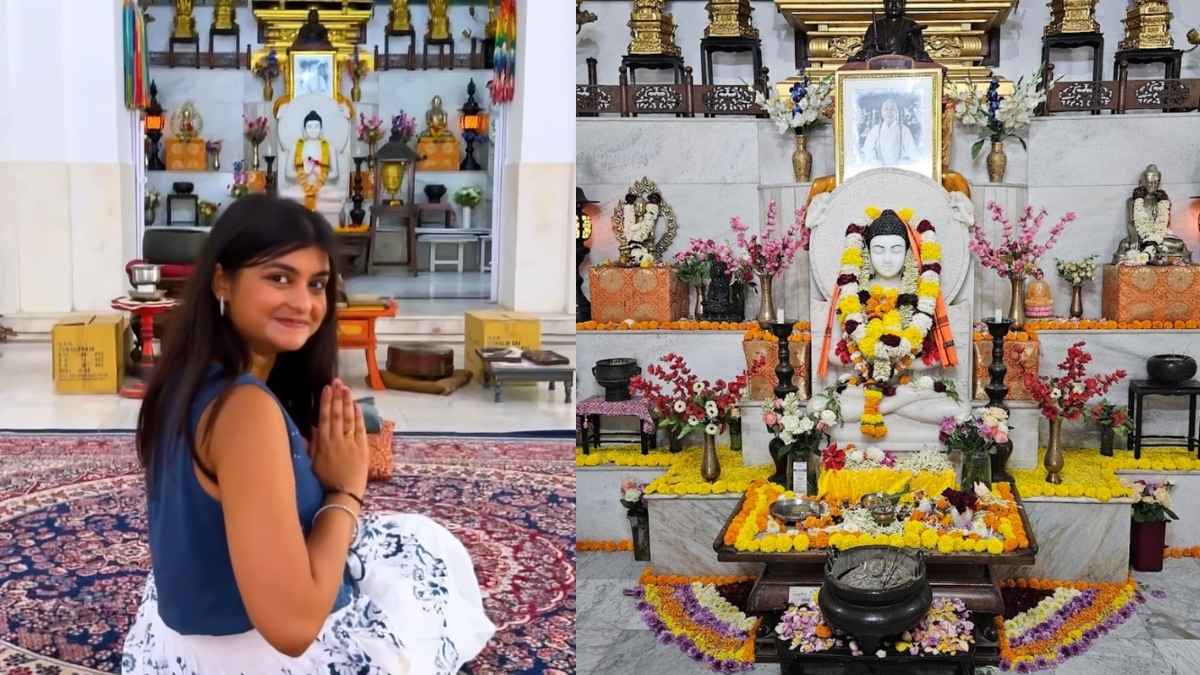


A few metres away from Worli’s traffic-clogged roads, where rickshaw horns collide with construction noise and people speed-walk like the city owes them something, stands a peaceful white building that feels almost misplaced. You enter expecting another old spiritual spot. Instead, you walk into soft drumbeats, flickering candles, Japanese chants, and the kind of silence Mumbai rarely offers for free.
There Is A Peaceful Japanese Temple In Worli, Mumbai
View this post on Instagram
The Nipponzan Myohoji Buddhist Temple has been here for nearly 70 years, though most Mumbaikars still drive past it without the slightest clue. Built in the years following India’s Independence, the temple was established by Japanese monks who travelled here carrying a philosophy shaped by war, peace movements, Buddhism, and, surprisingly, Mahatma Gandhi.
The story begins with Nichidatsu Fujii, the Japanese Buddhist monk who founded the Nipponzan Myohoji order. Fujii wasn’t just spiritually influenced by Gandhi from afar; he actually met him in the 1930s and became deeply moved by his belief in non-violence. Long before “peace activism” became the language of university discussions, Fujii was travelling across countries preaching disarmament, anti-war values, and spiritual resistance.
Also Read: Mumbai’s Mumbadevi Decorated With Mangoes As Temple Celebrates Mango Festival With 12,000 Mangoes
Story Behind The 70-Year-Old Japanese Buddhist Temple
There is also something almost disarming about the temple’s deeper origin story. Followers of the order believe its existence traces back to a 700-year-old prophecy by Nichiren, the Japanese Buddhist monk who believed India, the birthplace of Buddhism, would one day play a major role in spiritually guiding the world. Decades later, Japanese monks crossed borders and oceans to build a temple in Mumbai of all places, turning that prophecy into brick, prayer halls, and candle smoke.
Industrialist Jugal Kishore Birla eventually helped support the temple after being drawn to Fujii’s teachings. At the time, Mumbai reportedly had a thriving Japanese trading community too, and the temple became a cultural bridge between India and Japan in the middle of a rapidly modernising city.
What To Expect?
Even today, the rituals here remain beautifully unchanged. Prayers happen twice daily, once at 5 AM and again at 6 PM. Visitors are not treated like outsiders awkwardly observing from corners. You can sit through the chanting sessions, light candles, meditate, and even play the traditional drums yourself as an act of devotion. The steady rhythm of “Namu Myoho Renge Kyo” fills the hall in waves.
And the drums here are not merely for viewing. The Nipponzan Myohoji order became globally recognised after World War II for its peace marches and anti-war movements following the Hiroshima and Nagasaki bombings. The same spiritual order has also built more than 80 Peace Pagodas around the world, all rooted in the idea that prayer should exist beyond temple walls.
Inside the temple premises runs a kindergarten school for underprivileged children, funded entirely through donations. Kids are taught there free of cost, making the temple feel like a living community space built on compassion.
Also Read: This Hidden Navgraha Temple Near Mumbai Feels Like A Riverside Slice Of Kerala Escape
This one is a hidden Japanese temple in Mumbai, still holding onto peace in a city that rarely offers it otherwise.
Cover Image Courtesy: Internal
For more such snackable content, interesting discoveries and the latest updates on food, travel and experiences in your city, download the Curly Tales App. Download HERE.FAQs
Where is the Nipponzan Myohoji Buddhist Temple in Mumbai?
The Nipponzan Myohoji Buddhist Temple is located in Worli, Mumbai, just a short distance away from the city’s busy main roads.
What is special about the Nipponzan Myohoji Temple in Mumbai?
The temple is known for Japanese Buddhist chanting rituals, peace-focused spirituality, candle-lit prayer sessions, meditation, and its historical connection to Mahatma Gandhi.
Who founded the Nipponzan Myohoji Buddhist order?
The Nipponzan Myohoji Buddhist order was founded by Japanese monk Nichidatsu Fujii, who was deeply inspired by Gandhi’s philosophy of non-violence.
Can visitors attend prayers at the temple?
Yes, visitors can join chanting sessions, meditate, light candles, and even play traditional drums during prayer rituals.


