

Somewhere in India, a child is learning to write by tracing letters in a plate of rice. Elsewhere, people are exchanging leaves as gold, village deities are travelling to a grand gathering, and an entire town is preparing to become the setting of the Ramayana. Meanwhile, in one corner of Chhattisgarh, Ravana is not even the main character. So much for Dussehra being just about setting a giant demon on fire! Here are 10 Dussehra traditions with fascinating histories, unusual rituals and stories that deserve considerably more attention than the annual countdown to Ravana Dahan.
10 Fascinating Dussehra Traditions In India
1. Bastar Celebrates Dussehra For 75 Days Without Burning Ravana
Ravana is practically the celebrity guest at most Dussehra celebrations. In Bastar, Chhattisgarh, he does not even make the guest list.
The region’s extraordinary festival lasts approximately 75 days and centres on Maa Danteshwari, local deities and tribal customs rather than the Ramayana’s final battle. Its origins are traced to the 15th century, during the reign of King Purushottam Dev. One of its earliest rituals, Pat Jatra, involves worshipping a sacred log of wood brought from the forest for the festival’s ceremonial chariot.
Also Read: Why Is Sendha Namak Eaten Instead Of Regular Salt During Navratri Fasts?
2. Kullu’s Dussehra Begins When Everyone Else Goes Home

In Kullu, Vijayadashami is not the closing credits. It is the opening scene.
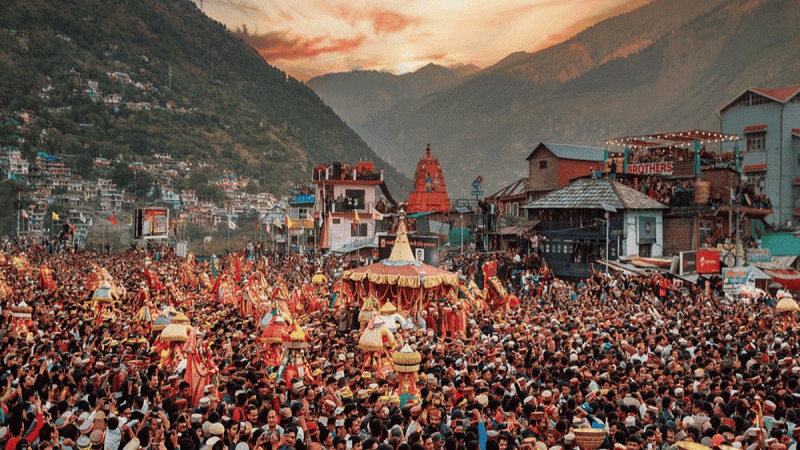
Dussehra in Kullu, Himachal Pradesh, is celebrated later than in most parts of India because the festival follows a unique local tradition centred on Lord Raghunath and the gathering of hundreds of village deities. In fact, Kullu Dussehra begins on Vijayadashami, the very day when Dussehra celebrations end in many other parts of the country, and continues for seven days.
Dating back to the 17th century, Kullu Dussehra began under Raja Jagat Singh, who installed an idol of Lord Raghunath brought from Ayodhya. The festival now brings hundreds of village deities to Dhalpur Maidan, many arriving in decorated palanquins accompanied by devotees and traditional musicians.
3. Maharashtra Exchanges Leaves As If They Were Gold
Inflation may have made actual gold prohibitively expensive, but Maharashtra has a centuries-old festive alternative that fits in your palm.
On Dussehra, people exchange Apta or Shami leaves as symbolic gold, wishing one another prosperity and good fortune. The custom is associated with the Mahabharata legend in which the Pandavas concealed their weapons in a Shami tree during exile.
4. Kerala Introduces Children To The Alphabet On Vijayadashami
Some children receive their first school bag. In Kerala, many begin their educational journey by tracing their first letters on a bed of rice.
Known as Vidyarambham, this ceremony marks a child’s introduction to learning. An elder or teacher guides the child’s finger as the first letters are written, often in rice or sand. Vijayadashami is especially auspicious for the ritual, which is performed at homes and temples across Kerala.
5. Mysuru Turns Dussehra Into A Royal Procession
If Dussehra had a royal red-carpet event, Mysuru Dasara would be a strong contender.
Celebrated since 1610, the festival inherited its grandeur from the royal traditions of the Wadiyar dynasty. Its celebrated finale, the Jumboo Savari, features Goddess Chamundeshwari carried in a golden howdah atop a decorated elephant, with the procession travelling from Mysuru Palace towards Bannimantap.
The festival also includes Ayudha Puja, when tools, weapons and other implements of work are worshipped.
6. Homes In Southern Indian Build Entire Doll Kingdoms For Navratri
Somewhere between the divine figurines, miniature villages and tiny wedding scenes, a family’s staircase becomes an entire civilisation.
The tradition is called Golu, or Bommai Kolu, and involves arranging dolls on tiered platforms during Navratri. The displays can feature gods, mythological characters, historical scenes and everyday life. The custom is associated with the royal Navratri celebrations of the Vijayanagara Empire, which flourished from the 14th century onwards.
The best part is that these are not disposable decorations. Many families preserve and pass down their dolls, adding new figures over the years.
Also Read: Navratri 2026: 8 Temples In Mumbai To Seek Goddess Durga’s Blessings This Festive Season
7. Sarangarh’s Dussehra Involves Conquering A Mud Fort
Forget watching a battle unfold. In Sarangarh, Chhattisgarh, the crowd gets to participate in one.
The distinctive tradition of Garh Chadhai involves participants attempting to climb a cone-shaped mud fort constructed using soil from the former royal palace. It is one of the defining features of the region’s Dussehra celebrations.
8. Kota’s Dussehra Mela Dates Back To 1723
Kota does not believe in keeping its Dussehra celebrations small. Its famous mela traces its history to 1723, during the reign of Maharao Durjanshal Singh Hada, when religious ceremonies and royal gatherings formed the heart of the festivities.
Over time, the celebration grew into a major fair featuring cultural performances, crowds and enormous effigies of Ravana, Kumbhakarna and Meghnad. Ravana’s downfall becomes a full-scale public spectacle, complete with the anticipation of a crowd waiting for the final explosion.
9. Ramnagar Turns An Entire Town Into The Ramayana
Most theatre productions ask you to find your seat. Ramnagar’s Ramlila asks you to follow the story.
Held across the Ganga from Varanasi, this celebrated Ramlila unfolds over approximately 31 days. Different locations become Ayodhya, Janakpur, Chitrakoot, Panchvati and Lanka, allowing spectators to move through the narrative instead of watching it from a conventional stage. The tradition is recognised by UNESCO as intangible cultural heritage.
10. Andhra Pradesh’s Banni Festival Includes A Ritual Stick Fight
This is where Dussehra takes a decidedly intense turn!
At Devaraguttu in Andhra Pradesh, Vijayadashami culminates in Banni Utsavam, a midnight ritual in which devotees wield bamboo sticks in a symbolic re-enactment of the battle between local deities and demons. The tradition draws thousands of participants and is associated with the region’s long-standing religious practices.
The ritual has resulted in serious injuries, making it important to understand it as a religious observance rather than a spectacle to romanticise. Its intensity also illustrates how differently communities interpret the idea of divine victory.
Also Read: Think You Know Garba? 9 Gujarati Dance Steps And The Stories Behind Their Names
From a 75-day festival without Ravana to a town that becomes a living epic, India’s Dussehra traditions refuse to fit neatly into one story.
And if that is not enough to make you look at Dussehra differently this year, nothing will.
Cover Image Courtesy: Wikimedia Commons
FAQs
What are some unique Dussehra traditions in India?
Some distinctive traditions include Bastar’s 75-day Dussehra, Maharashtra’s exchange of Apta leaves as symbolic gold, Kerala’s Vidyarambham ceremony, South India’s Golu doll displays and Ramnagar’s town-wide Ramlila.
Why does Bastar celebrate Dussehra without burning Ravana?
Bastar Dussehra centres on Maa Danteshwari, local deities and tribal traditions rather than the Ramayana’s battle between Lord Rama and Ravana.
Why do people exchange leaves on Dussehra in Maharashtra?
Apta and Shami leaves are exchanged as symbolic gold to represent prosperity and good fortune. The custom is associated with traditional legends, including the Mahabharata.