

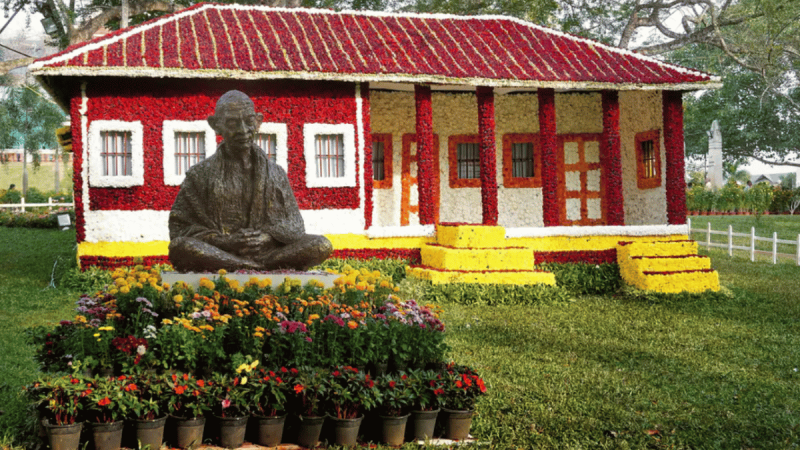
If your idea of a Gandhi Jayanti celebration is one more WhatsApp status with a black-and-white photograph of Bapu, we have a slightly better plan. Pack a small bag and go somewhere Gandhi actually lived, worked, wrote, argued, prayed, or tried to build the India he imagined. Gandhi’s ashrams were never simply places to escape the world. They were almost the opposite. Farming, spinning, education, sanitation, communal living and political strategy happened under the same roof, often with very little separating a kitchen from a meeting room or a prayer ground from a place where major decisions were made. Today, some are polished heritage attractions, while others remain very low-key. That is exactly what makes them interesting weekend destinations.
Gandhi Jayanti: 10 Gandhi Ashrams In India To Visit
1. Sabarmati Ashram, Ahmedabad, Gujarat
Start with the one that needs almost no introduction on Gandhi Jayanti. Gandhi moved his ashram from Kochrab to the banks of the Sabarmati on June 17, 1917, looking for enough open land to experiment with farming, animal husbandry, cow breeding, khadi and other forms of constructive work. He lived here until 1930, and on March 12 that year, walked out of the ashram with 78 companions to begin the Dandi March.
2. Kochrab Ashram, Ahmedabad, Gujarat

Before Sabarmati became the address everyone remembers, there was Kochrab. Gandhi established his first ashram in India here on May 25, 1915, just months after returning from South Africa. Barrister Jivanlal Desai offered his bungalow for the experiment, and roughly 25 people initially formed the community.
Kochrab is particularly fascinating because it captures Gandhi at the beginning of his Indian experiment. The ashram was not merely about meditation or spiritual retreat. Gandhi drafted rules for the community and began testing ideas around self-discipline, swadeshi, and social equality.
Also Read: From Khichdi To Salt: 8 Indian Foods That Became Symbols Of The Swadeshi Movement
3. Sevagram Ashram, Wardha, Maharashtra
Sevagram is where Gandhi’s story becomes noticeably more rural. He moved to the village near Wardha in 1936 and made it his home until his death in 1948. The name itself means “village of service”, and the place was deeply connected with his ideas about rural reconstruction, self-reliance and constructive work.
The campus still has the modest huts that formed the centre of everyday life here, including Bapu Kuti, Ba Kuti and Adi Niwas. There is something almost startling about seeing these spaces after reading about the political events that unfolded around them. The Quit India movement was discussed here. Satyagraha strategies were worked out here. Yet the physical surroundings remain deliberately simple on Gandhi Jayanti.
4. Anasakti Ashram, Kausani, Uttarakhand
Now for the one with the unfairly beautiful view for Gandhi Jayanti!
Gandhi spent 14 days in Kausani in 1929, staying at what is now Anasakti Ashram. His time here was connected with his work on Anasakti Yoga, centred on the idea of non-attachment. The ashram today has a small museum, prayer room, library and accommodation facilities.
Then there are the Himalayas.
Kausani’s mountains were so striking to Gandhi that the town became associated with his description of it as the “Switzerland of India”.
5. Sadaqat Ashram, Patna, Bihar
There is an important correction to make here: Sadaqat Ashram was not founded by Gandhi. It was established by Maulana Mazhar-ul-Haq in the early 1920s, and Gandhi later stayed there. The distinction actually makes the place more interesting because it reflects the wider network of people and institutions surrounding the freedom movement.
The name “Sadaqat” means truthfulness, and the campus became closely associated with Bihar’s national education movement. Bihar Vidyapith eventually moved here, after Gandhi had inaugurated its National College and National University initiatives in Patna in 1921. Gandhi himself wrote about staying at Sadaqat Ashram beside the Ganga.
6. Bhitiharwa Gandhi Ashram, West Champaran, Bihar
If Gandhi’s most famous ashrams tell you about the man, Bhitiharwa tells you about the people he was trying to work with.
The ashram became one of Gandhi’s bases during the Champaran Satyagraha of 1917. He visited Bhitiharwa twice during the campaign, and Kasturba Gandhi and Devdas Gandhi stayed there for months, helping run a school and social uplift programmes. The original room associated with the ashram still survives.
7. Brindaba Ashram, West Champaran, Bihar
Brindaba is the kind of Gandhi site that can disappear completely from the mainstream itinerary, which is precisely why it deserves attention.
Bihar’s official tourism material records that Gandhi stayed in the village in 1939 and started an ashram there, which continues to function. The village was also connected with the Gandhi Seva Sangh, and an All India Gandhi Seva Sangh conference was held here in 1937, attended by Gandhi and Dr Rajendra Prasad.
There is no polished metropolitan museum experience waiting for you here. Instead, Brindaba offers a glimpse of the village-level network through which Gandhian ideas about service and social reform were carried into everyday life.
8. Sodepur Khadi Pratishthan, West Bengal
Gandhi’s relationship with Sodepur is one of the better stories hiding in plain sight around Kolkata.
The Khadi Pratishthan at Sodepur was established under Satish Chandra Dasgupta and developed around khadi, spinning, weaving and cottage industries. Gandhi visited the institution repeatedly and referred to Sodepur as his “second home”. UNESCO’s documentation also identifies the Khadi Pratishthan and Ashram at Sodepur as a significant Gandhian Satyagraha site.
Also Read: Once A Hideout For Indian Freedom Fighters, Laxmi Nivas In Mumbai Sold For ₹276 Crore
9. Gandhi Ashram, Kingsway Camp, Delhi
You do not have to leave Delhi to find a genuinely Gandhi-linked retreat.
The Gandhi Ashram at Kingsway Camp is the headquarters of the Harijan Sevak Sangh, founded by Gandhi on September 30, 1932. The organisation was established around the fight against untouchability and the social and educational uplift of communities that had been subjected to caste discrimination.
The 20-acre green campus contains Kasturba Kutir, where Gandhi and Kasturba stayed during their visits to Delhi in the 1930s and 1940s. The restored museum there focuses on Kasturba’s life, while the wider campus continues to house educational and social-service institutions.
10. Maganwadi, Wardha, Maharashtra
If Sevagram is Gandhi’s famous Wardha address, Maganwadi is the fascinating prequel.
Gandhi began staying at Maganwadi after Jamnalal Bajaj offered his garden and building for the Village Industries Association. The estate was named in memory of Maganlal Gandhi, and Gandhi spent roughly a year and a half there working on village industries, sanitation, food experiments, and rural uplift.
It represents a side of Gandhi that often gets flattened in school chapters, which is his obsession with the practical details of self-reliance. What could villages produce? How could local industries survive? Could sanitation be improved? Could rural communities become less dependent on imported goods? These were not abstract questions inside Gandhi’s circle. They became experiments.
The most interesting thing about these ashrams is not that Gandhi once occupied the rooms; it is that he used ordinary rooms to try extraordinarily difficult things.
Cover Image Courtesy: sabarmatiashram/Website
FAQs
Which Gandhi ashrams can you visit in India?
Some notable Gandhi-linked sites include Sabarmati Ashram and Kochrab Ashram in Ahmedabad, Sevagram and Maganwadi in Wardha, Anasakti Ashram in Kausani, Bhitiharwa and Brindaba in Bihar, Sodepur Khadi Pratishthan in West Bengal and the Gandhi Ashram at Kingsway Camp in Delhi.
Which is the most famous Gandhi Ashram?
Sabarmati Ashram in Ahmedabad is among the best-known sites associated with Mahatma Gandhi. Gandhi lived there from 1917 until 1930 and began the Dandi March from the ashram in March 1930.
Where did Gandhi establish his first ashram in India?
Gandhi established his first ashram in India at Kochrab, Ahmedabad, on May 25, 1915, after returning from South Africa.