

Before Gandhi became the face on currency notes, the subject of school assemblies and the man behind one of history’s most recognisable spectacles of non-violent resistance, he was simply a traveller trying to understand India. For Gandhi Jayanti, here are 10 places where the story gets far more interesting than the textbook version.
Gandhi Jayanti: 10 Places In India Bringing Mahatma Gandhi’s Story To Life
1. Porbandar, Gujarat

Start at Porbandar this Gandhi Jayanti, because every Gandhi trail has to begin here. Mohandas Karamchand Gandhi was born in the coastal Gujarati town on October 2, 1869. His birthplace, now preserved within Kirti Mandir, takes you back to a much smaller, quieter Gandhi story, long before salt marches and prison cells entered the picture. Porbandar is less about a political movement and more about the beginning of the person behind it.
The house associated with his birth has been preserved as a memorial, making this the literal first chapter of his Indian story. Interestingly, Gandhi’s birthday was spent in different corners of India in later years. Records show that between 1915 and 1947, October 2 found him everywhere from Ahmedabad and Bombay to Yeravda Jail, Wardha and Delhi.
Also Read: 10 Simple Foods Mahatma Gandhi Ate That You Can Still Find Across India Today
2. Kochrab Ashram, Ahmedabad
In May 1915, Gandhi established his first ashram in India at Kochrab, Ahmedabad. This was where ideas that had taken shape during his years in South Africa began being tested against Indian realities. The ashram was established on May 25 and remained there until the community moved to the Sabarmati site in June 1917.
Gandhi chose Ahmedabad partly because he was Gujarati and believed he could communicate more effectively in the language, but also because the city had a strong handloom tradition and could become fertile ground for the revival of spinning and cottage industries.
3. Sabarmati Ashram, Ahmedabad
There is something almost magical about Sabarmati Ashram’s place in history on Gandhi Jayanti. Gandhi moved his ashram from Kochrab to the Sabarmati banks in 1917, and the site became one of the most important centres of his work in India. From here came experiments with khadi, self-reliance, education and social reform, alongside major political campaigns. Then, on March 12, 1930, Gandhi walked out of Sabarmati with 78 satyagrahis and began the march that would take them to Dandi. The Gandhi Heritage Portal records the departure at 6:30 a.m. that morning.
4. Champaran, Bihar
The road from political speeches to grassroots resistance ran through Champaran. In 1917, Gandhi travelled to Bihar after hearing about the problems faced by indigo cultivators. When the authorities ordered him to leave the district, he refused. The confrontation was significant because Gandhi was not simply speaking on behalf of people from a distance. He stayed, investigated their complaints, and worked alongside volunteers who also took up education and sanitation efforts.
5. Kheda, Gujarat
Kheda showed another side of Gandhi’s politics: the belief that a freedom movement could not ignore the economics of everyday life. In 1918, after crop failure affected farmers in the district, Gandhi supported their demand for relief from land revenue. The Kheda Satyagraha became one of the early campaigns through which he worked with local peasants and leaders, including Vallabhbhai Patel. The Gandhi Heritage Portal lists Kheda separately among his major satyagraha campaigns, with the movement unfolding from February to June 1918.
6. Dandi, Gujarat
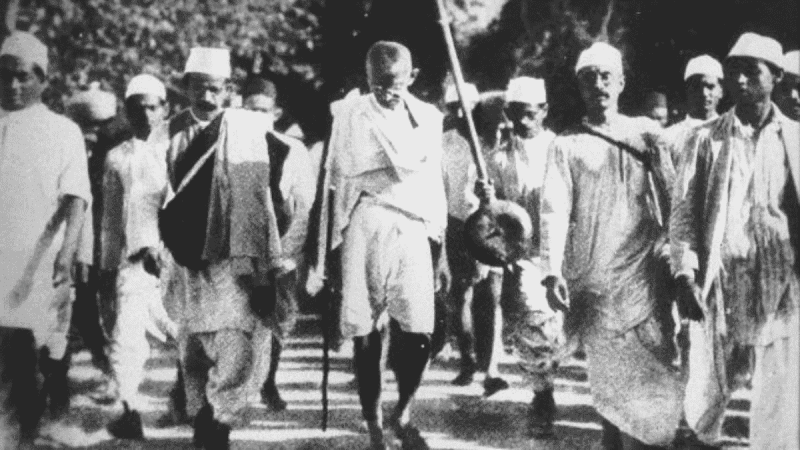
Few places are as instantly connected to Gandhi as Dandi. On April 6, 1930, after walking from Sabarmati for nearly a month, Gandhi broke the colonial salt law by making salt from seawater. The act itself was almost startlingly ordinary. That was precisely the point.
Salt belonged in every Indian kitchen, and the colonial state’s control over its production and taxation gave Gandhi a simple object through which to demonstrate civil disobedience. The march had begun on March 12 with 78 satyagrahis and moved through villages along the route before reaching the coast.
7. Mani Bhavan, Mumbai
Hidden away on Laburnum Road in Mumbai’s Gamdevi, Mani Bhavan looks modest compared with the enormity of the history attached to it. Gandhi used it as his Bombay headquarters between 1917 and 1934. From this house, he was involved in campaigns connected with satyagraha, swadeshi, khadi and civil disobedience.
The Rowlatt Satyagraha was launched from Mani Bhavan in 1919. In November 1921, Gandhi began a fast here following violence during the boycott of the Prince of Wales’ visit. The building also became the site of important Congress discussions, and Gandhi was arrested from its terrace in the early hours of January 4, 1932.
8. Sevagram, Wardha
By 1936, Gandhi was moving away from the idea of being permanently surrounded by the machinery of mainstream politics. He settled in Sevagram, a village near Wardha, on April 30 that year. The Maharashtra government’s account describes a place that initially had little infrastructure; no post office, no telegraph office and barely an approach road. Gandhi had arrived at the age of 67 and wanted to live in a genuinely rural setting. Even his hut came with a strict condition; it should cost no more than ₹500 and use locally available material. The village was eventually named Sevagram, meaning “village of service”, in 1940.
Also Read: Varanasi Has A Temple With No Idol But Map Of Pre-Partition India & Mahatma Gandhi Inaugurated It
9. Aga Khan Palace, Pune
The Aga Khan Palace looks like the sort of place where one would expect a royal reception, not a political prisoner. Yet following the launch of the Quit India Movement in August 1942, Gandhi was detained there with Kasturba Gandhi, Mahadev Desai and other associates. Gandhi remained imprisoned at the palace until May 1944. Mahadev Desai died there on August 15, 1942, only days after the detention began. Kasturba Gandhi also died during her imprisonment there.
10. Gandhi Smriti, New Delhi
And then there is Delhi, where Gandhi’s journey ended. Gandhi moved into the Old Birla House, now Gandhi Smriti, on September 9, 1947. He lived there for the final 144 days of his life, spending his time in prayer meetings, discussions and efforts to address the communal violence surrounding Partition. On January 20, 1948, a bomb exploded near a prayer meeting at the house. Gandhi continued with his address. Ten days later, on January 30, he was assassinated on the grounds while going towards the prayer meeting.
So, this Gandhi Jayanti, the most interesting way to remember him is not by looking at one statue, but by following the trail he left across India.
Cover Image Courtesy: Wikipedia
FAQs
Which places in India are associated with Mahatma Gandhi?
Some of the most significant places include Porbandar, Kochrab Ashram, Sabarmati Ashram, Champaran, Kheda, Dandi, Mani Bhavan, Sevagram, Aga Khan Palace and Gandhi Smriti.