

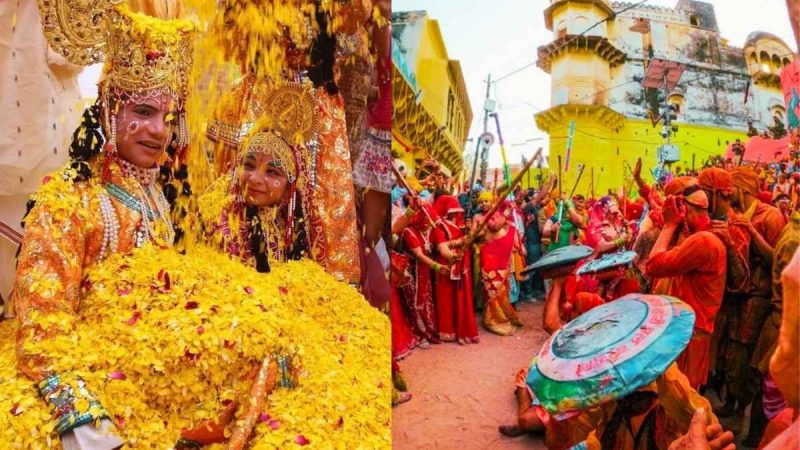
Every year, the same visuals circulate: clouds of gulal swallowing temple spires, women in Barsana swinging lathis, and foreigners dancing in white kurtas. It looks dramatic, chaotic and cinematic. But the real difference between Holi in Braj and Holi elsewhere isn’t intensity, it’s architecture and the meaning around it. The Braj region, including Vrindavan, Barsana, Mathura and Baldeo, doesn’t treat Holi as a two-day social release. Here are 6 Holi traditions in Vrindavan, which make the festival feel divine and meaningful.
6 Unique Holi Experiences You Get ONLY In Vrindavan
1. Phoolon Wali Holi

At the 19th-century Banke Bihari Temple, colour does not arrive first; flowers do!
The temple was formally established in 1864 by followers of Swami Haridas, a Bhakti saint whose devotional compositions shaped Krishna worship in Braj. By then, Vrindavan already functioned as a major Vaishnav centre, as many temples had been built in the 16th and 17th centuries when Mughal tolerance enabled large-scale construction.
Phoolon Wali Holi fits into that temple culture. Priests shower petals of rose and marigold flowers over the deity and then the gathered crowd.
In Vaishnav theology, sensory pleasures like colour, fragrance, and music are first offered to Krishna as seva. Outside the temple gates, colours soon explode, but inside, it is still controlled.
Also Read: Ahead Of Holi 2026, Women’s Bus Bookings Up 80% & Udaipur Flights Jump 94%, Says Survey
2. Lathmar Holi
Drive 45 minutes to Barsana, and the mood shifts.
Lathmar Holi unfolds near the Radha Rani Temple, and it draws from oral Braj narratives rather than scriptural injunctions. The story is familiar, as Krishna visits Radha’s village, teases her, and is chased away. The village women retaliate too.
In practice, men from Nandgaon enter Barsana’s courtyard space. Women meet them with lathis while the men carry shields. The blows are theatrical but real enough to command caution.
Anthropologists describe this as ritual inversion, a temporary flipping of everyday hierarchies inside a socially sanctioned framework. But reducing it to theory misses something. Barsana and Nandgaon historically maintained distinct village identities within Braj’s pastoral geography. This festival reinforces those boundaries annually.
And despite national attention, participation remains locally rooted. It’s still village versus village before it becomes a spectacle for cameras.
3. Widow’s Holi
Vrindavan has long been a city of widows. Colonial travel accounts from the 19th century describe women arriving here after being excluded from their families, surviving on bhajan singing and temple charity.
Traditionally, widowhood in many Hindu communities meant white clothing, dietary restriction, and withdrawal from celebration. Colour, especially during Holi, was considered inappropriate.
The public celebration of Holi by widows at the Gopinath Temple is modern. It gained visibility in the past decade through local advocacy groups. There is no medieval precedent for it.
White sarees streaked with pink and yellow gulal are not a revival of ancient custom; they are a refusal of inherited prohibition. In a town defined by devotion and renunciation, this act quietly redraws social boundaries.
Not all Braj traditions are old, some are corrections.
Also Read: Holi 2026: 8 Unique Holi Recipes That Go Beyond Gujiya And Thandai
4. The 40-Day Holi Cycle
In most cities, Holi sits on a civic calendar, but in Braj, it unfolds according to ritual tempo.
The season begins on Vasant Panchami. Yellow garments enter temple wardrobes, and spring ragas, especially Basant, are sung. Holi-themed verses from Braj Bhasha poetry begin appearing in temple gatherings.
As Phalguna progresses, colour enters gradually. Then comes Holika Dahan, the burning of Holika, recalling the Prahlad myth. Only after symbolic purification does Dhulandi arrive.
Dhulandi, the day of colour play, looks familiar to outsiders: streets saturated in pink dust, balconies pouring coloured water, and temple courtyards indistinguishable from clouds. But here it is not the entire story, it is one crest in a longer wave.
What makes the forty-day framing distinct is theological elasticity. Krishna’s leela is not confined to a single date. Temples stage different emotional moods over weeks, ranging from flirtation, devotion, play, to confrontation, instead of compressing them into 24 hours.
Elsewhere, Holi is an event, but in Braj, it’s a season with phases.
Also Read: 10 Best Cities To Celebrate Holi In India For A Once-In-A-Lifetime Experience
5. Samaj Gayan
Before social media amplified Holi’s visuals, Braj preserved it through sound.
Samaj Gayan refers to organised singing sessions inside temple spaces. The compositions, many attributed to 16th-century Bhakti poets like Surdas, describe Krishna playing Holi with Radha and the gopis. They are sung in Braj Bhasha, structured musically, accompanied by harmonium and dholak.
This is not casual singing, it is rehearsed, communal, and textually rooted.
Without Samaj Gayan, the theatrical Holi of Barsana would lose its narrative spine.
6. Dauji Huranga
Most places wind down after Dhulandi, but Baldeo does not.
At the Dauji Temple, dedicated to Balram (Dauji), the day after Dhulandi erupts into Huranga.
Balram, in mythology, embodies physical strength and agrarian identity. Fittingly, this ritual is rawer than Lathmar Holi. Women drench men with coloured water inside the temple courtyard. Cloth whips are used, shirts are torn, and escape is part of the choreography.
Unlike Barsana’s widely televised event, Huranga feels more locally contained. It’s the final exhale of the season.
Also Read: Holi 2026: 8 Traditional Food Items That Complete Holi Parties
What distinguishes Holi in Vrindavan and its neighbouring towns is continuity, from Bhakti poetry to Mughal-era temple formation, and from village rivalries to modern social reform. Phoolon Wali Holi keeps liturgy intact, Lathmar Holi sustains oral folklore, Widow’s Holi reshapes social participation, while the forty-day cycle stretches myth across time.
Also Read: Rang Barse! 6 Holi Parties In Ahmedabad And Vadodara Worth Getting Passes For!
And that is why Holi in Braj does not feel like a larger version of what the rest of India celebrates, it feels like a different system entirely.
Cover Image Courtesy: speakskshatriya/X and aaranynsh/X
FAQs
When does Holi start in Braj?
Holi season in Braj begins on Vasant Panchami and continues for nearly 40 days until Dauji Huranga in Baldeo.
What is Phoolon Wali Holi?
It is a flower Holi celebrated inside Banke Bihari Temple in Vrindavan where priests shower flower petals instead of gulal.
Why is Lathmar Holi famous?
Lathmar Holi in Barsana reenacts the playful legend of Krishna and Radha, where women symbolically strike men with sticks.