

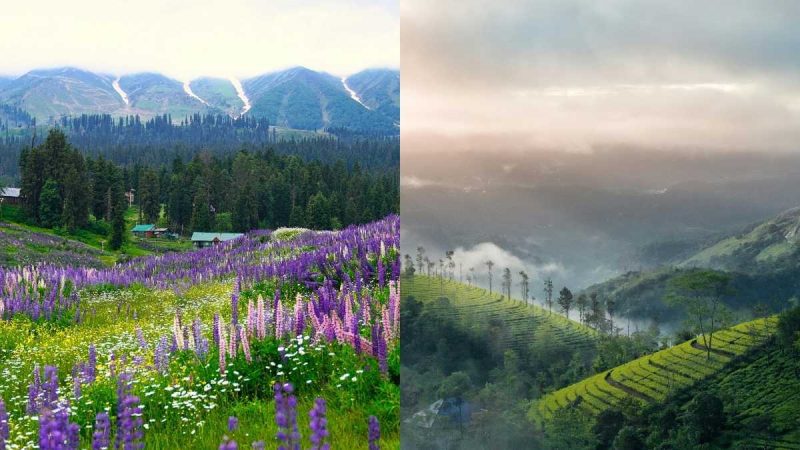
There are certain places where the landscape starts feeling imagined and too ethereal to be true. You must have noticed this when the roads curl through clouds so thick they erase entire mountainsides, valleys appear painted in impossible shades of green and monasteries rise out of fog like scenes from mythology. In some corners of India, nature seems to behave theatrically, arranging colour, light, altitude, rain, forests, and silence with almost obsessive precision. Here are some mountain towns in India that look exactly like a painting, and we believe God moved the brushstrokes magnificently.
Mountain Towns In India That Feel Like Living Paintings
1. Tawang, Arunachal Pradesh

Tawang sits high in the Eastern Himalayas with the kind of dramatic beauty that feels exaggerated…only until you actually see it. One moment the roads are cutting through snow-covered passes; the next, prayer flags explode into colour against stark white mountains.
At the centre of this landscape stands the 17th-century Tawang Monastery, enormous and commanding, its golden roofs and white walls glowing against the cold mountain terrain.
The visual contrast is what makes Tawang unforgettable! Bright Buddhist murals, saffron-robed monks, turquoise glacial lakes, dark pine forests, and icy peaks all coexist within the same frame. During winter, Sela Pass becomes almost monochromatic except for flashes of red, blue, yellow, and green prayer flags cutting through the snowstorm.
What kind of painting does it look like: A Himalayan thangka brought to life with frozen lakes, gold-lit monasteries, and clouds spilling across mountain edges.
Also Read: Rajkummar Rao Spotted At A Cosy Shillong Cafe & Its Specialty Coffee Is Worth A Trip To Meghalaya
2. Munnar, Kerala
Munnar’s beauty lies in texture! The tea plantations are so perfectly sculpted that the hills resemble velvet fabric stretched across the Western Ghats. Every slope curves with geometric precision, interrupted occasionally by silver oak trees, winding roads, or colonial cottages left behind from the British tea era.
During monsoon season, the landscape becomes intensely marvellous. The region also shelters wildlife such as Nilgiri tahrs, giant squirrels, and rare bird species within nearby protected forests. Then there is the Neelakurinji bloom, the phenomenon that turns sections of the hills blue-violet once every twelve years, briefly altering the entire colour palette of the mountains.
What kind of painting does it look like: An Impressionist landscape where every brushstroke is dipped in emerald and rainwater.
3. Dzukou Valley, Nagaland
Dzukou Valley does not look beautiful in the conventional Himalayan sense. There are no jagged snowy peaks towering overhead. Its beauty is subtler and still takes notice.
During monsoon and summer, wildflowers bloom across the valley floor while dense fog drifts through the grasslands, dissolving the horizon completely.
The valley sits between Nagaland and Manipur and remains relatively untouched despite growing popularity among trekkers. The rare Dzukou lily grows here, delicate and pale against the intensely green terrain.
What kind of painting does it look like: A fantasy landscape painted with soft green gradients, silver mist, and endless rolling horizons.
Also Read: Why Hill Stations In India Are Not A Refuge From Summer Heat Anymore?
4. Kaza, Himachal Pradesh
Kaza belongs to a different visual universe altogether! Unlike the lush mountain towns of the Northeast or Western Ghats, Spiti Valley strips the landscape down to rock, shadow, and sky. Mountains rise in layers of ash grey, rust brown, beige, and chalk white, shaped by wind into forms that appear almost sculptural.
The starkness is exactly what makes Kaza extraordinary. The air is thin, the sky impossibly blue, and the silence absolute. Buddhism has shaped the cultural landscape here for centuries, visible in prayer wheels, mud-brick homes, and monasteries such as Key Gompa overlooking the valley.
What kind of painting does it look like: A vast mural painted in mineral pigments beneath an endless cobalt sky.
Also Read: Beyond Manali: 8 Underrated Himachali Escapes That Still Feel Raw And Untouched
5. Khajjiar, Himachal Pradesh
Khajjiar almost looks god-like. The meadow at its centre appears too vividly green to be natural, especially after rainfall when the grass glows beneath dark cedar forests. Snow-covered Himalayan peaks rise at a distance, framing the landscape so perfectly it resembles a travel poster from another era.
The region’s mythology stretches back centuries through the Khajji Nag temple, dedicated to the serpent deity from whom the town takes its name.
What kind of painting does it look like: A romantic alpine canvas framed by forests and mountains dusted in silver snow.
6. Landour, Uttarakhand
Landour seduces through the atmosphere. Hidden above Mussoorie, this old cantonment town is a beautiful spot. During rain, the entire town smells of wet wood, pine needles, and old paperbacks from forgotten bookstores.
The British colonial imprint remains visible in churches, bakeries, schools, and architecture that somehow survived modernisation. Fog changes and somehow brings alive everything here!
What kind of painting does it look like: A rain-soaked Victorian oil painting illuminated by lantern light.
7. Gulmarg, Kashmir
Few places in India transform as marvellously with the seasons as Gulmarg. In spring and summer, the meadows erupt into wildflowers beneath dense pine forests and snow-lined peaks. By winter, the same landscape disappears beneath thick snow, turning the town into a near-monochrome alpine world.
The Mughal emperors were drawn to Gulmarg centuries ago, long before it became a skiing destination under British influence. The surrounding forests shelter Himalayan wildlife including musk deer and black bears, though most visitors remain hypnotised by the scenery itself.
What kind of painting does it look like: A grand alpine masterpiece layered with wildflowers and snowfall.
Also Read: Can’t Make It To Kashmir? See Over 5 Lakh Tulips Blooming In Delhi This Month; All Details Here!
8. Shillong, Meghalaya
Shillong’s beauty makes itself obvious through the weather. Rain reshapes everything here! The rooftops, often painted in blues, reds, and greens, glow softly against the grey skies, creating a landscape that feels almost painted by watercolour.
The town became known as the “Scotland of the East” during the colonial period, though Shillong possesses a rhythm entirely of its own.
What kind of painting does it look like: A monsoon watercolour washed in pine green and fading twilight blue.
9. Kudremukh, Karnataka
Kudremukh feels astonishingly alive during the monsoon season! The mountains ripple outward like giant green brushstrokes across the Western Ghats, covered in grass so vivid it almost looks artificial.
Part of one of the world’s major biodiversity hotspots, the region shelters remarkable wildlife including Malabar giant squirrels, leopards, and countless endemic bird species.
What kind of painting does it look like: A monsoon landscape painted in liquid emerald.
So, which of these magnificent landscapes attracts you the most?
Cover Image Courtesy: nandhukumar/Canva Pro and Imadclicks/Canva Pro
For more such snackable content, interesting discoveries and the latest updates on food, travel and experiences in your city, download the Curly Tales App. Download HERE.
FAQs
Which are the most beautiful mountain towns in India?
Some of the most beautiful mountain towns in India include Tawang, Gulmarg, Munnar, Shillong, Landour, Kaza, Khajjiar, Dzukou Valley, and Kudremukh. These destinations are known for dramatic landscapes, forests, valleys, monasteries, and scenic mountain views.
Which mountain town in India looks most like a painting?
Tawang in Arunachal Pradesh, Munnar in Kerala, and Gulmarg in Kashmir are often considered among the most painting-like destinations in India because of their surreal colours, misty landscapes, and dramatic mountain scenery.
What are the best scenic hill stations in Northeast India?
Some of the best scenic hill destinations in Northeast India include Tawang, Shillong, and Dzukou Valley. These places are famous for monasteries, rolling valleys, waterfalls, forests, and cloud-covered landscapes.