
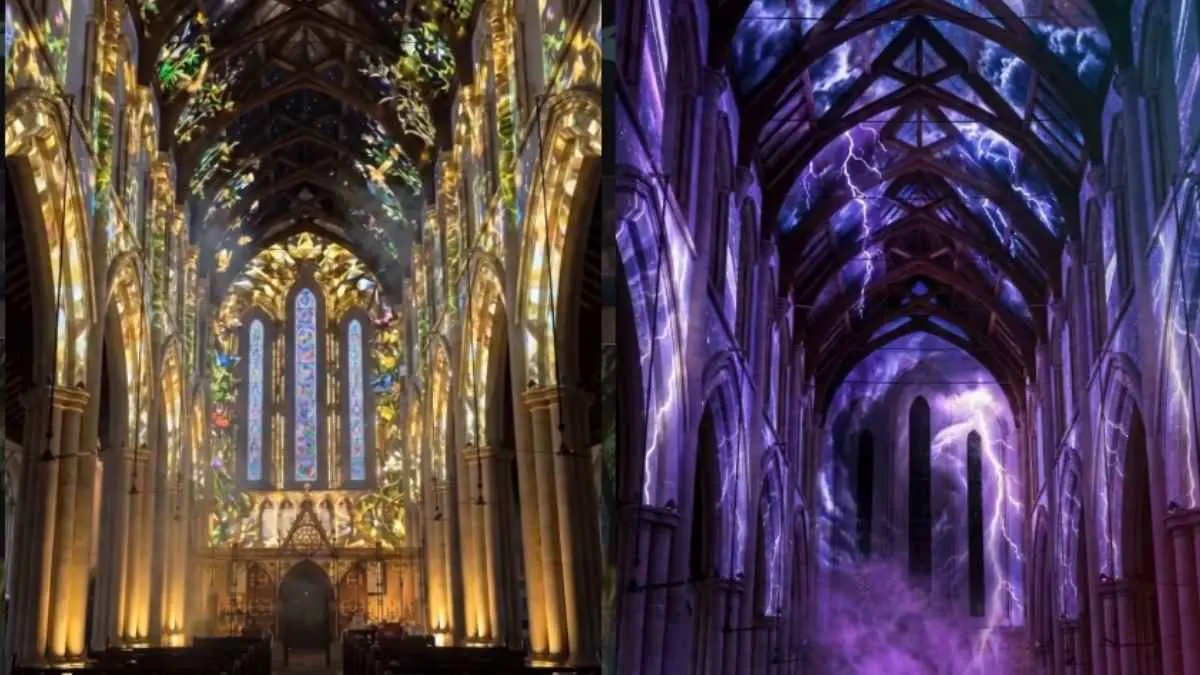


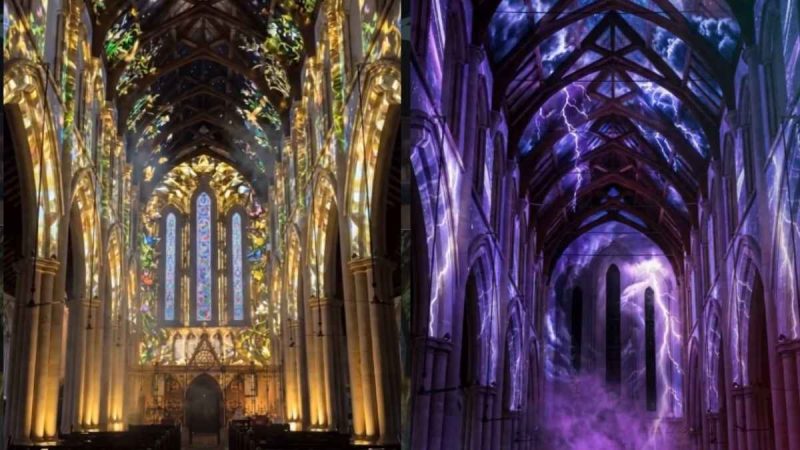
Mumbai’s historic Afghan Church in Colaba is set to glow with light, colour and celestial imagery for three days as part of the Mumbai Light Festival, a public art initiative by the Floating Canvas Company (FCC). FCC’s debut installation, ASCENSION, will run from August 27 to 29, with five-minute projection-mapping shows taking place every half hour between 7:30 pm and 10 pm. Read on to know how beautiful it looks.
Mumbai’s Iconic Afghan Church Lights Up With Celestial Imagery
Centred around the theme of space and humanity’s fascination with the unknown, the experience will transform the church’s interiors with cosmic visuals while retaining its Gothic character. Rather than using the church simply as a projection surface, FCC has designed the installation around its existing architectural details. Visitors can sit inside the Grade I heritage structure, originally known as the Church of St John the Evangelist, and watch shifting patterns interact with its stained-glass windows, arches and Gothic forms. The head of Projects at FCC, Aagam Mehta, talked about the festival and told Local Samosa that when working with a heritage structure, it is paramount that the technology responds to the architecture, not overpower it, adding that the Afghan Church remains at the centre of the experience.
Also Read: “Last Time, Saw Old Woman Wheezing,” Vikas Khanna Thanks Mumbai Airport For Carpet Replacement
According to Rahul Singh Yadav, Creative Director at FCC, the creative process began by studying the church’s architectural character. The team aimed to use light to highlight details visitors might otherwise miss, rather than cover the structure with layers of projection. Built in the early English Gothic Revival style, the church is known for its soaring 60-metre steeple and 19th-century stained-glass windows.
FCC Hopes ASCENSION To Promote City’s Heritage
FCC hopes ASCENSION will encourage people to look at the city’s heritage from a different perspective. There are buildings in Mumbai that people pass every day without really stopping to look at them, said Shakti Swarup Sahu, Creative Director at FCC, explaining that the project aims to create a moment of pause and reconnect audiences with their surroundings.
Also Read: Japanese Man Enjoys ₹200 Mudde Meal At The Rameshwaram Cafe; Calls It “Top Veg Spot In India”
While the five-minute projection may seem brief compared with the longer immersive experiences that have become popular on social media, ASCENSION could nevertheless give Mumbai residents a reason to step inside and appreciate one of Colaba’s historic landmarks, which can often be overlooked amid the city’s busy streets.
This looks so beautiful.
Cover Image Courtesy: Instagram/Afghan Church Colaba Mumbai
FAQs
Why is it called Afghan Church?
The Afghan Church in Mumbai is named after the First Anglo-Afghan War and the tragic 1842 retreat from Kabul.
When was the Afghan Church in Mumbai built?
The Afghan Church in Mumbai was built between 1847 and 1858, with the final work on its steeple finished in 1865.
Can you visit the Afghan Church in Mumbai?
Yes, you can visit the Afghan Church in Mumbai.


