

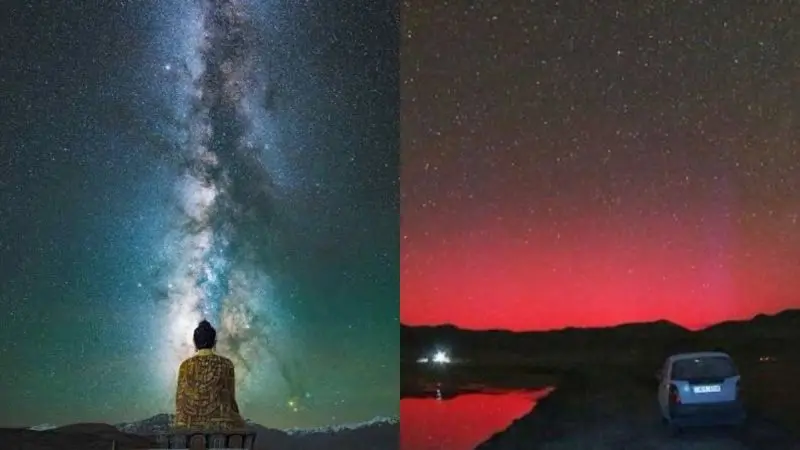
Across India, a magical and almost cinematic kind of travel is beginning to emerge. People are driving into salt deserts at midnight, camping in remote valleys without network coverage, or sitting beside freezing lakes just to watch the sky become visible again. And each place changes the experience completely. In Ladakh, the stars look sharp enough to cut through the darkness. In the Andamans, they hang above black water and palm silhouettes. And each of them is magical, using its own wand! Here are 8 unmissable night sky experiences in India.
8 Night Sky Places In India For Best Stargazing Experience
1. Hanle, Ladakh

Located close to the Indo-Tibet border in eastern Ladakh, Hanle sits at nearly 14,800 feet above sea level. The village became India’s first Dark Sky Reserve in 2022, but astronomers had valued the region long before tourism discovered it. The Indian Astronomical Observatory was established here because the conditions are unusually stable: dry air, high altitude, minimal atmospheric disturbance, and almost no artificial light.
The result is startling! The Milky Way does not appear faint or decorative here; it dominates the sky completely. Travellers often mention noticing colour variations inside the galaxy band itself: bluish-white clusters, dusty streaks, or pale amber patches. During moonless nights, visibility becomes so intense that people sometimes walk without flashlights because starlight alone illuminates the terrain faintly enough.
Also Read: When Is Ladakh Hosting The World’s Highest Art Biennale In 2026? Dates, Theme More
2. Langza, Spiti Valley
Spiti’s landscapes already look stripped down to essentials. Bare mountains. Roads curling around cliffs with almost no vegetation in sight. Langza, one of the valley’s highest inhabited villages, feels especially isolated once evening settles in.
At over 14,000 feet, the village experiences extremely low levels of light pollution. Electricity supply can still be inconsistent in parts of the region, unintentionally preserving the darkness that astrophotographers now travel here specifically to capture.
The strange thing about Langza is how quickly the stars arrive. There is barely any gradual transition. One moment the valley sits under deep blue twilight; the next, the sky is crowded with constellations dense enough to blur together. Familiar star patterns become harder to recognise because there are suddenly too many stars surrounding them.
The giant Buddha statue overlooking the village changes the visual experience entirely. Long-exposure photographs taken from Langza often frame the statue against thick bands of the Milky Way, making the landscape feel almost mythological rather than geographical.
Winter skies between October and February remain clearest, though temperatures regularly fall below freezing.
Also Read: Beyond Manali: 8 Underrated Himachali Escapes That Still Feel Raw And Untouched
3. White Rann Of Kutch, Gujarat
The White Rann does not behave like a normal landscape after dark. During the daytime, the salt desert stretches outward in blinding white emptiness. At night, however, the ground begins interacting with the sky in strange ways. The salt crust reflects faint celestial light so subtly that the horizon nearly disappears. Standing there during a moonless night can feel disorienting because there is no clear separation between land and sky anymore.
Unlike mountain destinations where peaks interrupt visibility, the Rann offers uninterrupted panoramic exposure in every direction. Nothing blocks the horizon.
The best conditions usually arrive between November and February during the Rann Utsav season, although experienced travellers often prefer nights slightly away from festival crowds. On particularly clear evenings, constellations appear unusually low against the horizon because of the completely flat terrain.
4. Neil Island, Andaman & Nicobar Islands
Neil Island, officially renamed Shaheed Dweep, offers the kind of night sky people rarely associate with tropical destinations. Beaches usually bring to mind nightlife, cafés, music, and illuminated coastlines. This island remains different.
After sunset, several parts of Neil Island become almost unnervingly dark. Beaches like Sitapur and Laxmanpur have very limited surrounding development, which means the sky remains visible in astonishing detail once the moonlight fades.
But the atmosphere here changes the experience completely compared to Himalayan stargazing. In Ladakh, the cold sharpens everything. On Neil Island, humidity softens the air instead. You hear waves constantly, and the sea reflects fragments of light while constellations spread above the waterline.
Then there are the rare bioluminescent nights! They do not happen predictably, but when they do, the beach appears lit from two directions at once: glowing plankton beneath the water and stars overhead.
Also Read: As PM Modi Urges Indians To Skip Foreign Trips, 8 Indian Destinations To Visit Instead
5. Sam Sand Dunes, Jaisalmer
The Thar Desert changes personality once the performances end. During evenings, Sam Sand Dunes outside Jaisalmer are crowded with folk music shows, camel rides, and campfire dinners. Then midnight passes, the generators switch off, conversations fade, and the desert returns to itself.
That is when the sky becomes worth paying attention to. Dry desert air and low humidity create excellent visibility during the winter months, especially between November and February. Without urban glow interfering overhead, stars appear unusually sharp above the dunes. Even the darkness feels textured here because moonlight and starlight catch shifting patterns in the sand.
The experience also carries a certain cinematic quality that other destinations lack. Camel silhouettes move across ridges. Wind reshapes dune lines overnight, and the scale of the open sky makes the desert feel larger after midnight than it ever does during the day.
6. Dzukou Valley, Nagaland
Dzukou Valley rarely appears in mainstream astro-tourism lists, which honestly works in its favour. Straddling the Nagaland-Manipur border, the valley is known for rolling green terrain and seasonal flowers during the daytime. At night, though, the geography creates something stranger. Clouds often settle below the valley itself, leaving campers positioned above drifting mist while stars spread overhead.
There is very little ambient light anywhere around the valley, which allows the darkness to deepen fully after sunset. And unlike deserts where visibility feels expansive, Dzukou’s sky feels enclosed by surrounding hills, creating a more intimate kind of stargazing experience.
7. Munsiyari, Uttarakhand
Munsiyari still escapes the over-tourism affecting many North Indian hill stations, which may be exactly why its skies remain this clear.
Located in Uttarakhand’s Kumaon region, the town faces the Panchachuli peaks directly. On cloudless nights, the snow-covered mountains remain faintly visible under starlight instead of disappearing entirely into darkness.
In many stargazing destinations, the landscape becomes secondary after sunset. In Munsiyari, the mountains continue participating in the scene all night long.
Winter conditions between November and February usually provide the sharpest visibility because cold alpine air contains less moisture. Astrophotographers regularly visit the region for long-exposure images combining glaciers, ridgelines, and dense star fields in a single frame.
8. Kolli Hills, Tamil Nadu
Kolli Hills feels almost understated compared to Ladakh or Spiti, but that subtlety is part of its appeal.
Located in Tamil Nadu’s Namakkal district, the region recently gained attention after the development of a Dark Sky Park within the Ariyur Shola forest zone. Dense vegetation blocks nearby artificial light effectively, allowing stars to emerge with surprising clarity.
Forest silhouettes replace barren mountain ridges, and constellations appear through gaps in tree canopies rather than across open valleys.
Also Read: Did You Know Theres A Temple In Tamil Nadu Where Devotees Receive Money As Prasad?
So, which of these looks the most magical to you?
Cover Image Courtesy: flyingpebbles/X
FAQs
Which is the best stargazing destination in India?
Hanle in Ladakh is considered one of the best stargazing destinations in India because of its high altitude, dry air, and minimal light pollution.
Where can you see the Milky Way clearly in India?
Places like Hanle, Langza in Spiti Valley, Munsiyari, and the White Rann of Kutch offer excellent Milky Way visibility during moonless nights.
What is India’s first Dark Sky Reserve?
Hanle in Ladakh became India’s first Dark Sky Reserve in 2022.
Which Indian beach destination is best for stargazing?
Neil Island in the Andaman & Nicobar Islands offers beautiful stargazing experiences with minimal surrounding light pollution.
Which Indian desert is good for watching stars?
The White Rann of Kutch and Sam Sand Dunes in Jaisalmer provide incredible desert stargazing experiences because of low humidity and open horizons.