

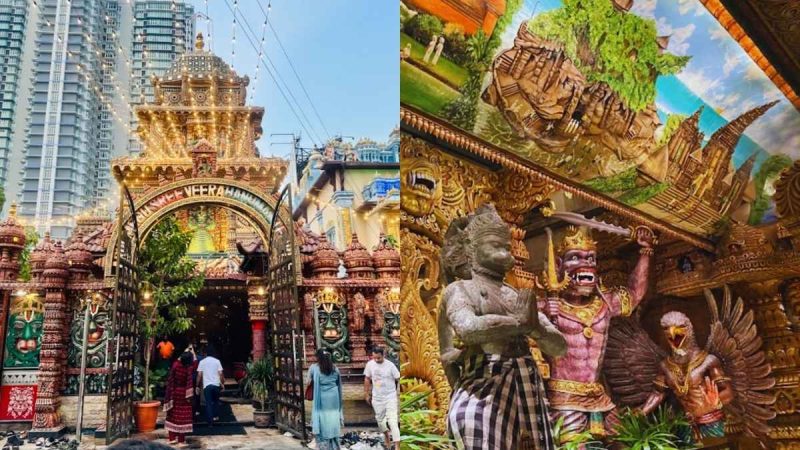
If someone showed you a photo of a temple crowned by a giant green tail spiralling into the sky, you’d probably assume it was somewhere in India. Spoiler: It’s not. The structure stands in Brickfields, Kuala Lumpur’s Little India neighbourhood, where traffic, train stations and banana leaf restaurants surround one of the most unusual Hanuman temples you’ll ever come across.
Discover Malaysia’s Remarkable Hanuman Temple
The Sree Veera Hanuman Temple doesn’t have a towering Hanuman statue greeting visitors. Instead, the temple itself becomes Hanuman.
A 17-foot-long tail coils around the main tower 41 times before forming a dome above it. The result is ethereal, slightly surreal and unlike anything usually associated with Hindu temple architecture. Temple authorities and local heritage sources describe it as the world’s longest Hanuman tail monument, a title that has turned the shrine into a point of curiosity for visitors from across Asia.
The real story, however, begins long before the tail. More than a century ago, Indian labourers came to British Malaya to build railways, lay tracks and work on plantations. Many settled around what is now Brickfields. Life was hard, money was scarce and home was an ocean away. Somewhere along the way, a small shrine dedicated to Hanuman emerged near the Klang River. It wasn’t grand, nor was it famous. It was simply a place where workers could pray before returning to the demanding realities of colonial-era labour.
That modest shrine eventually became the Sree Veera Hanuman Temple! Isn’t that magical?
Also Read: Kolkata To Soon Get A Grand Lord Balaji Temple & Heres All You Need To Know!
Temple’s Giant Hanuman Tail: A Major Attraction
The temple was formally established in 1942 and later relocated to Jalan Scott in 1999 when urban development reshaped parts of Kuala Lumpur. Nearly twenty years of planning, fundraising and construction transformed the site into the stunning complex visitors see today.
Step inside and another surprise awaits. The temple houses more than 100 forms of Hanuman collected and inspired by traditions from India and other parts of Asia. Some reflect familiar South Indian imagery, while other glorious pieces draw from artistic interpretations found across Southeast Asia. Hidden throughout the structure are 1,008 miniature Hanuman sculptures, tucked into walls, decorative elements and architectural details. Many visitors don’t even realise they’ve walked past hundreds of them! Maybe that’s the beauty of it.
Then there’s a detail that sounds almost unbelievable. At this temple, Hanuman isn’t just the deity being worshipped. He is regarded as the temple’s symbolic president. Administrative committees may oversee daily operations, but spiritually, the highest authority belongs to the deity himself.
This temple is a living archive of migration, memory and faith. Behind every sculpture, every coil and every prayer is the story of a community that carried its beliefs across the Bay of Bengal and built something extraordinary far from home.
Also Read: Jagannath Temple In Puri To Have ‘Samarpan’, An E-Hundi Facility; Heres What It Is
And somehow, one of the most remarkable Hanuman temples in the world ended up not in India, but in the middle of Kuala Lumpur.
Cover Image Courtesy: sreeverahanumantemple/GoogleBusiness
FAQs
Where is the Sree Veera Hanuman Temple located?
The Sree Veera Hanuman Temple is located in Brickfields, Kuala Lumpur’s famous Little India neighbourhood in Malaysia.
Why is the temple famous?
The temple is renowned for its massive spiralling Hanuman tail monument, believed to be the world's longest Hanuman tail monument.
How long is the Hanuman tail monument?
The tail is approximately 17 feet long and coils around the temple tower 41 times before forming a dome at the top.
Is the Sree Veera Hanuman Temple a popular tourist attraction?
Yes, the temple attracts devotees, architecture enthusiasts and tourists from across Asia due to its unique design and cultural significance.