

There are places that become famous because they’re beautiful, and then there are places that become unforgettable because of the story behind that beauty. Ashikaga Flower Park, blooming away in Japan’s Tochigi Prefecture, belongs in the latter category.
Why Ashikaga Flower Park Is One Of Japan’s Most Beautiful Attractions
Every spring, thousands of visitors arrive hoping to witness what appears to be a purple waterfall frozen in time. Long curtains of wisteria spill from enormous trellises, floral tunnels glow in shades of white and lavender, and entire pathways disappear beneath fragrant blooms. The park has become a viral favourite, often mistaken for an AI creation or a movie set! Yup, it’s that beautiful.
In reality, its most stunning attraction is the result of decades of painstaking horticultural work, and one remarkably stubborn vine that refused to disappear.
The Great Wisteria Isn’t Actually A Tree
The Great Wisteria is the face of Ashikaga Flower Park, but calling it a tree isn’t technically correct. Wisteria belongs to a group of woody climbing vines that spend their lives wrapping around nearby structures. Left alone, they climb whatever they can find. At Ashikaga, however, the vine has been trained over an enormous steel framework that allows its branches to spread horizontally instead of vertically.
The result is oh-so-breathtaking! Today, the canopy stretches across nearly 1,000 square metres, while thousands of flower clusters hang overhead like chandeliers. The vine itself is believed to be over 160 years old, making it one of Japan’s oldest living wisterias.
Also Read: 8 Lesser-Known Places In Japan To Escape The Crowds And Experience Authentic Culture
How Japan Saved A 160-Year-Old Wisteria From Disappearing
In the early 1990s, the land where the Great Wisteria had stood for generations was marked for redevelopment. For most mature plants, relocation is already risky. For a century-old wisteria with an immense root network and sprawling branches, many experts believed it simply couldn’t be done. Instead of accepting its loss, specialists chose to attempt something unprecedented.
Preparations reportedly took years. Engineers studied the vine’s structure, gardeners worked to reduce transplant shock, and nearly 2,000 people became part of the relocation effort. The move finally took place in 1996 when the ancient vine was transported to what is now Ashikaga Flower Park.
There was no guarantee it would survive. Yet, against expectations, the wisteria bloomed the following spring again.
But, moving the vine was only half the challenge.
The new park had been developed on land that was once marshy and unsuitable for supporting an ancient root system. Before planting began, horticulturists transformed the ground itself. More than 250 tonnes of charcoal were incorporated into the soil to improve drainage, regulate moisture and encourage healthy microbial activity around the roots.
Also Read: What’s Inside Michelin-Starred Chef Gaggan Anand’s First Japan Hotel Set In A 200-YO Sake Brewery?
The Best Time To Visit Ashikaga Flower Park
Unlike most flower festivals that rely on a single peak bloom, Ashikaga Flower Park unfolds almost like a calendar.
The season begins in mid-April with soft pink wisteria. By late April, the iconic purple varieties reach their peak, covering the park in shades of lavender and deep violet. White wisteria follows in early May, when visitors flock to walk through the park’s famous 80-metre-long White Wisteria Tunnel. Soon after, golden laburnum takes over.
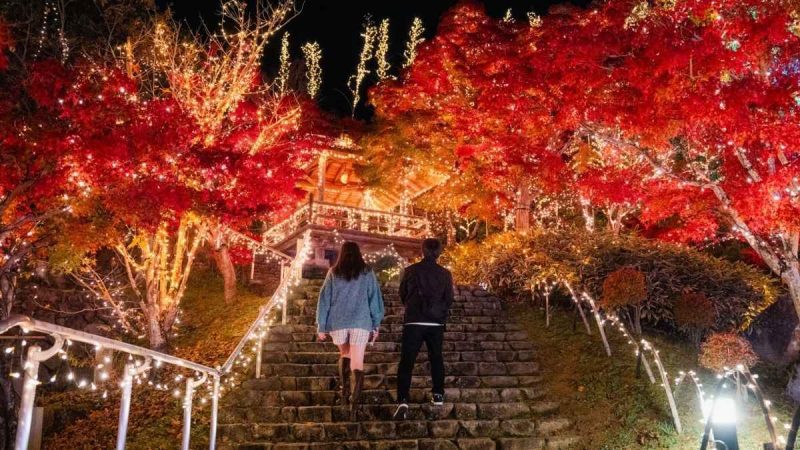
Ashikaga is equally celebrated for its winter illumination event, Flower Fantasy, when millions of LED lights transform the gardens into one of Japan’s most acclaimed seasonal displays.
Ashikaga Flower Park is often introduced online as the place that resembles scenes from Demon Slayer or Avatar. Those comparisons have certainly fuelled its popularity, even though neither franchise has an official connection to the park.
Its real story is arguably far more adorable. Behind every cascading bloom is decades of careful pruning.
Also Read: Bengalurus First Japanese Taiyaki Bar Serves Fish-Shaped Waffles In Red Bean, Nutella Flavours
The park isn’t famous simply because it flowers each spring. It’s famous because one of Japan’s oldest living wisterias was given a second life instead of being lost to development. Now, isn’t that beautiful, both literally and figuratively?
Cover Image Courtesy: ichiban_japan/X
For more such snackable content, interesting discoveries and the latest updates on food, travel and experiences in your city, download the Curly Tales App. Download HERE.
FAQs
Where is Ashikaga Flower Park located?
Ashikaga Flower Park is located in Tochigi Prefecture, Japan, and is famous for its spectacular seasonal flower displays, especially its centuries-old wisteria.
How old is the Great Wisteria at Ashikaga Flower Park?
The park's iconic Great Wisteria is believed to be more than 160 years old, making it one of Japan's oldest living wisteria vines.
When is the best time to visit Ashikaga Flower Park?
The best time to visit is between mid-April and early May, when the park's pink, purple and white wisterias bloom in succession. The winter Flower Fantasy illumination is another major attraction.
Why is Ashikaga Flower Park famous?
The park is best known for its enormous Great Wisteria, breathtaking floral tunnels and the remarkable effort undertaken to relocate and preserve the ancient vine.